Tantalus Myth — Meaning and Psychological Relevance
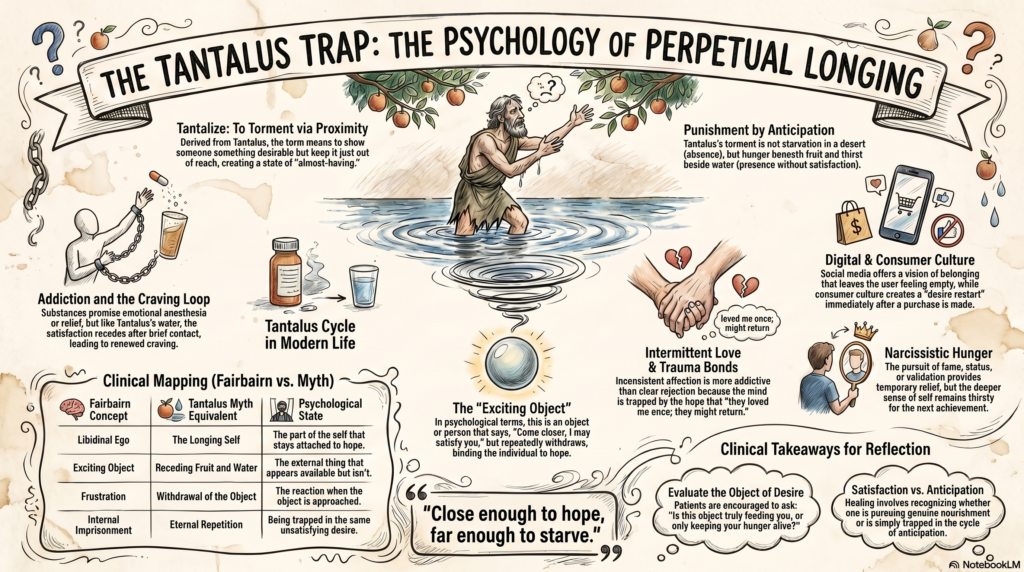 The myth
Tantalus was a king in Greek mythology, often described as a son of Zeus. He was privileged enough to dine with the gods, but he betrayed divine trust.
Different versions describe his crime differently. The most famous version says that Tantalus killed his own son, Pelops, cooked him, and served him to the gods to test whether they were truly all-knowing. The gods recognized the deception and restored Pelops to life.
As punishment, Tantalus was condemned to eternal torment in the underworld.
He stood in a pool of water beneath a fruit tree.
Whenever he bent down to drink, the water receded.
Whenever he reached up to eat the fruit, the branches moved away.
So he was surrounded by what he desired, but could never possess it.
From his name comes the word:
Tantalize — to torment someone by showing something desirable but keeping it just out of reach.
Core image of the myth
The myth is psychologically powerful because the punishment is not absence.
It is almost-having.
Not starvation in a desert.
Not thirst in emptiness.
But thirst beside water.
Hunger beneath fruit.
Hope without satisfaction.
Desire without completion.
This is why the Tantalus myth is so clinically useful.
Psychological meaning
1. Desire kept alive by frustration
Tantalus is not punished by being denied desire completely.
He is punished by being kept in a state of endless anticipation.
This resembles many human situations:
unavailable love,
intermittent reinforcement,
addiction,
obsessive longing,
social media validation,
narcissistic admiration seeking,
trauma bonds,
unresolved grief,
and chronic dissatisfaction.
The object is close enough to activate longing, but far enough to prevent satisfaction.
2. The exciting object
In Fairbairn’s language, the Tantalus myth beautifully illustrates the exciting object.
The exciting object says:
“Come closer. I may satisfy you.”
But it never fully does.
The person remains bound to hope.
Examples:
A partner who occasionally shows warmth but remains emotionally unavailable.
A parent who gives approval only rarely.
A substance that promises relief but leaves emptiness.
A career fantasy that says, “Once I reach this, I will finally be enough.”
A phone notification that promises connection but rarely gives real intimacy.
The tragedy is not merely desire. The tragedy is desire attached to an object that repeatedly withdraws.
3. Addiction and craving
Tantalus is an almost perfect metaphor for addiction.
The addictive object promises:
relief,
pleasure,
escape,
confidence,
sleep,
warmth,
or emotional anesthesia.
But after the brief contact, the person is left again with craving.
The cycle becomes:
Craving → pursuit → brief relief → disappearance of satisfaction → renewed cravingLike Tantalus, the person feels:
“It is right there. One more time, and I will be satisfied.”
But satisfaction recedes.
4. Borderline relationships and intermittent love
In emotionally unstable or borderline relationship dynamics, Tantalus appears as the pain of intermittent availability.
The person may be attached to someone who gives:
occasional affection,
sudden withdrawal,
brief reassurance,
then distance.
This creates powerful attachment.
The mind says:
“They loved me once. Maybe they will return.”
The hope itself becomes imprisoning.
This is why inconsistent love can be more addictive than clear rejection.
Clear rejection hurts, but intermittent love traps.
5. Narcissistic longing
Tantalus also represents narcissistic hunger.
The person may seek:
admiration,
recognition,
status,
beauty,
fame,
achievement,
or superiority.
Each success gives temporary relief.
But the deeper hunger remains.
The fruit moves away again.
The person thinks:
“One more achievement, one more title, one more validation — then I will finally feel complete.”
But the self remains thirsty.
6. Depression and the unreachable good object
In depression, Tantalus may represent the unreachable good object.
The person sees happiness, love, ordinary life, and belonging around them, but feels unable to access them.
They may say:
“Everyone else seems to live. I am only watching.”
“I know what I need, but I cannot reach it.”
“Joy is near, but not for me.”
The pain is intensified because the desired world is visible.
Tantalus and Fairbairn
Fairbairn’s object relations theory helps us understand Tantalus very deeply.
The Tantalus situation is not just:
“I want something.”
It is:
“I am attached to an object that excites longing but refuses satisfaction.”
This is the world of the libidinal ego and the exciting object.
| Fairbairn concept | Tantalus myth equivalent |
|---|---|
| Libidinal ego | The longing self |
| Exciting object | Fruit and water that appear available |
| Frustration | The object withdraws when approached |
| Internal imprisonment | Eternal repetition of the same desire |
| Psychopathology | Hope trapped in an unsatisfying object relationship |
Tantalus is not punished by losing the object.
He is punished by being unable to stop hoping for the object.
That is the depth of the myth.
Tantalus and modern life
The Tantalus myth is everywhere today.
Social media
You see connection, recognition, beauty, success, and belonging — but feel more empty after scrolling.
Dating apps
Endless possibility, little emotional nourishment.
Consumer culture
Every product promises completion, but desire restarts after purchase.
Career ambition
The next title, next degree, next clinic, next milestone always seems like the final fruit.
Addiction
The substance or behavior promises relief but never gives lasting peace.
Toxic relationships
The person gives just enough affection to keep hope alive.
Clinical use of the myth
The Tantalus myth helps patients understand the difference between:
desire that nourishes
and
desire that imprisons
A useful therapeutic question:
“Is this object truly feeding you, or only keeping your hunger alive?”
Another:
“Are you pursuing satisfaction, or are you trapped in anticipation?”
Another:
“Does this relationship give nourishment, or only the promise of nourishment?”
One-line summary
The Tantalus myth is the story of endless craving: the object of desire is always visible, almost reachable, emotionally powerful — but never truly available.
Clinical takeaway
Tantalus teaches that the most painful deprivation is not always absence.
Sometimes the deepest suffering comes from intermittent promise:
close enough to hope,
far enough to starve.