Cannabis: How It Rewires the Brain and How to Quit
 A Practical, Brain-Based Guide for Patients and Families
Cannabis is often described casually as “just weed” or “not addictive.” That is misleading. Many people can use cannabis occasionally without developing dependence, but a significant number develop a pattern where cannabis becomes linked to sleep, relaxation, appetite, social confidence, boredom relief, creativity, emotional escape, or daily functioning.
When cannabis becomes difficult to stop, it is not simply a lack of discipline. It reflects changes in the brain’s reward system, stress system, sleep system, memory circuits, motivation circuits, and frontal control networks.
1. What Cannabis Does in the Brain
The main intoxicating chemical in cannabis is THC, or tetrahydrocannabinol. THC acts mainly on CB1 receptors, which are part of the brain’s endocannabinoid system.
The endocannabinoid system normally helps regulate:
- mood
- appetite
- sleep
- pain
- stress response
- reward
- memory
- emotional learning
- motivation
THC artificially stimulates this system. With repeated use, the brain adapts to the presence of THC. This is how cannabis can slowly move from “relaxing” to “necessary.”
NIDA notes that cannabis products containing THC can affect mood, thinking, and perception, and cannabis is associated with dependence and cannabis use disorder in some users.
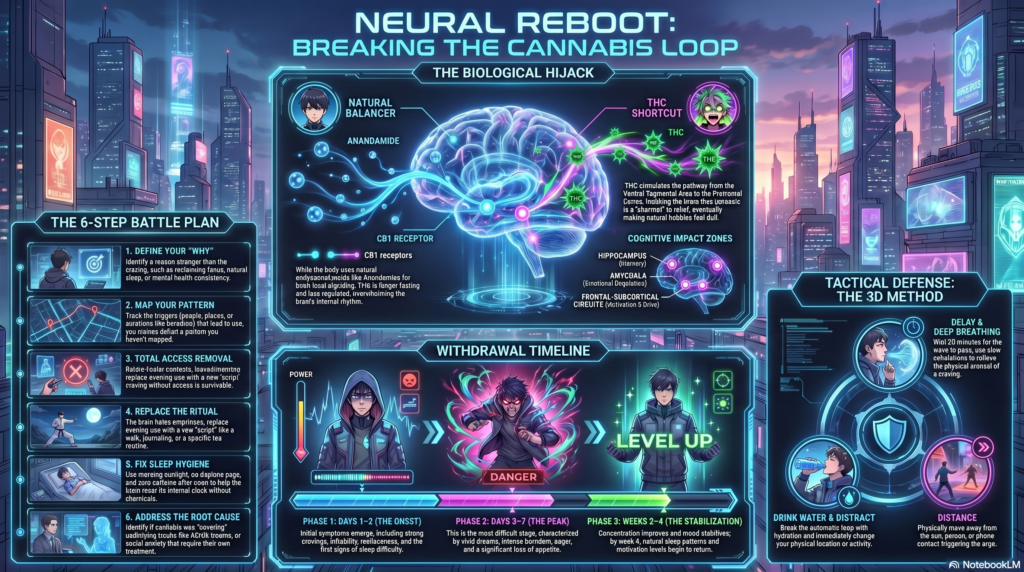
2. The Endocannabinoid System: The Brain’s Internal Balancer
The body already produces its own cannabis-like chemicals called endocannabinoids.
The two important ones are:
- Anandamide
- 2-AG
These natural chemicals work briefly and locally. They help the brain fine-tune signals.
THC is different. It is stronger, longer-lasting, and less precisely regulated.
So repeated cannabis use can disturb the brain’s natural balance in areas related to:
- reward
- motivation
- sleep
- emotional regulation
- memory
- anxiety
- appetite
- learning
The brain starts depending on external THC rather than its own balanced endocannabinoid rhythm.
3. Cannabis and the Reward Pathway
Cannabis increases dopamine indirectly in the reward pathway.
The main reward circuit is:
Ventral Tegmental Area → Nucleus Accumbens → Prefrontal Cortex
This pathway teaches the brain:
“This is rewarding. Remember it. Repeat it.”
In the beginning, cannabis may produce:
- relaxation
- mild euphoria
- laughter
- enhanced music or food enjoyment
- reduced boredom
- social ease
- sleepiness
- emotional numbing
The brain then stores cannabis as a shortcut to relief or pleasure.
Over time, natural rewards may feel dull compared with cannabis-assisted reward. This is why some people lose interest in studies, work, fitness, social life, or hobbies.
4. Cannabis and Motivation
A common clinical complaint is:
“I know what I should do, but I don’t feel like doing it.”
Cannabis can affect motivation through reward and frontal-subcortical circuits.
The person may still have goals, but the brain’s drive system becomes blunted. Tasks that require delayed reward—studying, career building, exercise, long-term planning—feel less attractive.
Cannabis offers instant state-change.
Life requires slow reward.
That mismatch is one reason quitting becomes difficult.
5. Cannabis and Memory
Cannabis affects the hippocampus, a region important for learning and memory.
This can lead to:
- poor short-term memory
- reduced working memory
- difficulty retaining what is read
- forgetfulness
- reduced academic performance
- difficulty following complex conversations
- reduced learning efficiency
The CDC notes that cannabis can slow reaction time, affect decision-making, impair coordination, and distort perception.
For students and professionals, this matters because cannabis may not destroy intelligence, but it can reduce consistency, recall, attention, and mental sharpness.
6. Cannabis and Anxiety
Many people start cannabis because it seems to reduce anxiety.
But the relationship is complicated.
Low doses may feel calming for some people. Higher THC exposure can worsen:
- panic
- paranoia
- social anxiety
- suspiciousness
- racing thoughts
- derealization
- fearfulness
In vulnerable individuals, cannabis can increase risk of psychotic experiences such as paranoia, hallucinations, and loss of reality testing. The CDC states that people who use cannabis are more likely to develop psychosis and that the association is stronger with earlier and more frequent use.
So cannabis may begin as self-medication but later become an anxiety amplifier.
7. Cannabis and Sleep
Cannabis may initially help sleep onset. But with regular use, the brain starts depending on cannabis for sleep regulation.
When the person stops, withdrawal commonly causes:
- insomnia
- vivid dreams
- restless sleep
- early morning waking
- irritability due to poor sleep
This creates a trap:
“I cannot sleep without cannabis.”
But the truth is often:
“My sleep system has become temporarily dependent on cannabis and needs time to reset.”
Sleep usually improves with sustained abstinence, but the first 1–3 weeks can be uncomfortable.
8. Cannabis and Emotional Regulation
Cannabis can become an emotional anaesthetic.
People may use it for:
- anger
- sadness
- loneliness
- boredom
- rejection
- family stress
- relationship conflict
- work pressure
- trauma reminders
The problem is that repeated emotional numbing prevents natural coping skills from developing.
The person may become less able to tolerate normal emotional discomfort.
Then cannabis becomes the default answer to every unpleasant feeling.
9. How Cannabis “Rewires” the Brain
Cannabis rewiring does not mean the brain is permanently damaged. It means repeated use trains the brain into a new pattern.
A. Reward rewiring
The brain learns:
“Cannabis gives fast relief.”
Natural rewards become less satisfying.
B. Stress rewiring
The brain becomes more irritable, anxious, or restless without cannabis.
C. Sleep rewiring
The person feels unable to sleep without it.
D. Memory rewiring
Cannabis-associated cues become strongly remembered.
E. Habit rewiring
Using becomes automatic at certain times.
F. Frontal control weakening
The ability to pause, decide, and resist cravings becomes weaker during stress or craving.
This is why quitting cannabis is not just about removing the substance. It is about retraining the brain.
10. Signs Cannabis Has Become a Problem
Cannabis may be causing harm if there is:
- daily or near-daily use
- inability to sleep without it
- irritability when not using
- repeated failed quit attempts
- reduced motivation
- poorer academic or work performance
- memory problems
- anxiety or paranoia
- social withdrawal
- spending too much time obtaining or using it
- using despite family conflict
- using despite panic, psychosis, or depression
- mixing with alcohol or other drugs
- driving or working while intoxicated
- needing higher amounts than before
- feeling “normal” only after using
Cannabis use disorder is recognized as a substance use disorder, and addiction represents the more severe end where use continues despite negative consequences.
11. Cannabis Withdrawal: What to Expect
Cannabis withdrawal is real. It is usually not medically dangerous like severe alcohol withdrawal, but it can be very uncomfortable.
Common symptoms include:
- irritability
- anger
- anxiety
- restlessness
- sleep disturbance
- vivid dreams
- low mood
- reduced appetite
- craving
- headache
- sweating
- stomach discomfort
- difficulty concentrating
A clinical review describes anxiety, irritability, anger/aggression, disturbed sleep/dreaming, depressed mood, and appetite loss as common features of cannabis withdrawal.
Typical Withdrawal Timeline
Day 1–2
- craving begins
- irritability
- restlessness
- sleep difficulty
- anxiety
Day 3–7
Usually the hardest phase.
- poor sleep
- vivid dreams
- mood swings
- anger
- low appetite
- strong urges
- boredom feels intense
Week 2
- sleep may still be disturbed
- cravings come in waves
- mood begins to stabilize
- concentration slowly improves
Week 3–4
- clearer thinking
- better energy
- natural sleep starts returning
- motivation improves gradually
Some symptoms can last longer in heavy daily users, especially sleep disturbance, boredom, emotional flatness, and cue-triggered craving.
12. Cold Turkey vs Tapering
Both can work. The right choice depends on the person.
Cold turkey may suit people who:
- use smaller amounts
- are strongly motivated
- can take a few difficult days
- have good support
- have no severe psychiatric instability
- do not have major sleep or anger issues
Tapering may suit people who:
- use heavily every day
- panic when stopping abruptly
- have severe insomnia
- have repeated failed sudden quit attempts
- use cannabis to manage emotional distress
- have work or exam responsibilities
- need a structured reduction plan
A taper should be specific, time-limited, and monitored. Otherwise, “tapering” can become continued use with a new name.
13. Practical Quitting Plan
Step 1: Write the real reason for quitting
Examples:
- “I want my focus back.”
- “I want natural sleep.”
- “I want to stop depending on it.”
- “I want my confidence back.”
- “I want better memory.”
- “I want to protect my mental health.”
- “I want to stop hiding.”
- “I want to become consistent again.”
The brain needs a reason stronger than craving.
Step 2: Identify your cannabis pattern
Write down:
- time of use
- place
- people
- emotion before use
- trigger
- amount
- consequence
Common patterns:
- after work
- before sleep
- after conflict
- during boredom
- while gaming
- with friends
- after alcohol
- before food
- when lonely
You cannot defeat a pattern you have not mapped.
Step 3: Remove access
This is essential.
Remove:
- cannabis
- rolling papers
- bongs/pipes/vapes
- dealer contacts
- stash locations
- cannabis-related photos/videos
- online groups that trigger use
Craving plus access is dangerous.
Craving without access is survivable.
Step 4: Prepare for the first 7 days
The first week should be treated like a planned recovery period.
Prepare:
- sleep routine
- light exercise
- hydration
- simple meals
- supportive person
- reduced social exposure to users
- distraction list
- emergency craving plan
- medical review if severe anxiety, depression, psychosis, or insomnia is present
Step 5: Replace the evening ritual
Most cannabis use is ritual-based.
Replace the ritual, not just the substance.
Examples:
- evening walk
- gym
- shower
- herbal tea
- music without cannabis
- journaling
- phone call with a safe person
- breathing practice
- reading
- structured gaming limit if gaming is not a trigger
- early dinner
- planned sleep wind-down
The brain hates emptiness. Give it a new script.
Step 6: Manage craving like a wave
Craving usually rises, peaks, and falls.
Use the 4D method:
Delay
Wait 20 minutes. Do not decide during peak craving.
Deep breathing
Slow exhalation reduces arousal.
Drink water
Breaks the automatic loop.
Distract
Walk, shower, call someone, leave the room, change location.
Add one more D:
Distance
Move away from the cue, person, place, or phone contact.
Step 7: Fix sleep without cannabis
Sleep is often the biggest relapse trigger.
Helpful steps:
- fixed wake-up time
- sunlight exposure in the morning
- no daytime naps initially
- avoid caffeine after noon
- exercise before evening
- reduce screens before bed
- cool, dark room
- same bedtime routine
- avoid alcohol as a “replacement sedative”
- treat anxiety if present
In some cases, short-term medical help for sleep may be needed, but self-medicating with alcohol, benzodiazepines, or sedatives can create a second problem.
Step 8: Treat the underlying reason
Cannabis often covers another problem.
Common underlying issues:
- anxiety
- depression
- ADHD
- trauma
- insomnia
- social anxiety
- loneliness
- anger
- relationship stress
- academic pressure
- work burnout
- chronic pain
If these are not treated, cannabis relapse risk remains high.
The goal is not just “stop cannabis.”
The goal is:
“Learn healthier ways to regulate the state for which cannabis was being used.”
14. Psychological Treatments That Help
The best-supported treatments are behavioural and psychological.
Motivational Enhancement Therapy
Helps the patient resolve ambivalence:
“Part of me wants to quit. Part of me wants to continue.”
CBT for Cannabis Use
Helps identify triggers, thoughts, routines, cravings, and relapse patterns.
Contingency Management
Uses rewards or incentives for abstinence and treatment engagement. SAMHSA describes contingency management as an evidence-based intervention for substance use disorders that reinforces recovery behaviours.
Family Involvement
Useful when the patient is young, dependent on family, or repeatedly relapsing.
Relapse Prevention
Teaches the person to manage high-risk situations before relapse happens.
15. Are There Medicines to Quit Cannabis?
There is no universally approved “anti-cannabis” medicine equivalent to nicotine replacement therapy or opioid substitution therapy.
However, medicines may help specific symptoms or comorbidities:
- sleep disturbance
- anxiety
- depression
- irritability
- ADHD
- psychosis
- bipolar disorder
- nausea
- appetite disturbance
Medication should be individualized. The aim is not to replace cannabis with another dependence-producing substance.
16. When to Seek Urgent Psychiatric Help
Seek urgent help if cannabis use is associated with:
- paranoia
- hallucinations
- panic attacks
- suicidal thoughts
- severe depression
- aggression
- confusion
- manic symptoms
- inability to sleep for several nights
- repeated vomiting
- use of multiple substances
- risky driving
- severe withdrawal distress
- relapse after repeated quit attempts
Cannabis-induced psychosis, severe anxiety, bipolar destabilization, and suicidality need professional care.
17. What to Tell Patients
A useful explanation:
“Cannabis initially gives relaxation or pleasure, but with repeated use the brain adapts. Your natural reward, sleep, stress, and motivation systems start depending on cannabis. When you stop, the brain feels restless, sleepless, irritable, and bored. That does not mean you cannot quit. It means your brain is resetting. The first few weeks are uncomfortable, but with structure, treatment, and support, the brain can recover.”
18. The Recovery Timeline
First week
Hardest physically and emotionally.
Focus: survive cravings, sleep hygiene, no access.
Second week
Mood and sleep begin to fluctuate.
Focus: routine, exercise, social support.
Third and fourth week
Clarity improves.
Focus: rebuild motivation and natural reward.
One to three months
Relapse risk continues through cues, stress, and boredom.
Focus: deeper therapy, lifestyle rebuilding, treating comorbidities.
Beyond three months
Identity changes from:
“I am trying not to smoke.”
to:
“I am someone who does not need cannabis to function.”
That identity shift is powerful.
19. Relapse Does Not Mean Failure
A lapse means use happened once or briefly.
A relapse means the old pattern returned.
Both are information.
Ask:
- What triggered it?
- Was it stress, boredom, sleep, friends, alcohol, anger, loneliness?
- Was access too easy?
- Was the quitting plan too vague?
- Was an underlying disorder untreated?
- Did shame push further use?
Do not convert one lapse into a full return.
The recovery sentence is:
“Stop quickly. Learn from it. Restart immediately.”
20. Final Takeaway
Cannabis can rewire the brain by repeatedly linking THC with reward, sleep, emotional relief, appetite, social ease, and escape from boredom or distress. Over time, the brain may become less responsive to natural rewards and more dependent on cannabis for regulation.
Quitting is difficult because the person is not only giving up a substance. They are giving up a learned shortcut for mood, sleep, reward, and identity.
But the brain can reset.
With proper assessment, withdrawal planning, sleep correction, trigger control, therapy, family support, and treatment of underlying psychiatric conditions, cannabis dependence can be overcome.
Need Help to Quit Cannabis?
Cannabis dependence, withdrawal, anxiety, low motivation, sleep disturbance, and cannabis-related psychosis are treatable. A structured plan can help you quit safely, manage cravings, rebuild sleep and motivation, and prevent relapse.
Dr. Srinivas Rajkumar T, MD (AIIMS, New Delhi), DNB, MBA (BITS Pilani)
Consultant Psychiatrist & Neurofeedback Specialist
Mind & Memory Clinic, Apollo Clinic Velachery (Opp. Phoenix Mall)
✉ srinivasaiims@gmail.com 📞 +91-8595155808