Confusion of Tongues: Ferenczi’s Forgotten Key to Understanding Childhood Trauma
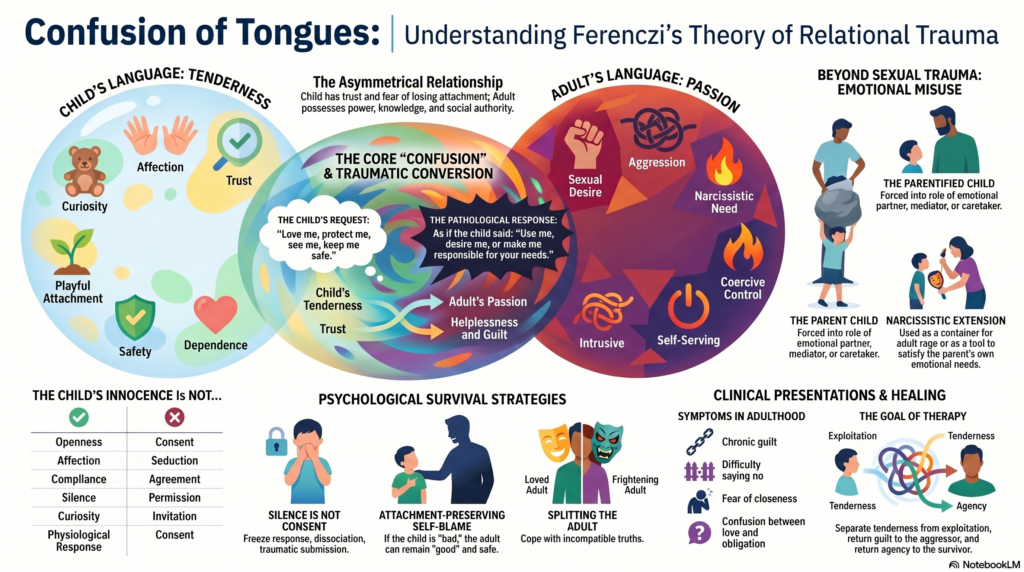 Among the many psychoanalytic ideas that deserve to be rescued from the margins, Sandor Ferenczi’s concept of “Confusion of Tongues” stands out as one of the most clinically powerful.
It is not merely a theory about childhood sexual abuse. It is a theory about how the child’s world of tenderness can be invaded, distorted, and traumatised by the adult world of passion, power, domination, or emotional misuse.
Ferenczi saw something that was radical for his time: when a child is harmed by an adult, the damage is not only physical or behavioural. The injury occurs at the level of meaning. The child’s innocent need for love, safety, play, and dependence is misread or exploited by an adult who introduces sexuality, aggression, control, or emotional burden into a relationship where the child is developmentally unprepared to understand or resist it.
The Child’s Language: Tenderness
A child approaches the adult world with a language of tenderness.
This language is not verbal alone. It is expressed through:
- wanting closeness
- seeking affection
- needing protection
- playful attachment
- dependence
- trust
- curiosity
- emotional openness
The child may hug, cling, laugh, imitate, admire, or seek special attention from an adult. In the child’s world, these gestures belong to the realm of safety and attachment.
The child does not yet possess the adult capacity to understand sexuality, manipulation, exploitation, sadism, or emotional coercion.
This is why childhood dependency is sacred. The child’s openness is not consent. The child’s affection is not seduction. The child’s compliance is not agreement. The child’s silence is not permission.
The child’s language is tenderness.
The Adult’s Language: Passion
Ferenczi contrasted the child’s language of tenderness with the pathological adult’s language of passion.
Here, “passion” does not simply mean sexuality. It refers to the adult’s intrusive, excessive, or self-serving emotional world.
The adult may bring into the relationship:
- sexual desire
- aggression
- domination
- possessiveness
- emotional hunger
- narcissistic need
- coercive control
- sadistic pleasure
- boundary violation
The adult may misread the child’s affection as invitation. Or worse, the adult may knowingly exploit the child’s dependence.
The tragedy is that the child is not meeting the adult on equal psychological ground. The adult has power, knowledge, language, social authority, and physical dominance. The child has dependence, trust, and fear of losing attachment.
This is the beginning of the confusion.
What Is the “Confusion of Tongues”?
The confusion occurs when the adult imposes the language of passion onto the child’s language of tenderness.
The child says, in effect:
“Love me, protect me, see me, keep me safe.”
The pathological adult responds as though the child has said:
“Use me, desire me, control me, burden me, or make me responsible for your needs.”
This is not a misunderstanding between equals. It is a traumatic distortion inside an asymmetrical relationship.
The child’s tenderness is converted into the adult’s passion.
The child’s trust is converted into vulnerability.
The child’s dependence is converted into helplessness.
The child’s love is converted into guilt.
This is why Ferenczi’s idea remains so clinically important. He recognised that trauma is not only what happened. Trauma is also the child’s catastrophic inability to make sense of what happened.
The Traumatic Moment: Shock, Paralysis, and Submission
When the adult violates the child’s world, the child is overwhelmed.
The child may not scream, protest, or run away. This absence of resistance is often misunderstood by adults, families, courts, and even survivors themselves.
But Ferenczi understood the child’s silence differently.
The child may become frozen. The child may enter a trance-like state. The child may become obedient, numb, compliant, or strangely detached.
Modern trauma language would call this:
- freeze response
- fawn response
- dissociation
- tonic immobility
- traumatic submission
- depersonalisation
- derealisation
The child’s mind does not say, “I consent.”
The child’s mind says, “I cannot survive this unless I disappear inside myself.”
This is one of Ferenczi’s most compassionate insights. What looks like passivity may actually be psychological survival.
Why the Child Blames the Self
One of the most painful consequences of childhood trauma is self-blame.
Many survivors later say:
“It was my fault.”
“I must have wanted it.”
“Why didn’t I stop it?”
“Maybe I encouraged it.”
“Maybe I imagined it.”
“Maybe it was not that bad.”
Ferenczi recognised this not as evidence against trauma, but as one of trauma’s signatures.
Why does the child blame the self?
Because blaming the adult may be psychologically impossible.
The child depends on the adult for love, safety, food, shelter, belonging, and emotional survival. To fully know that the adult is dangerous may be too terrifying.
So the child performs an unconscious psychological manoeuvre:
“If I am bad, the adult can remain good.”
This preserves attachment.
It is painful, but it protects the child from an even more unbearable truth: that the person needed for safety is also the source of danger.
Self-blame, therefore, is not stupidity. It is not weakness. It is not masochism. It is an attachment-preserving strategy under conditions of helplessness.
“I Still Love the Person Who Hurt Me”
This is one of the most difficult experiences for survivors to speak about.
A person may say:
“I know they hurt me, but I still love them.”
“I cannot hate them fully.”
“Part of me misses them.”
“I feel guilty for being angry.”
“I keep remembering the good moments.”
Ferenczi helps us understand this without judgment.
The traumatised child often splits the adult into different psychological parts:
- The loved adult — the one who gave attention, warmth, gifts, protection, or moments of tenderness.
- The frightening adult — the one who violated, dominated, humiliated, or exploited.
The child cannot integrate these two realities.
So the mind divides them.
One part of the child remains attached to the tender image of the adult. Another part carries terror, disgust, anger, and betrayal. This splitting can continue into adulthood.
This is why survivors may feel internally divided. They are not being inconsistent. Their mind has preserved incompatible truths in separate compartments.
Dissociation: When Memory Cannot Become Story
Ferenczi was ahead of his time in recognising that trauma fragments memory.
A child who is overwhelmed may not encode the event as an ordinary narrative memory. Instead, the trauma may be stored as:
- bodily sensations
- shame
- nightmares
- sudden fear
- emotional flashbacks
- disgust
- sexual confusion
- unexplained guilt
- relational mistrust
- fragmented images
- states of numbness
The survivor may remember without remembering.
The body may know before the mind can speak.
This is why trauma therapy cannot be reduced to asking, “What exactly happened?”
Sometimes the more clinically useful question is:
“What does your body, fear, shame, or relationship pattern seem to remember?”
Ferenczi understood that the traumatised psyche may speak indirectly, through symptoms, enactments, self-blame, and dissociated states.
The Child’s Tenderness Is Not Consent
This point must be stated clearly.
A child’s affection is not consent.
A child’s curiosity is not consent.
A child’s compliance is not consent.
A child’s silence is not consent.
A child’s return to the adult is not consent.
A child’s confusion is not consent.
A child’s physiological response is not consent.
Ferenczi’s concept is clinically and ethically important because it protects the meaning of childhood tenderness from adult distortion.
The adult is responsible for the boundary.
The adult is responsible for the power differential.
The adult is responsible for not exploiting the child’s dependency.
Emotional Misuse: Beyond Sexual Trauma
Although Ferenczi wrote powerfully about sexual abuse, the concept of confusion of tongues can be extended to other forms of relational trauma.
A child’s tenderness may also be exploited emotionally.
For example, a parent may make the child:
- the emotional partner
- the caretaker
- the confidant
- the mediator in marital conflict
- the parent’s narcissistic extension
- the container for adult loneliness
- the rescuer of a depressed or addicted parent
- the object of adult rage or disappointment
Here too, the child’s language is tenderness.
The adult’s language is emotional need, control, or burden.
The child wants love.
The adult demands regulation.
The child seeks safety.
The adult makes the child responsible for the adult’s emotional survival.
This is also a confusion of tongues.
Clinical Presentations in Adult Life
Adults who grew up with such trauma may present with many different symptoms.
They may have:
- chronic guilt
- shame around desire
- difficulty trusting affection
- fear of closeness
- fear of abandonment
- sexual confusion or aversion
- emotional numbness
- dissociative episodes
- people-pleasing
- harsh self-criticism
- unstable relationships
- attraction to controlling partners
- difficulty saying no
- confusion between love and obligation
- confusion between care and surrender
Some may appear highly functional. They may become doctors, teachers, leaders, therapists, or caregivers. But internally, they may carry a deep wound around dependency.
The question is not only, “What symptoms do they have?”
The deeper question is:
“What happened to their capacity to trust tenderness?”
Why This Concept Matters in Therapy
Ferenczi’s idea changes the therapist’s stance.
The therapist must not rush to interpret the survivor’s confusion as fantasy, exaggeration, resistance, or secondary gain.
Instead, the therapist must create a space where the patient can slowly separate:
- tenderness from exploitation
- affection from obligation
- guilt from responsibility
- bodily response from consent
- attachment from safety
- loyalty from truth
- memory from self-blame
The therapeutic task is not simply to recover facts. It is to restore meaning.
The patient must gradually come to know:
“I was a child.”
“I needed love.”
“My tenderness was misused.”
“My confusion was not consent.”
“My silence was survival.”
“My guilt belongs to the trauma, not to my character.”
This is often profoundly liberating.
Ferenczi’s Radical Compassion
Ferenczi’s greatness lies in his refusal to blame the child.
He saw that the traumatised child may become silent, compliant, attached, confused, guilty, and self-blaming — not because the trauma was imaginary, but because the trauma was too real.
He recognised that the abused child may preserve love for the abuser because attachment is biologically and psychologically essential.
He understood that the mind may split not because it is weak, but because it is trying to preserve life, love, and continuity under impossible conditions.
This is why “Confusion of Tongues” remains one of the most humane concepts in psychoanalysis.
Conclusion: Restoring the Child’s Language
Ferenczi’s “Confusion of Tongues” gives us a language for what happens when adult passion invades childhood tenderness.
It explains why survivors may feel guilty, confused, loyal, ashamed, and divided.
It reminds us that trauma is not only an event in the past. It is a distortion of meaning that continues inside the survivor’s mind and body.
The work of therapy is to undo this confusion.
To return guilt to the aggressor.
To return tenderness to the child.
To return agency to the survivor.
And most importantly, to help the person realise:
“What happened to me was not my fault. My need for love was innocent. My confusion was a trauma response. My tenderness deserved protection.”
That is the enduring clinical power of Ferenczi’s insight.
About the Author
Dr. Srinivas Rajkumar T, MD (AIIMS, New Delhi), DNB, MBA (BITS Pilani)
Consultant Psychiatrist & Neurofeedback Specialist
Mind & Memory Clinic, Apollo Clinic Velachery (Opp. Phoenix Mall)
Dr. Srinivas Rajkumar T provides comprehensive psychiatric evaluation and psychotherapy-informed care for adults, adolescents, and families dealing with trauma, anxiety, depression, ADHD, emotional dysregulation, addiction, personality-related difficulties, and relationship stress.
His clinical approach combines modern psychiatry, psychodynamic understanding, trauma-informed care, objective assessments, and neuroscience-based interventions to help individuals understand not only their symptoms, but also the deeper emotional patterns behind them.
For appointments:
✉ srinivasaiims@gmail.com
📞 +91-8595155808