The Lexical Approach — Why Language Holds the Clues to Personality
 Human beings have always needed words to describe one another.
We call some people kind, others cruel. Some are brave, others fearful. Some are honest, others deceitful. Some are disciplined, others careless. Some are imaginative, others conventional.
These words did not appear by accident.
They emerged because personality traits matter in human life.
This is the core idea behind the lexical approach to personality.
What Is the Lexical Hypothesis?
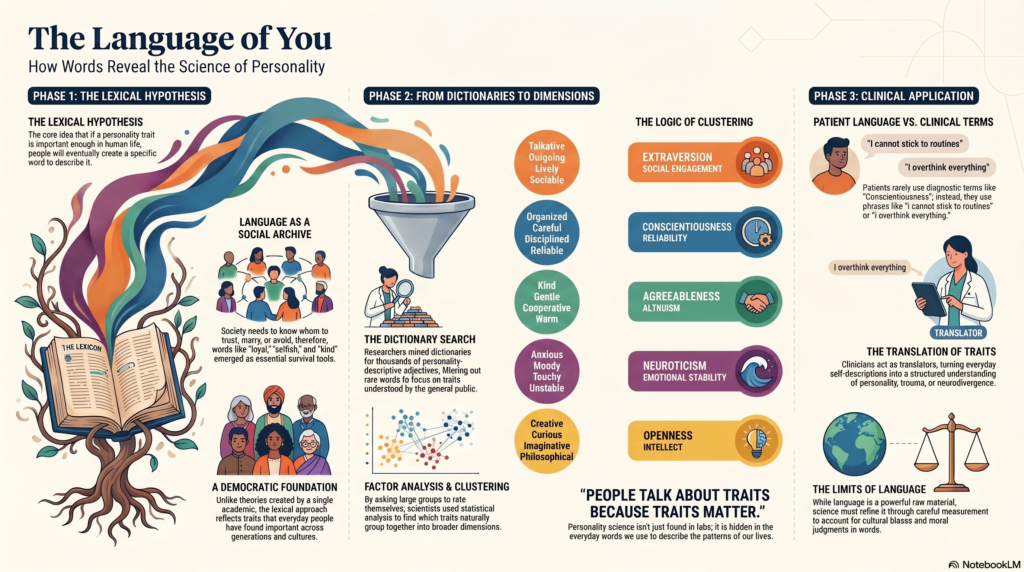
The lexical hypothesis states that important personality characteristics eventually become encoded in language.
In simple terms:
If a trait is important enough in human life, people will create words for it.
For example, every society needs to know whom to trust, whom to avoid, whom to marry, whom to appoint as leader, whom to depend on, and whom to be cautious about.
So languages develop words for traits such as:
honest, dishonest, brave, fearful, kind, cruel, lazy, hardworking, loyal, selfish, modest, arrogant, calm, anxious, talkative, quiet, creative, conventional.
Language becomes a living archive of human personality observation.
Why Dictionaries Became Important
Personality researchers realized that dictionaries contain thousands of words describing human characteristics.
Instead of asking one researcher to decide which traits are important, they asked:
What if we study all the personality words that already exist in language?
Researchers searched dictionaries and collected personality-descriptive adjectives. They removed very rare words and focused on traits that ordinary people understood. Then they asked large numbers of people to rate themselves or others using these words.
After that, they used factor analysis to find which traits grouped together.
This became one of the most important methods in personality psychology.
Why the Lexical Approach Is Powerful
The lexical approach has several strengths.
First, it is broad. It does not begin with one researcher’s favourite theory. It begins with language itself.
Second, it is democratic. It reflects traits people have found important across generations, not merely traits preferred by academic psychologists.
Third, it is practical. If many words in a language describe a trait, that trait probably matters in everyday life.
Fourth, it allows cross-cultural comparison. Researchers can study personality words in different languages and ask whether similar personality dimensions appear across cultures.
From Words to Personality Dimensions
When researchers studied personality words, they found that many adjectives clustered together.
For example:
Talkative, outgoing, lively, and sociable clustered together.
Organized, careful, disciplined, and reliable clustered together.
Kind, gentle, cooperative, and warm clustered together.
Anxious, moody, touchy, and emotionally unstable clustered together.
Creative, curious, imaginative, and philosophical clustered together.
These clusters eventually contributed to models such as the Big Five and later HEXACO.
Language and Clinical Practice
In clinical practice, patients rarely present using diagnostic language.
They do not usually say:
“I have high neuroticism.”
“I have low conscientiousness.”
“I have low honesty-humility.”
“I have interpersonal antagonism.”
Instead, they say:
“I overthink everything.”
“I get hurt easily.”
“I cannot control my anger.”
“I keep making the same mistakes.”
“I am too trusting.”
“I cannot say no.”
“I manipulate people before they leave me.”
“I feel empty.”
“I am always restless.”
“I cannot stick to routines.”
These are everyday personality descriptions.
A clinician must translate these descriptions into a structured understanding.
That is why language matters. It is often the first door into personality assessment.
The Limits of Language
Language is useful, but it is not perfect.
Some cultures may emphasize certain traits more than others. Some personality traits may have many words; others may be harder to describe. Some words may carry moral judgment. Some may change meaning over time.
Also, just because a word exists does not mean it is a scientifically valid trait.
That is why lexical research must be combined with careful measurement, factor analysis, clinical observation, and psychological theory.
Language gives the raw material. Science gives the structure.
The Main Takeaway
The lexical approach teaches us that personality is not only found in laboratories and questionnaires. It is also hidden in everyday language.
The words we use to describe people are clues to what human beings have always cared about: trust, cooperation, courage, emotional control, discipline, creativity, and social behaviour.
Personality science begins with a simple observation:
People talk about traits because traits matter.
Want to Understand the Words Behind Your Patterns?
Many people describe themselves with words such as “sensitive,” “angry,” “lazy,” “overthinking,” “introverted,” “emotionally intense,” “detached,” “dependent,” “impulsive,” or “perfectionistic.”
A psychiatric consultation can help clarify what these words really mean clinically. They may reflect personality traits, anxiety, depression, ADHD, autism spectrum traits, trauma, bipolar disorder, substance use, or relationship patterns.
For a structured evaluation, consult:
Dr. Srinivas Rajkumar T, MD (AIIMS, New Delhi), DNB, MBA (BITS Pilani)
Senior Consultant Psychiatrist
Mind & Memory Clinic, Apollo Clinic Velachery, Chennai
Opp. Phoenix Mall
Email: srinivasaiims@gmail.com
Phone: +91-8595155808