From Chlorpromazine to Cobenfy: The 74-Year Journey from an Anaesthetic Booster to Muscarinic Psychiatry
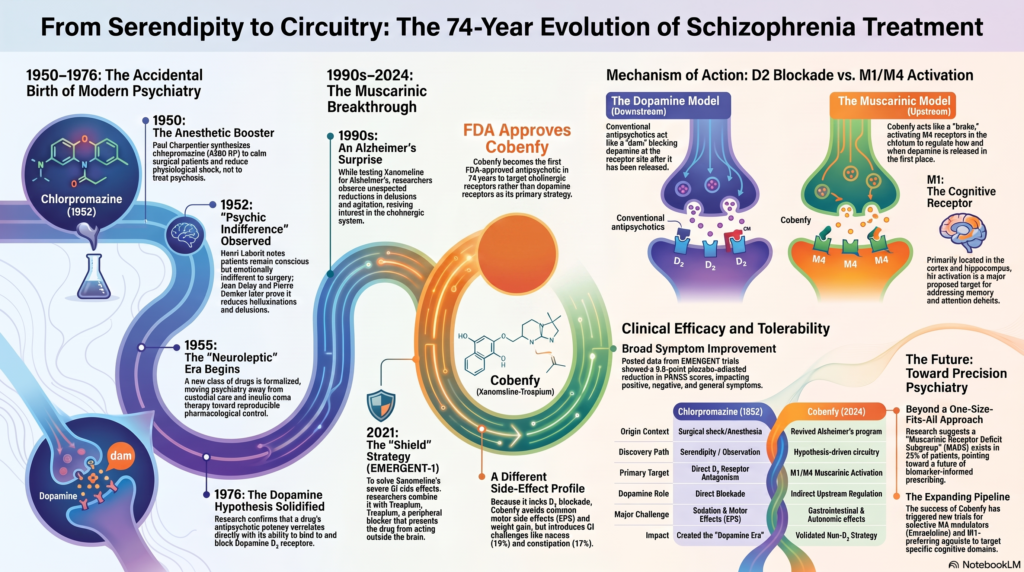 In 1950, chlorpromazine was not designed to treat schizophrenia. It was synthesized as part of a search for drugs that could support anaesthesia, calm patients undergoing surgery and reduce the physiological consequences of surgical shock.
More than seven decades later, on 26 September 2024, the US Food and Drug Administration approved Cobenfy—xanomeline combined with trospium chloride—for schizophrenia in adults. It became the first approved antipsychotic to target cholinergic rather than dopamine receptors as its primary pharmacological strategy.
These two milestones represent contrasting eras of medical discovery.
Chlorpromazine emerged from clinical observation and serendipity. Cobenfy emerged from decades of receptor biology, post-mortem research, animal models, medicinal chemistry and controlled clinical trials. Yet both drugs share an intriguing origin: neither active component began its life as a conventional antipsychotic.
The journey from chlorpromazine to Cobenfy is therefore not simply the history of two medicines. It is the history of psychiatry progressing from accidental discovery to circuit-based pharmacology.
A timeline of the major developments
| Year | Development | Scientific significance |
|---|---|---|
| 1950 | Paul Charpentier synthesizes chlorpromazine, initially designated 4560 RP | Developed within a phenothiazine programme rather than as a psychiatric drug |
| 1951–1952 | Henri Laborit and Pierre Huguenard use chlorpromazine as part of “potentiated anaesthesia” | Laborit observes calmness and emotional indifference without complete loss of consciousness |
| January 1952 | Joseph Hamon, Jean Paraire and Jean Velluz administer chlorpromazine to a psychiatric patient along with other treatments | Among the earliest documented psychiatric uses |
| May–June 1952 | Jean Delay and Pierre Deniker publish systematic observations in psychotic patients | Chlorpromazine is recognized as acting beyond ordinary sedation |
| 1954 | Chlorpromazine is introduced widely in North America as Thorazine | Rapid international expansion of pharmacological treatment for psychosis |
| 1955 | Delay and Deniker popularize the term neuroleptic | A new therapeutic drug class is formally conceptualized |
| 1976 | Dopamine-receptor binding is shown to correlate with antipsychotic potency | Strong pharmacological foundation for the dopamine hypothesis |
| 1990s | Xanomeline is studied for cognitive and behavioural symptoms of Alzheimer’s disease | Unexpected reductions in hallucinations, delusions and behavioural disturbance revive interest in muscarinic treatment |
| 2008 | Xanomeline is tested in schizophrenia | Proof-of-concept that muscarinic stimulation can reduce psychotic symptoms without direct D₂ blockade |
| 2021 | The phase 2 EMERGENT-1 trial of xanomeline–trospium is published | Peripheral muscarinic blockade makes central muscarinic activation more tolerable |
| 2024 | EMERGENT-2 and EMERGENT-3 phase 3 trials report positive results | Reproducible short-term efficacy is demonstrated |
| 26 September 2024 | FDA approves Cobenfy for schizophrenia in adults | First approved cholinergic rather than dopamine-receptor-targeting antipsychotic |
| 2026 | The 52-week EMERGENT-5 study is published | Longer-term safety data become available, although the study remains open-label |
Historical accounts recognize the contributions of Laborit, Hamon, Paraire, Velluz, Delay and Deniker rather than attributing the discovery to a single individual. Delay and Deniker were particularly important because they systematically demonstrated that chlorpromazine’s effects extended beyond nonspecific tranquillization.
The anaesthetic booster that changed psychiatry
During the 1940s and early 1950s, French surgeon and researcher Henri Laborit was attempting to reduce the dangerous physiological stress associated with surgery. He believed that shock could be limited by suppressing excessive autonomic and metabolic responses.
Laborit and his colleagues experimented with antihistamines and combinations of drugs known as lytic cocktails. Their goal was to produce what they called potentiated anaesthesia or artificial hibernation: a state in which metabolism, autonomic activation, body temperature and emotional reactivity were reduced.
When chlorpromazine was added, Laborit noticed an unusual psychological effect. Patients were not merely unconscious or heavily sedated. Some remained awake and responsive but appeared remarkably unconcerned about their surroundings and the prospect of surgery. This state was described as one of psychic indifference.
Laborit proposed that such an effect might be useful in psychiatry.
The earliest psychiatric applications were not clean modern monotherapy trials. Chlorpromazine was initially administered alongside barbiturates, analgesics or electroconvulsive treatment. Delay and Deniker subsequently treated larger groups of patients and demonstrated that the drug could reduce psychotic excitement, delusions, hallucinations and behavioural disorganization without simply producing sleep.
This was revolutionary because psychiatry had previously relied on institutional care, heavy sedation, insulin coma treatment, chemically induced seizures, electroconvulsive therapy and psychosurgery. Chlorpromazine provided the first widely reproducible pharmacological means of controlling psychosis.
The discovery also created a new scientific question:
What biological action could make hallucinations and delusions diminish?
How chlorpromazine created the dopamine era
Chlorpromazine interacts with several receptor systems, but its antipsychotic action was eventually linked principally to antagonism at the dopamine D₂ receptor. In 1976, research demonstrated a close relationship between a drug’s dopamine-receptor binding affinity and its clinical antipsychotic potency. That finding provided a powerful pharmacological basis for the dopamine hypothesis of schizophrenia.
The resulting model was clinically useful:
- increased presynaptic dopamine synthesis and release in striatal or mesolimbic pathways became associated with positive symptoms;
- reduced or dysregulated cortical dopamine signalling was proposed to contribute to cognitive and negative symptoms;
- D₂ antagonism became the common mechanism linking most first- and second-generation antipsychotics;
- D₂/D₃ partial agonists such as aripiprazole, brexpiprazole and cariprazine later attempted to stabilize rather than simply block dopaminergic transmission.
Dopamine-based treatment remains indispensable. It is not an obsolete or disproven model. However, it does not explain the entire syndrome.
What the dopamine model explains—and what it does not fully solve
| The model explains relatively well | Persistent clinical limitations |
|---|---|
| Why amphetamine and other dopamine-enhancing drugs can precipitate psychosis | Cognitive impairment may precede psychosis and often persists despite treatment |
| Why D₂ antagonists reduce hallucinations and delusions | Primary negative symptoms frequently remain |
| Increased presynaptic striatal dopamine function in many patients | A substantial minority show treatment resistance |
| Relationship between D₂ occupancy and antipsychotic effect | D₂ blockade may produce extrapyramidal symptoms, akathisia and hyperprolactinaemia |
| Mechanism of many established antipsychotics | Metabolic, sedative and cardiovascular adverse effects remain major concerns |
| Positive-symptom improvement during acute episodes | Functional recovery is not guaranteed by PANSS reduction alone |
Approximately 20–30% of patients have positive symptoms that are refractory or resistant to conventional antipsychotic treatment, while broader estimates suggest that nearly 30% may meet criteria for treatment-resistant schizophrenia. Negative symptoms, cognition and functional outcomes remain important areas of unmet need.
The two IUPHAR reviews supplied for this article emphasize that schizophrenia is better understood as a heterogeneous neurodevelopmental syndrome involving interacting dopaminergic, cholinergic, glutamatergic, GABAergic, inflammatory, oxidative and metabolic processes—not as the consequence of one neurotransmitter abnormality.
Why acetylcholine became relevant to schizophrenia
Acetylcholine acts through two broad receptor families:
- Nicotinic receptors, which are ligand-gated ion channels producing relatively rapid signalling.
- Muscarinic receptors, which are G-protein-coupled receptors producing slower and more modulatory effects.
There are five muscarinic receptors: M1, M2, M3, M4 and M5.
They do not all perform the same function.
| Receptor | Major signalling pathway | Important CNS or peripheral roles | Relevance to schizophrenia treatment |
|---|---|---|---|
| M1 | Gq/11; increases phosphoinositide signalling | Highly represented in cortex and hippocampus; contributes to attention, memory, neuronal excitability and plasticity | Major proposed cognitive and cortical therapeutic target |
| M2 | Gi/o; reduces cyclic AMP | Frequently functions as an inhibitory autoreceptor; important in cardiac and autonomic regulation | Not a principal current schizophrenia target |
| M3 | Gq/11 | Smooth muscle contraction, glandular secretion, gastrointestinal and bladder function | Activation contributes to sweating, salivation, diarrhoea, nausea and other peripheral adverse effects |
| M4 | Gi/o | Highly represented in striatal circuitry; regulates acetylcholine–dopamine interactions | Major proposed antipsychotic target through indirect regulation of dopamine circuits |
| M5 | Gq/11 | Lower abundance; associated with midbrain dopaminergic and vascular functions | Experimental target with an incompletely defined clinical role |
The human cortex contains substantially more M1 than M4 receptor expression, while M4 receptors are especially prominent in striatal regions. The simplified description of M1 as a “cognitive receptor” and M4 as an “antipsychotic receptor” is useful educationally, but neither receptor functions in isolation. Both influence distributed networks involving acetylcholine, dopamine, glutamate and GABA.
M1: cortical processing, plasticity and cognition
M1 receptors are expressed extensively in the cerebral cortex and hippocampus, including on pyramidal neurons. They influence neuronal excitability, calcium signalling, potassium currents, synaptic plasticity and the expression of multiple genes.
Animal studies provide converging evidence for their cognitive role. M1 receptor knockout mice show abnormalities in:
- object recognition;
- learning;
- working memory;
- attentional control;
- response inhibition;
- perseverative behaviour;
- memory consolidation;
- sleep and circadian regulation.
Conversely, experimental M1-positive allosteric modulators have improved performance in object-recognition, working-memory, paired-associate learning and continuous-performance paradigms. Some have also altered gamma-frequency activity and quantitative EEG measures associated with arousal and cognition.
This does not prove that M1 agonism will reverse the cognitive impairment of schizophrenia in ordinary clinical practice. It establishes a biologically credible treatment pathway requiring confirmation in dedicated cognitive trials.
M4: regulating dopamine without directly blocking D₂ receptors
M4 receptors are concentrated in striatal and limbic circuits where cholinergic interneurons closely interact with dopaminergic terminals.
Activation of M4 receptors can act as a physiological brake on dopamine signalling. Preclinical M4 activation has been associated with:
- reduced dopamine-mediated hyperlocomotion;
- reduced receptor-mediated striatal dopamine release;
- improvement in prepulse-inhibition abnormalities;
- reversal of behavioural effects produced by NMDA-receptor antagonists;
- improvements in selected learning and memory paradigms.
This provides a conceptually different method of treating psychosis.
A D₂ antagonist acts downstream, blocking dopamine’s effect at its receptor. An M4-directed treatment may act upstream, modifying the cholinergic circuits that regulate when and how dopamine is released.
That distinction may help explain why muscarinic therapy can produce antipsychotic effects without necessarily reproducing the complete neurological adverse-effect pattern of direct postsynaptic D₂ blockade. However, the precise therapeutic mechanism in humans remains incompletely established.
Evidence that muscarinic signalling is altered in schizophrenia
The muscarinic hypothesis was not created retrospectively to explain the success of Cobenfy. It developed over decades from several independent research methods.
| Evidence source | Principal finding | Interpretation and limitation |
|---|---|---|
| Post-mortem receptor binding | Reduced pirenzepine binding reported in cortex, hippocampus and caudate nucleus | Supports reduced M1 or M1/M4 availability, but ligand selectivity varies with assay conditions |
| Post-mortem molecular studies | Regionally lower CHRM1 messenger RNA and M1 protein; fewer M1-positive cortical pyramidal neurons | Suggests cortical M1 abnormalities, although findings are not uniform across every brain region |
| Striatal studies | Reduced binding compatible with lower M4 availability in some studies | Supports a possible role in dopamine-regulating circuits |
| Functional neuroimaging | Reduced muscarinic-ligand binding observed across multiple regions in a small schizophrenia sample | Clinically relevant but requires replication using more receptor-selective tracers |
| Genetics | Some CHRM4 variants and chromosome-11 regions containing CHRM4 have been associated with schizophrenia risk | Associations do not establish that CHRM4 dysfunction alone causes schizophrenia |
| CHRM1 genetics | CHRM1 variation has been linked more consistently with differences in cognition or cortical structure than with overall illness risk | Potential modifier of phenotype rather than a simple risk gene |
| Knockout models | M1 deletion produces cognitive abnormalities; M4 deletion alters dopamine-related and sensorimotor-gating behaviours | Animal behaviours are models of individual domains, not complete models of schizophrenia |
| Clinical pharmacology | Broad antimuscarinic treatment can worsen cognition; muscarinic stimulation can reduce psychotic symptoms | Strong translational support, although nonselective receptor activation causes adverse effects |
| Xanomeline trials | Improvement across psychotic symptom measures without direct D₂ blockade | Clinical proof-of-concept for muscarinic treatment |
The overall evidence indicates regionally selective muscarinic abnormalities, not a universal acetylcholine deficiency in every patient.
The muscarinic receptor deficit subgroup
One of the most provocative findings is that schizophrenia may contain a muscarinic receptor deficit subgroup, or MRDS.
Post-mortem research suggests that approximately one-quarter of people with schizophrenia may have markedly low cortical M1 receptor binding. This subgroup also appears to show molecular differences involving cholinergic, glutamatergic, AKT-related and gene-regulatory pathways.
This finding has two potentially opposing implications:
- Patients with low M1 signalling might theoretically have more to gain from an M1-directed agonist.
- Alternatively, a profound loss of available receptors or impaired receptor coupling could reduce responsiveness to M1-positive allosteric modulation.
At present, MRDS cannot be routinely identified in living patients. There is no clinically validated blood test, EEG signature, PET scan or symptom profile that can reliably select such patients for treatment. It is therefore a research model of biological heterogeneity—not yet a prescribing biomarker.
Nevertheless, it illustrates the direction in which schizophrenia therapeutics may eventually move: from treating a syndrome as one uniform disease toward matching treatments with specific molecular subtypes.
The first muscarinic clue came from an Alzheimer’s drug
Xanomeline was originally investigated for cognitive and behavioural symptoms in Alzheimer’s disease. Researchers noted not only potential cognitive effects but also reductions in hallucinations, suspiciousness, delusions and agitation.
That unexpected behavioural signal prompted trials in schizophrenia.
A small placebo-controlled study published in 2008 reported improvements in positive, negative and cognitive symptom measures. The result was scientifically important because xanomeline did not require direct dopamine D₂ blockade to produce an antipsychotic signal.
The problem was tolerability.
Xanomeline reached muscarinic receptors not only in the brain but also in the gastrointestinal tract, salivary glands, bladder, cardiovascular system and other peripheral tissues. Participants experienced adverse effects including:
- nausea;
- vomiting;
- diarrhoea;
- abdominal discomfort;
- sweating;
- salivation;
- autonomic symptoms.
The pharmacological hypothesis appeared promising, but xanomeline alone was difficult to use clinically.
The central–peripheral pharmacology of Cobenfy
The solution was not to abandon xanomeline. It was to protect the rest of the body from it.
Cobenfy combines:
| Component | Pharmacological role |
|---|---|
| Xanomeline | Binds all five muscarinic receptor subtypes with broadly comparable affinity but demonstrates greater functional agonist activity at M1 and M4 receptors |
| Trospium chloride | A muscarinic antagonist acting primarily in peripheral tissues, with restricted central penetration |
| Therapeutic principle | Preserve central muscarinic activation while reducing peripheral cholinergic adverse effects |
The FDA label carefully states that xanomeline’s exact mechanism in schizophrenia is unclear, although efficacy is believed to arise from central M1 and M4 agonist activity. The label also notes that xanomeline binds M1–M5 receptors rather than being an absolutely subtype-selective ligand. It is therefore more accurate to call it an M1/M4-preferring functional agonist than a perfectly selective M1/M4 agonist.
Trospium does not make peripheral side effects disappear. It makes the overall central–peripheral balance more clinically manageable.
What did the clinical trials show?
The pivotal EMERGENT programme studied hospitalized adults experiencing acute exacerbations of schizophrenia. The primary endpoint was change in the Positive and Negative Syndrome Scale, or PANSS, a 30-item clinician-rated scale covering positive symptoms, negative symptoms and general psychopathology.
Clinical evidence at a glance
| Study | Design | Main result | Important interpretation |
|---|---|---|---|
| Xanomeline pilot, 2008 | Small placebo-controlled schizophrenia study | Signal across positive, negative and cognitive symptoms | Established proof-of-concept but limited by size and cholinergic adverse effects |
| EMERGENT-1 | Phase 2, 5-week, randomized placebo-controlled study | Approximately 11.6-point placebo-adjusted PANSS advantage | Strong initial evidence for xanomeline–trospium |
| EMERGENT-2 | Phase 3, 5-week, randomized placebo-controlled study | Approximately 9.6-point placebo-adjusted PANSS advantage | Replicated efficacy in a pivotal trial |
| EMERGENT-3 | Phase 3, 5-week, randomized placebo-controlled study involving 256 randomized participants | PANSS changed by −20.6 with treatment versus −12.2 with placebo; difference −8.4 points; Cohen’s d 0.60 | Confirmed short-term efficacy and reproducibility |
| Pooled EMERGENT-1, 2 and 3 | 640 participants in modified intention-to-treat analysis | Placebo-adjusted difference −9.9 points; Cohen’s d 0.65 | Treatment effect was consistent across most examined demographic and baseline groups |
| EMERGENT-5 | 52-week open-label study in 566 stable adults | Symptoms improved or remained stable over one year; no new safety signal | Useful longer-term evidence, but no placebo or active comparator and only 48.9% completed the trial |
In the pooled short-term analysis, xanomeline–trospium produced a 9.9-point greater PANSS reduction than placebo, with an effect size of 0.65. Significant separation from placebo appeared at week 2, the earliest measured post-baseline visit. A ≥30% PANSS response occurred in 41.4% of treated participants versus 20.9% receiving placebo.
In EMERGENT-3, the placebo-adjusted PANSS difference was 8.4 points. Treatment-emergent adverse events caused discontinuation in 6.4% of participants receiving xanomeline–trospium and 5.5% receiving placebo. Measures of extrapyramidal symptoms were similar between groups.
These are meaningful results. However, they do not establish that Cobenfy is superior to risperidone, olanzapine, aripiprazole or clozapine because the pivotal trials used placebo rather than an active antipsychotic comparator.
Positive, negative and cognitive symptoms: how strong is the evidence?
The most secure conclusion is that xanomeline–trospium reduces overall acute schizophrenia symptom severity, including positive symptoms.
The pooled analysis also found placebo-adjusted improvements in:
| Measure | Placebo-adjusted benefit at week 5 | Effect size |
|---|---|---|
| PANSS total | −9.9 points | 0.65 |
| PANSS positive subscale | −3.2 points | 0.67 |
| PANSS negative subscale | −1.7 points | 0.40 |
| Marder negative factor | −2.0 points | 0.42 |
| CGI-Severity | −0.6 points | 0.63 |
The negative-symptom findings are promising but require caution. In short acute-psychosis studies, apparent negative-symptom improvement may occur secondarily because patients become less psychotic, less anxious, less hostile or less sedated. Dedicated longer trials in patients with persistent primary negative symptoms are needed.
Cognitive findings are even more preliminary. Post hoc analyses suggested cognitive improvement among participants who had meaningful cognitive impairment at baseline, and the improvement appeared partly independent of overall PANSS change. However:
- cognition was not the primary indication-defining endpoint;
- analyses were exploratory or post hoc;
- patients without meaningful baseline impairment were excluded from some analyses;
- dedicated cognition trials remain necessary.
Cobenfy should therefore not yet be described as an established cognitive enhancer.
The adverse-effect profile: different, not absent
The absence of direct D₂ blockade changes the anticipated adverse-effect profile, but Cobenfy is not free of risk.
Common adverse reactions in the pooled 5-week FDA studies
| Adverse reaction | Cobenfy | Placebo |
|---|---|---|
| Nausea | 19% | 4% |
| Dyspepsia | 18% | 5% |
| Constipation | 17% | 7% |
| Vomiting | 15% | 1% |
| Hypertension-related events | 11% | 2% |
| Abdominal pain | 8% | 4% |
| Diarrhoea | 6% | 2% |
| Tachycardia | 5% | 2% |
| Dizziness | 5% | 2% |
| Gastro-oesophageal reflux disease | 5% | less than 1% |
| Non-akathisia extrapyramidal symptoms | 2% | less than 1% |
The FDA label additionally warns about urinary retention, hepatic impairment, active biliary disease, decreased gastrointestinal motility, angioedema, narrow-angle glaucoma, increased heart rate and greater anticholinergic exposure in renal impairment.
The long-term EMERGENT-5 study provides a more realistic picture of cumulative tolerability. Among 566 participants, 48.9% completed 52 weeks. At least one treatment-emergent adverse event occurred in 82.3%, although most were mild or moderate. Common events included nausea in 23.1%, vomiting in 20.3%, constipation in 18%, hypertension in 10.4%, diarrhoea and dry mouth in 9.4% each, dizziness in 8.8% and somnolence in 6.2%.
The high attrition rate should not be ignored. The study also lacked blinding and a control group, and the publication’s authors were affiliated with the manufacturer. Long-term comparative effectiveness, adherence and real-world tolerability remain important questions.
Chlorpromazine and Cobenfy compared
| Feature | Chlorpromazine | Cobenfy |
|---|---|---|
| Original development context | Anaesthetic potentiation and reduction of surgical shock | Revival of a discarded Alzheimer’s programme through central–peripheral pharmacological design |
| Discovery pathway | Largely serendipitous clinical observation | Hypothesis-driven receptor and circuit pharmacology |
| Principal therapeutic strategy | Direct postsynaptic D₂ receptor antagonism | Central muscarinic activation, thought to involve M1 and M4 |
| Relationship with dopamine | Direct receptor blockade | Indirect upstream regulation of dopamine and related circuits |
| Major early adverse-effect challenge | Sedation, hypotension, anticholinergic effects and neurological motor effects | Gastrointestinal and autonomic cholinergic/anticholinergic effects |
| Historical impact | Created modern psychopharmacology and the dopamine era | Validated a clinically effective non-D₂-blocking strategy |
| Landmark year | 1952 | 2024 |
The contrast is striking, but the story is not simply “dopamine has been replaced by acetylcholine.” Muscarinic signalling itself influences dopamine, glutamate, GABA and cortical network function.
Cobenfy expands the neurochemical model; it does not abolish the dopamine model.
What the approval does—and does not—prove
The FDA approval establishes that muscarinic pharmacology can produce clinically meaningful antipsychotic efficacy without direct D₂ receptor blockade.
It does not yet prove that:
- Cobenfy is superior to established antipsychotics;
- it should replace clozapine in treatment-resistant schizophrenia;
- it definitively treats primary negative symptoms;
- it reliably reverses cognitive impairment;
- it prevents tardive dyskinesia during decades of use;
- every patient with schizophrenia has an M1 or M4 deficit;
- receptor biomarkers can currently predict who will respond;
- combining it with dopamine-blocking antipsychotics is always safe or more effective.
The pivotal studies were short, primarily involved hospitalized adults with acute psychosis and lacked active comparators. The pooled analysis was performed after completion of the individual trials. Longer, pragmatic and head-to-head studies are therefore essential.
The muscarinic pipeline: success is not guaranteed
Cobenfy’s approval has stimulated development of more selective muscarinic treatments, but results have already demonstrated that the pharmacology is more complicated than merely “activate M4.”
| Candidate | Strategy | Current signal |
|---|---|---|
| Cobenfy | Xanomeline plus peripheral antagonist trospium; functional M1/M4 preference | FDA approved for adults with schizophrenia |
| Emraclidine | Selective M4 positive allosteric modulator | Promising early signal, but two phase 2 EMPOWER trials failed their primary endpoints |
| NBI-1117568 / direclidine | Selective orthosteric M4 agonist | A 20-mg dose produced a 7.5-point placebo-adjusted PANSS advantage in phase 2, but higher doses did not show a clear dose–response pattern |
| Dual M1/M4 agonists | Attempt to reproduce or refine xanomeline’s central effects | Early clinical development |
| M1-preferring agonists or PAMs | Primarily cognitive and cortical target | Experimental; schizophrenia efficacy not yet established |
| M4-preferring agonists | Primarily psychosis and striatal dopamine-regulation target | Under development; receptor selectivity may improve tolerability but could lose M1-associated benefits |
AbbVie reported that both phase 2 EMPOWER studies of emraclidine failed to show statistically significant improvement over placebo, despite acceptable tolerability. By contrast, the M4 orthosteric agonist NBI-1117568 showed a positive result at 20 mg, although the absence of a conventional dose-response relationship requires replication.
These mixed results raise important scientific possibilities:
- activating both M1 and M4 may be more effective than selective M4 modulation;
- orthosteric agonism may behave differently from allosteric potentiation;
- positive allosteric modulators require sufficient endogenous acetylcholine to work;
- patient subgroups may differ biologically in receptor availability;
- the balance of receptor activity may matter more than maximal receptor selectivity.
This is precisely why Cobenfy should be regarded not as the end of muscarinic research, but as its first successful clinical validation.
From serendipity to precision psychiatry
Chlorpromazine taught psychiatry that psychosis could respond to a molecule. It also revealed that behaviour, thought and perception were linked to measurable neurochemical systems.
Cobenfy teaches a second lesson: an antipsychotic effect does not require direct dopamine-receptor blockade.
Between these two discoveries, psychiatry has moved through several conceptual stages:
| Era | Dominant therapeutic framework |
|---|---|
| Pre-1950s | Custodial care, somatic treatments and nonspecific sedation |
| 1950s–1970s | Neuroleptic treatment and direct dopamine antagonism |
| 1980s–2000s | Dopamine–serotonin receptor pharmacology and atypical antipsychotics |
| 2000s–2020s | Dopamine partial agonism, glutamatergic models and circuit neuroscience |
| 2024 onward | Muscarinic modulation and expansion beyond direct D₂ mechanisms |
| Future | Biomarker-informed combinations addressing psychosis, cognition, negative symptoms, inflammation and neuroplasticity |
The emerging model of schizophrenia is not a competition between dopamine, acetylcholine and glutamate. These systems are anatomically and functionally interconnected. A treatment may act at one receptor while producing therapeutic effects through an entire network.
The next major advance may therefore come from identifying which patient has predominantly presynaptic dopaminergic dysregulation, cortical muscarinic receptor loss, glutamatergic dysfunction, inflammatory activation or another molecular subtype—and then selecting treatment accordingly.
Conclusion
Chlorpromazine began as an anaesthetic booster and became the molecule that launched modern psychopharmacology. Its antipsychotic effects established dopamine D₂ blockade as the central treatment strategy for schizophrenia for more than seventy years.
Cobenfy arose through a different route. Xanomeline’s unexpected effects on psychosis were discovered during Alzheimer’s research, but intolerable peripheral cholinergic effects initially halted its progress. Combining it with the peripherally acting muscarinic antagonist trospium transformed an abandoned scientific signal into an approvable medication.
The FDA approval of Cobenfy is therefore both a pharmacological and conceptual milestone. It validates muscarinic M1/M4 activation as a viable antipsychotic strategy and confirms that schizophrenia treatment can move beyond direct D₂ blockade.
At the same time, scientific caution is necessary. Short-term efficacy has been demonstrated convincingly, but comparative effectiveness, primary negative symptoms, cognition, treatment resistance, combination therapy and long-term real-world outcomes remain incompletely answered.
Chlorpromazine did not give psychiatry a complete understanding of schizophrenia. Neither will Cobenfy.
What both drugs provide is something equally valuable: a new door into the biology of psychosis.
About the Author
Dr. Srinivas Rajkumar T, MD (AIIMS, New Delhi), DNB, MBA (BITS Pilani)
Senior Consultant Psychiatrist
Mind & Memory Clinic, Apollo Clinic Velachery, Chennai
Opp. Phoenix Mall
Email: srinivasaiims@gmail.com
Phone: +91-8595155808
This article is intended for professional and public education. It does not replace individualized psychiatric assessment or prescribing guidance.
About the Author
Dr. Srinivas Rajkumar T, MD (AIIMS, New Delhi), DNB, MBA (BITS Pilani) is a Senior Consultant Psychiatrist with a special interest in precision psychiatry, integrating evidence-based clinical practice with emerging neuroscience. His areas of expertise include ADHD, Autism, Dementia, Neuropsychiatry, qEEG, Continuous Performance Testing (CPT), advanced EEG–fNIRS neurofeedback, and AI-assisted psychiatric assessment. Through his clinical practice and academic writing, he aims to make cutting-edge psychiatric research accessible to clinicians, patients, and caregivers while advancing objective, personalized mental healthcare.
Mind & Memory Clinic, Apollo Clinic, Velachery, Chennai
🌐 www.srinivasaiims.com | 📧 srinivasaiims@gmail.com | 📞 +91-8595155808