Tadalafil, Cardiovascular Health and Sexual Health – Beyond the “performance tablet”
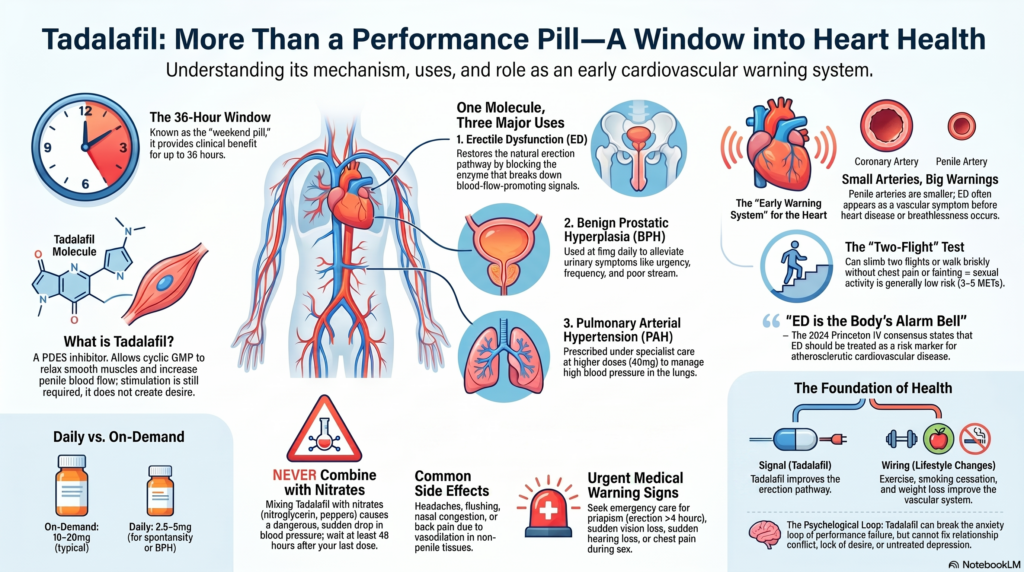 Tadalafil is best known as a medicine for erectile dysfunction, but its importance is larger than that. Sexual health, vascular health, metabolic health and psychological health are deeply connected. Erectile dysfunction may be the first visible sign of endothelial dysfunction, diabetes, hypertension, dyslipidaemia, obesity, smoking-related vascular disease, medication side effects, depression, anxiety or relationship stress.
A modern approach to tadalafil should therefore ask three questions: Is it effective? Is it safe for the heart? And what is the erectile dysfunction trying to tell us about the person’s overall health?
What is tadalafil?
Tadalafil is a phosphodiesterase type-5 inhibitor, or PDE5 inhibitor. During sexual stimulation, nitric oxide is released in penile tissue. This increases cyclic GMP, relaxes smooth muscle, increases penile blood flow and helps produce an erection. PDE5 breaks down cyclic GMP. Tadalafil blocks PDE5, allowing the erection pathway to work more effectively. Importantly, tadalafil does not create sexual desire by itself; sexual stimulation is still required.
Compared with sildenafil, tadalafil is longer acting. Its terminal half-life is about 17.5 hours, and clinical benefit for erectile function may last up to 36 hours, which is why it is sometimes informally called the “weekend pill.” Food does not significantly affect its absorption, so it can be taken with or without meals.
Approved and common clinical uses
Tadalafil is used for three major medical purposes:
- Erectile dysfunction — either as-needed or daily dosing.
- Benign prostatic hyperplasia — especially urinary symptoms such as poor stream, urgency, frequency and night-time urination.
- Pulmonary arterial hypertension — under specialist care, using a different dosing schedule.
For erectile dysfunction, usual prescribing patterns include 10 mg before anticipated sexual activity, adjusted to 5 mg or 20 mg depending on response and tolerability, or 2.5–5 mg once daily for men who prefer spontaneity or have frequent sexual activity. For BPH or combined ED/BPH, tadalafil is commonly used as 5 mg once daily. For pulmonary arterial hypertension, the recommended adult dose is 40 mg once daily, which should not be confused with ED dosing.
Why erectile dysfunction is a cardiovascular warning sign
Erectile dysfunction is not always “psychological.” In many men, especially after the age of 35–40, it may be an early vascular symptom. The penile arteries are smaller than coronary arteries, so endothelial dysfunction and atherosclerosis may show up as erectile difficulty before angina or breathlessness appears. Mayo Clinic describes ED as a possible early warning sign of heart disease, because both ED and heart disease depend on healthy blood vessels and share risk factors.
The 2024 Princeton IV consensus went further: erectile dysfunction should be treated as a risk marker and risk-enhancing factor for atherosclerotic cardiovascular disease, and men with ED should be assessed for vascular risk factors rather than only being given a tablet.
The European Association of Urology also recommends cardiovascular risk assessment in men with predominantly vasculogenic ED, including use of ASCVD risk scoring. The guideline highlights that ED shares common risk factors with cardiovascular disease and that lifestyle modification, regular exercise and weight reduction can improve erectile function.
In simple terms: ED can be the body’s early alarm bell. Tadalafil may help the symptom, but the clinician must also look for the cause.
Is sex safe for the heart?
For most people with stable cardiovascular disease, sexual activity is comparable to mild-to-moderate physical activity. The American Heart Association scientific statement describes sexual activity as roughly 3–5 METs, similar to mild or moderate exertion.
A practical clinical rule is this: if a person can climb two flights of stairs or walk briskly without chest pain, severe breathlessness, dizziness or fainting, sexual activity is usually considered low risk. However, men with recent myocardial infarction, unstable angina, uncontrolled hypertension, decompensated heart failure or significant arrhythmia need medical clearance before resuming sexual activity or using ED medicines.
Is tadalafil safe for the heart?
In properly selected patients, tadalafil and other PDE5 inhibitors are generally cardiovascularly safe. The EAU guideline notes that PDE5 inhibitors do not adversely affect total exercise time or time-to-ischaemia during exercise testing in men with stable angina.
Princeton IV also reflects increasing confidence in PDE5 inhibitor safety when used correctly, while emphasising careful cardiovascular evaluation in men with ED. Observational data suggest possible cardioprotective associations, but these findings should not be overstated as proof that tadalafil prevents heart attacks. Association is not the same as causation, and randomised cardiovascular outcome trials are still needed.
So the balanced message is: tadalafil is not usually dangerous to the heart by itself; the danger comes from using it in the wrong patient, with the wrong medicines, or without recognising unstable cardiovascular disease.
The absolute danger: nitrates and tadalafil
The most important safety rule is simple:
Never combine tadalafil with nitrates.
This includes nitroglycerin, isosorbide dinitrate, isosorbide mononitrate and recreational “poppers” such as amyl nitrite. The combination can cause a sudden and dangerous fall in blood pressure. DailyMed/FDA labelling states that tadalafil is contraindicated with any form of organic nitrate because it potentiates nitrate-induced hypotension.
If a person develops anginal chest pain after taking tadalafil, they should seek urgent medical care and must tell the treating doctor that tadalafil was taken. The label advises that if nitrate administration is medically necessary in a life-threatening situation, at least 48 hours should have elapsed after the last tadalafil dose, and nitrates should be administered only with close medical monitoring.
Tadalafil is also contraindicated with soluble guanylate cyclase stimulators such as riociguat, because the combination may also drop blood pressure to unsafe levels.
Other situations requiring caution
Tadalafil can interact with blood-pressure-lowering medicines. It may be used safely with many antihypertensives, but caution is needed with alpha-blockers, multiple antihypertensives, dehydration, frailty, autonomic dysfunction and heavy alcohol use. The label warns that alpha-blockers, antihypertensives and substantial alcohol intake can increase the risk of hypotension.
Dose adjustment or avoidance may be needed in renal impairment, severe liver disease, and with strong CYP3A4 inhibitors such as ketoconazole or ritonavir. In severe renal impairment or haemodialysis, daily tadalafil is generally not recommended, and as-needed use requires strict dose limitation.
Common side effects
Common side effects include headache, flushing, nasal congestion, dyspepsia, back pain and muscle pain. These effects are usually related to vasodilation and PDE5 inhibition in non-penile tissues.
Serious but uncommon warning symptoms include:
Priapism — an erection lasting more than 4 hours needs emergency care. Untreated priapism can permanently damage erectile tissue.
Sudden vision loss — stop PDE5 inhibitors and seek urgent care, as rare cases of non-arteritic anterior ischaemic optic neuropathy have been reported.
Sudden hearing loss, tinnitus or dizziness — stop the medicine and seek prompt medical attention.
Daily tadalafil vs on-demand tadalafil
On-demand tadalafil is useful when sexual activity is occasional and predictable. Daily tadalafil may be better when a couple prefers spontaneity, when sexual activity is frequent, or when ED coexists with urinary symptoms of BPH. The EAU guideline notes that tadalafil 5 mg once daily is an alternative to on-demand dosing and that continuous and on-demand regimens do not show a clinically significant difference overall, though daily treatment may suit some patients better.
A practical way to decide:
| Situation | Often preferred option |
|---|---|
| Occasional sexual activity | On-demand tadalafil |
| Desire for spontaneity | Daily low-dose tadalafil |
| ED with urinary symptoms/BPH | Daily tadalafil 5 mg |
| Side effects with higher dose | Lower daily dose may be considered |
| Nitrates or unstable cardiac disease | Avoid tadalafil unless cleared by doctor |
Tadalafil and psychological sexual performance
Erectile dysfunction often becomes a loop: one failed erection leads to anticipatory anxiety, anxiety increases sympathetic tone, sympathetic tone interferes with erection, and the next attempt becomes even more stressful.
Tadalafil may help break this loop by improving erectile reliability. But when performance anxiety, depression, relationship conflict, pornography-related conditioning, guilt, trauma, alcohol use, cannabis use or stimulant use are contributing, the tablet alone may not be enough. A comprehensive sexual-health plan should include medical assessment, medication review, lifestyle work and psychological formulation.
This is especially important in men taking antidepressants. Sexual dysfunction is a known side effect of many antidepressants, especially serotonergic medicines such as SSRIs and SNRIs. Mayo Clinic notes that serotonin-affecting antidepressants carry higher sexual-side-effect risk, while options such as bupropion, mirtazapine, vortioxetine and vilazodone may have lower risk in some patients. Medication changes should never be done abruptly or without medical supervision.
What tadalafil will not do
Tadalafil is useful, but it is not magic.
It will not automatically increase desire.
It will not cure relationship dissatisfaction.
It will not treat premature ejaculation as its primary indication.
It will not protect against sexually transmitted infections.
It will not reverse diabetes, smoking-related vascular injury or obesity unless these causes are addressed.
The official label also reminds clinicians that tadalafil offers no protection against sexually transmitted diseases, and patients should be counselled about protective measures where relevant.
A proper clinical evaluation before tadalafil
A good consultation for erectile dysfunction should include:
Medical history: diabetes, hypertension, dyslipidaemia, obesity, smoking, sleep apnoea, heart disease, kidney disease, liver disease, endocrine disorders and neurological illness.
Medication review: antidepressants, antipsychotics, beta-blockers, diuretics, antiandrogens, opioids, finasteride, alcohol, cannabis and recreational substances.
Sexual history: onset, rigidity, morning erections, libido, ejaculation, orgasm, pain, pornography use, relationship context and partner factors.
Psychological assessment: depression, anxiety, stress, body image, shame, performance anxiety and relationship conflict.
Physical and lab assessment where indicated: blood pressure, waist circumference, fasting glucose/HbA1c, lipids, testosterone when symptoms suggest hypogonadism, prolactin when indicated, thyroid function and cardiovascular risk scoring.
The EAU guideline specifically emphasises detailed medical and sexual history, focused physical examination, validated questionnaires such as IIEF/SHIM, and evaluation for underlying medical conditions rather than treating ED as an isolated symptom.
Lifestyle: the foundation that makes tadalafil work better
Tadalafil improves the erection pathway, but lifestyle improves the vascular system behind that pathway. The same factors that protect the heart also protect erectile function: regular aerobic exercise, resistance training, weight management, good sleep, smoking cessation, diabetes control, blood-pressure control, lipid optimisation and reduction of harmful alcohol use.
The EAU guideline gives lifestyle modification a strong role, noting that regular exercise and reduction in BMI can improve erectile function.
In clinical language: tadalafil can improve the signal, but lifestyle improves the wiring.
When to seek urgent care
A man using tadalafil should seek urgent care if he develops:
Chest pain during or after sex.
Severe breathlessness, fainting or palpitations.
Erection lasting more than 4 hours.
Sudden visual loss.
Sudden hearing loss or severe dizziness.
Symptoms of stroke or heart attack.
These are not “side effects to wait out.”
The balanced conclusion
Tadalafil is one of the most useful medicines in sexual medicine because it is effective, long acting and compatible with spontaneity. It can improve erections, confidence, sexual satisfaction and urinary symptoms in selected men. It also has an important role in pulmonary arterial hypertension under specialist care.
But the deeper message is this: erectile dysfunction is not just a sexual problem. It may be a cardiovascular, metabolic, hormonal, medication-related or psychological signal.
The best treatment is not simply “take tadalafil.” The best treatment is:
evaluate the person, protect the heart, treat the cause, restore confidence, and use tadalafil safely when appropriate.
Professional help for sexual dysfunction, medication-related sexual side effects and performance anxiety
Sexual difficulties are often treatable when assessed without judgement. At Mind & Memory Clinic, the focus is on a comprehensive biopsychosocial evaluation — medical, psychiatric, medication-related, relationship-based and lifestyle-related — with referral to cardiology, urology or endocrinology when needed.
Dr. Srinivas Rajkumar T, MD — AIIMS, New Delhi; DNB; MBA — BITS Pilani
Senior Consultant Psychiatrist
Mind & Memory Clinic, Apollo Clinic Velachery, Chennai
Opp. Phoenix Mall
✉️ srinivasaiims@gmail.com
📞 +91-8595155808
Related posts:
- Sexual Health Is More Than Performance: Why Quick Fixes Miss the Bigger Picture
- Post-SSRI Sexual Dysfunction in Men: When Desire and Performance Don’t Return
- OROS Concerta Explained: How a Once-Daily ADHD Tablet Works Like a Tiny Pump
- fNIRS Neurofeedback for Peak Performance: Live Brain Scan Training the Brain with Light