Methylphenidate for ADHD: What Patients Should Know
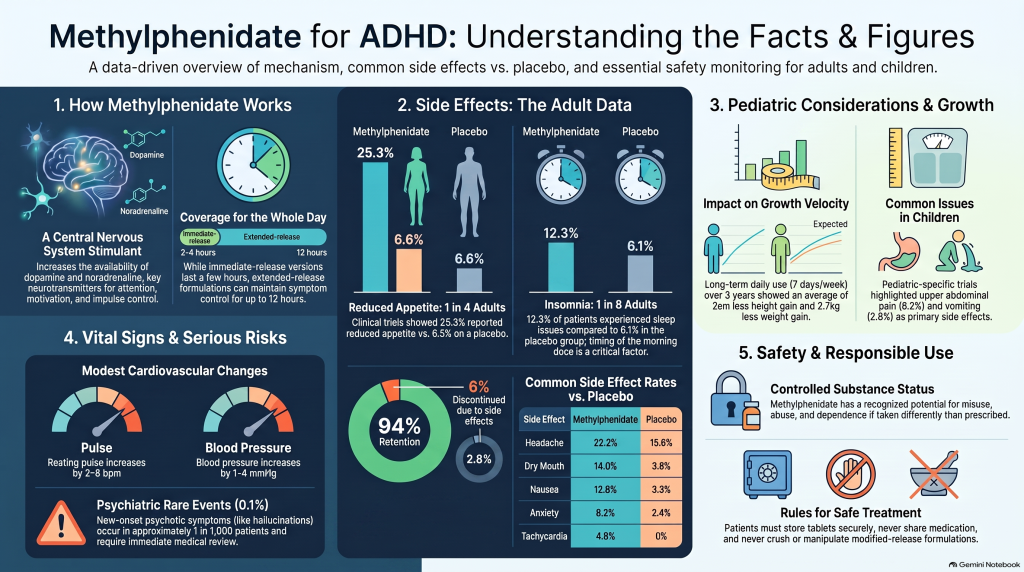 Methylphenidate is one of the most widely used medications for Attention-Deficit/Hyperactivity Disorder (ADHD) in children, adolescents and adults.
Patients often have two very different questions:
Will it help my ADHD?
and
How safe is it?
Instead of giving patients a long list of possible side effects without context, it is often more useful to look at the actual numbers from clinical trials.
What does methylphenidate do?
Methylphenidate is a central nervous system stimulant. It increases the availability of dopamine and noradrenaline, neurotransmitters involved in attention, motivation, impulse control and executive functioning.
Different formulations last for different lengths of time.
Some immediate-release preparations work for only a few hours, while long-acting formulations are designed to cover much of the working or school day.
In studies of one extended-release methylphenidate formulation, improvements in attention and behaviour were maintained for up to 12 hours after the morning dose.
What are the most common side effects?
Adult placebo-controlled trials provide particularly useful numbers.
| Side effect | Methylphenidate | Placebo |
|---|---|---|
| Reduced appetite | 25.3% | 6.6% |
| Headache | 22.2% | 15.6% |
| Dry mouth | 14.0% | 3.8% |
| Nausea | 12.8% | 3.3% |
| Insomnia | 12.3% | 6.1% |
| Anxiety | 8.2% | 2.4% |
| Dizziness | 6.7% | 5.2% |
| Weight decrease | 6.5% | 3.3% |
| Irritability | 5.8% | 1.4% |
| Increased sweating | 5.1% | 0.9% |
| Fast heartbeat | 4.8% | 0% |
| Palpitations | 3.1% | 0.9% |
Put more simply:
About 1 in 4 adults reported reduced appetite.
About 1 in 5 reported headache.
About 1 in 8 reported insomnia.
About 1 in 8 reported nausea.
About 1 in 12 reported anxiety.
Importantly, the majority of adverse reactions reported in these clinical trials were described as mild to moderate.
Appetite and weight
Reduced appetite is probably the most recognisable methylphenidate side effect.
In the adult trials:
25.3% reported decreased appetite compared with 6.6% receiving placebo.
But actual reported weight decrease occurred in 6.5%, compared with 3.3% receiving placebo.
Appetite and weight should therefore be monitored, particularly after starting medication or increasing the dose.
What about sleep?
Insomnia occurred in:
12.3% with methylphenidate
versus
6.1% with placebo.
The timing of the medication matters.
Long-acting methylphenidate is generally taken in the morning. If sleep becomes significantly worse, the dose, timing and formulation should be reviewed.
Does methylphenidate cause anxiety?
Anxiety was reported in:
8.2% with methylphenidate
compared with
2.4% with placebo.
This does not mean that every episode of anxiety occurring during ADHD treatment is caused by methylphenidate.
ADHD and anxiety frequently coexist. A clinician therefore needs to distinguish between:
- pre-existing anxiety
- anxiety related to ADHD-related difficulties
- anxiety emerging after medication
- excessive stimulant dosage
What happens to blood pressure and heart rate?
Stimulants can increase heart rate and blood pressure.
In paediatric clinical studies, resting pulse increased by around 2–6 beats per minute, with blood-pressure increases of roughly 1–4 mmHg during the day.
In one adult study, increases in standing pulse ranged from approximately 3.9 to 9.8 beats per minute, depending on dose.
In adult placebo-controlled studies:
Tachycardia: 4.8%
Palpitations: 3.1%
For most patients, average cardiovascular changes are modest.
However, some individuals can have larger increases.
This is why pulse and blood pressure should be checked before and during stimulant treatment.
Are serious psychiatric reactions common?
Serious psychiatric reactions are possible but uncommon.
In pooled short-term placebo-controlled trials of CNS stimulants, newly emerging psychotic or manic symptoms occurred in approximately:
0.1%
That is around:
1 in 1,000 patients
compared with 0% in placebo-treated patients in that pooled analysis.
Symptoms can include hallucinations, delusional thinking or mania.
New-onset psychotic or manic symptoms after starting a stimulant require prompt medical review.
A history of bipolar disorder, psychosis and other relevant psychiatric conditions should therefore be assessed before treatment.
How many people actually stop methylphenidate because of side effects?
This is perhaps one of the most useful numbers for patients.
In two placebo-controlled adult studies:
6.0% of methylphenidate-treated patients stopped treatment because of an adverse reaction.
The corresponding figure with placebo was 2.8%.
In other words:
About 94 out of 100 adults did not discontinue treatment because of an adverse reaction during these controlled trials.
Among the specific reasons for stopping treatment were:
Anxiety — 1.7%
Irritability — 1.4%
Increased blood pressure — 1.0%
Nervousness — 0.7%
What should parents know about methylphenidate?
In controlled trials involving children and adolescents, commonly reported adverse effects included:
| Side effect | Methylphenidate | Placebo |
| Upper abdominal pain | 6.2% | 3.8% |
| Vomiting | 2.8% | 1.6% |
| Insomnia | 2.8% | 0.3% |
| Dizziness | 1.9% | 0% |
Most adverse reactions were mild to moderate.
Can methylphenidate affect growth?
Long-term stimulant treatment can affect appetite, weight gain and growth velocity in some children.
Follow-up observations in children receiving methylphenidate 7 days per week throughout the year found approximately:
2 cm less height gain
and
2.7 kg less weight gain
over approximately 3 years.
This does not mean that every child taking methylphenidate will permanently lose 2 cm of adult height.
It does mean that children’s height and weight should be monitored regularly during treatment.
Can methylphenidate be addictive?
Methylphenidate is a controlled stimulant medication and has recognised potential for misuse, abuse and dependence, particularly when it is taken differently from how it was prescribed.
The prescribing information specifically warns about misuse, diversion, overdose and addiction.
Patients should therefore:
- take only the prescribed dose
- never share medication
- store tablets securely
- never increase the dose without medical advice
- avoid crushing or manipulating modified-release formulations
Appropriate prescribing and monitoring are part of safe stimulant treatment.
Methylphenidate: the numbers worth remembering
For adults, a useful summary is:
25% — reduced appetite
22% — headache
14% — dry mouth
13% — nausea
12% — insomnia
8% — anxiety
6.5% — reported weight decrease
5% — tachycardia
3% — palpitations
0.1% — approximately 1 in 1,000 — psychotic or manic symptoms in pooled short-term stimulant trials
6% — discontinued treatment because of an adverse reaction in the adult controlled studies
And with certain long-acting formulations:
up to approximately 12 hours of demonstrated symptom control after a morning dose.
The important question is not simply: “Is methylphenidate safe?”
Every effective medication has potential adverse effects.
The more useful questions are:
Does the person actually have ADHD?
Is methylphenidate producing a meaningful improvement in attention, organisation, impulse control and daily functioning?
Is the dose appropriate?
Are sleep, appetite, weight, pulse and blood pressure being monitored?
Are benefits greater than adverse effects?
ADHD treatment should therefore be measured and individualised, rather than reduced to simply prescribing a stimulant.
Structured ADHD Assessment at ATTN Clinic, Chennai
At ATTN Clinic, we take a diagnosis-first approach to ADHD and other causes of attention difficulty.
Not every person with poor concentration has ADHD. Anxiety, depression, sleep problems, substance use, medical conditions and nutritional deficiencies can also produce significant problems with attention.
Assessment therefore begins with a detailed clinical evaluation.
Where clinically appropriate, this can be supplemented with structured assessments and objective measures such as Continuous Performance Testing (CPT) and QEEG, while treatment response is evaluated using symptoms and real-world functioning.
ATTN Clinic
Attention. Understood.
Apollo Clinic (Opp. Phoenix Market City), Velachery, Chennai
Appointments: +91 85951 55808
Email: srinivasaiims@gmail.com
This article is intended for patient education and does not replace individual medical advice. The percentages quoted above are primarily from placebo-controlled clinical trials of a specific extended-release methylphenidate formulation. Side-effect rates can differ depending on formulation, dose, age and individual patient characteristics.