Is It Really ADHD? Understanding the Science Behind Inattention, Distractibility, and Executive Dysfunction
 Introduction: When Everything Starts Looking Like ADHD
You forget where you kept your keys. You postpone an important task until the last minute. You find yourself scrolling through your phone despite having several things to finish. You struggle to concentrate during meetings but can spend hours watching an interesting series or playing a video game.
Does that mean you have Attention-Deficit/Hyperactivity Disorder (ADHD)?
Not necessarily.
ADHD has received considerable public attention in recent years, particularly through social media. This increased awareness has helped many adults recognise previously overlooked symptoms and seek professional evaluation.
However, it has also created an interesting diagnostic challenge: many experiences commonly attributed to ADHD are not specific to ADHD.
Inattention, procrastination, forgetfulness, restlessness, and difficulty completing tasks can occur in several psychiatric disorders, medical conditions, and even during periods of prolonged stress or inadequate sleep.
The challenge is therefore not simply identifying symptoms of ADHD. It is understanding their origins.
To appreciate this distinction, we need to examine what attention actually is, how ADHD affects the brain, and how clinicians distinguish ADHD from other causes of cognitive difficulty.
1. ADHD Is Not Simply an Attention Deficit
The name Attention-Deficit/Hyperactivity Disorder can be misleading.
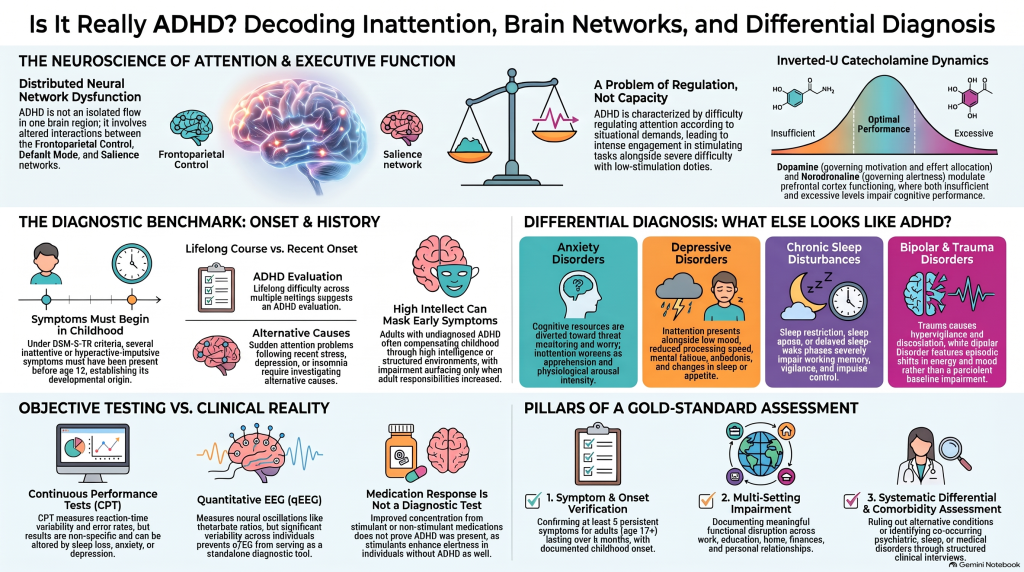
People with ADHD do not necessarily lack the ability to pay attention. Rather, they often experience difficulties regulating attention according to the demands of a situation.
For example, an adult with ADHD may struggle to read an uninteresting report for 15 minutes but remain intensely engaged in a stimulating activity for several hours.
This apparent contradiction has sometimes been described as a problem of attention regulation rather than attention capacity.
However, the popular term hyperfocus is not a formal diagnostic criterion and is not unique to ADHD.
The neuroscience of attention
Attention is not controlled by a single brain region. It emerges from interactions between multiple neural networks.
Three particularly relevant systems are:
The frontoparietal control network
This network, involving regions such as the dorsolateral prefrontal cortex and posterior parietal cortex, supports goal-directed behaviour, working memory, and cognitive control.
It helps us maintain task goals, organise information, and resist distractions.
The default mode network (DMN)
The DMN includes regions such as the medial prefrontal cortex, posterior cingulate cortex, and precuneus.
It is frequently active during internally directed mental activity, including autobiographical thinking, self-referential processing, and spontaneous thought.
During externally demanding tasks, activity within parts of this network often decreases.
Some neuroimaging studies of ADHD have identified altered interactions between the DMN and task-positive networks. One hypothesis proposes that inadequate suppression of internally directed activity may contribute to lapses in attention.
However, these findings are heterogeneous and are not sufficiently specific to diagnose ADHD in an individual.
The salience network
The salience network, particularly involving the anterior insula and dorsal anterior cingulate cortex, contributes to detecting behaviourally relevant information and coordinating shifts between different modes of processing.
Disruptions in the interactions among these networks may contribute to difficulties in maintaining attention and regulating behaviour.
The important point is that ADHD is increasingly understood as a disorder involving distributed neural systems rather than dysfunction of one isolated brain region.
2. Executive Dysfunction: Why Knowing What to Do Is Not the Same as Doing It
One of the most clinically important concepts in ADHD is executive functioning.
Executive functions are higher-order cognitive processes that allow individuals to organise behaviour toward future goals.
They include working memory, inhibitory control, planning, cognitive flexibility, task initiation, and self-monitoring.
Consider a simple example.
A person knows that a report must be submitted by Friday. They understand its importance, possess the knowledge required, and genuinely intend to complete it.
Yet they repeatedly postpone starting.
As the deadline approaches, urgency increases, and the report is finally completed during an intense period of last-minute effort.
This pattern is frequently described by adults with ADHD.
The problem is not necessarily a lack of intelligence, knowledge, or motivation. It may involve difficulty initiating and sustaining goal-directed behaviour without sufficient external structure or immediate reinforcement.
Research has demonstrated group-level differences in executive functioning among individuals with ADHD, particularly in inhibitory control, working memory, and response variability.
Nevertheless, executive dysfunction is not universal in ADHD, and it is not specific to the disorder.
Depression, anxiety, sleep deprivation, traumatic brain injury, and several other conditions can produce similar difficulties.
Therefore, executive dysfunction alone cannot establish an ADHD diagnosis.
3. Dopamine, Noradrenaline, and the Regulation of Attention
ADHD is associated with alterations in catecholaminergic neurotransmission, particularly dopamine and noradrenaline.
These neurotransmitters influence how the prefrontal cortex maintains information, regulates impulses, and coordinates goal-directed behaviour.
Dopamine: More than the pleasure chemical
Dopamine is frequently described as a neurotransmitter associated with pleasure. This is an oversimplification.
Dopamine contributes to reinforcement learning, reward prediction, motivation, action selection, and the allocation of effort.
In ADHD, altered reward processing may contribute to difficulties sustaining effort toward goals that offer delayed or uncertain rewards.
This can help explain why immediate, stimulating activities may feel easier to engage with than repetitive tasks offering benefits only in the distant future.
However, it would be inaccurate to conclude that everyone with ADHD simply has low dopamine levels. ADHD does not have a single established neurotransmitter abnormality that can be measured clinically.
Noradrenaline: Maintaining the signal
Noradrenaline plays an important role in alertness, attention, and prefrontal cortical functioning.
Optimal catecholamine signalling helps the prefrontal cortex maintain task-relevant information while filtering irrelevant distractions.
Importantly, the relationship is not linear.
Both insufficient and excessive catecholaminergic stimulation can impair prefrontal functioning, a relationship commonly described through an inverted-U model.
This provides part of the neurobiological rationale for medications such as methylphenidate and atomoxetine.
Methylphenidate inhibits dopamine and noradrenaline transporters, increasing extracellular catecholamine availability.
Atomoxetine primarily inhibits the noradrenaline transporter, influencing noradrenergic transmission and also dopamine availability in the prefrontal cortex.
These mechanisms help explain their therapeutic effects, but response to a stimulant or atomoxetine is not a diagnostic test for ADHD.
Improved alertness or concentration following medication does not, by itself, prove that ADHD was present.
4. The Most Important Diagnostic Question: When Did It Begin?
One of the defining features of ADHD is its developmental origin.
ADHD is classified as a neurodevelopmental disorder because its symptoms begin during development, even when the diagnosis is not recognised until adulthood.
Under DSM-5-TR criteria, several symptoms must have been present before the age of 12 years.
This does not mean that every adult with ADHD must have received a childhood diagnosis.
Many individuals, particularly those with predominantly inattentive symptoms, may have remained undiagnosed.
Some compensated through intelligence, family support, highly structured environments, or substantial additional effort.
Their difficulties may become more apparent when responsibilities increase during university, employment, marriage, parenthood, or independent living.
Nevertheless, a careful developmental history remains essential.
Consider two individuals.
Person A: A 30-year-old professional describes lifelong forgetfulness, poor organisation, frequent loss of belongings, difficulty following instructions, and repeated procrastination. Similar patterns were present during school, although academic performance remained satisfactory.
Person B: A 30-year-old professional previously functioned without significant attentional difficulties but developed poor concentration, forgetfulness, and reduced productivity over the last six months following a period of severe insomnia and depression.
Both individuals may report similar current symptoms.
However, the underlying diagnostic possibilities are quite different.
Person A may warrant evaluation for ADHD.
Person B requires careful assessment of sleep, mood, and other potential causes of newly emerging cognitive difficulties.
The distinction is clinically significant because the treatment approach may differ considerably.
5. When Inattention Is Not ADHD: Understanding the Differential Diagnosis
Inattention is a transdiagnostic symptom.
This means that it occurs across multiple psychiatric and neurological conditions rather than belonging exclusively to one diagnosis.
ADHD versus anxiety disorders
Anxiety can significantly interfere with attention.
When an individual is preoccupied with worries about future events, social evaluation, health, finances, or personal safety, cognitive resources are repeatedly diverted toward perceived threats.
The person may appear distracted, forgetful, or unable to concentrate.
A useful clinical distinction is the relationship between attention difficulties and worry.
In anxiety disorders, concentration may deteriorate particularly when worry, apprehension, or physiological arousal intensifies.
In ADHD, difficulties are more likely to reflect a longstanding pattern of attention regulation and executive functioning problems across different situations.
However, anxiety and ADHD frequently coexist.
ADHD versus depression
Depression can produce substantial cognitive impairment.
Patients may experience reduced processing speed, difficulty concentrating, indecisiveness, poor memory, reduced motivation, and diminished mental energy.
These symptoms can resemble inattentive ADHD.
The temporal relationship is particularly important.
If attentional difficulties emerged alongside persistent low mood, anhedonia, fatigue, or changes in sleep and appetite, depression may be a major contributor.
In contrast, longstanding ADHD may contribute to repeated failures, occupational difficulties, and reduced self-esteem, potentially increasing vulnerability to secondary depressive symptoms.
Both conditions may therefore require treatment.
ADHD versus sleep disorders
Sleep is fundamental to attention and executive functioning.
Chronic sleep restriction can impair vigilance, working memory, emotional regulation, and inhibitory control.
Obstructive sleep apnoea may produce daytime sleepiness, fatigue, forgetfulness, and reduced cognitive efficiency.
Delayed sleep-wake phase disorder is also relevant because sleep timing difficulties are common among individuals with ADHD.
A patient who sleeps five hours per night and experiences severe daytime inattention should not automatically receive an ADHD diagnosis without evaluating sleep.
ADHD versus bipolar disorder
Distractibility and increased activity can occur during manic or hypomanic episodes.
However, bipolar disorder is characterised by distinct mood episodes involving changes in mood, energy, activity, sleep, and other symptoms.
ADHD generally follows a more persistent developmental course.
A marked episodic change from baseline, particularly with elevated or irritable mood, increased energy, decreased need for sleep, and increased goal-directed activity, raises the possibility of a mood episode.
ADHD and bipolar disorder can also coexist, making longitudinal assessment essential.
ADHD versus trauma-related disorders
Trauma-related conditions may involve hypervigilance, intrusive recollections, dissociation, sleep disturbances, and concentration difficulties.
A person constantly monitoring their environment for potential threats may have difficulty sustaining attention on routine tasks.
Understanding the relationship between symptoms, traumatic experiences, and developmental history helps guide differential diagnosis.
Other important possibilities
Medical illnesses, medication adverse effects, substance use, learning disorders, autism spectrum disorder, and other neurodevelopmental or cognitive conditions may also contribute to inattention.
In older adults, newly emerging attentional difficulties require consideration of cognitive disorders, including mild cognitive impairment, alongside psychiatric and medical causes.
The presence of an alternative condition does not automatically exclude ADHD. The clinician must determine whether it better explains the symptoms or represents a comorbidity.
6. Why Social Media ADHD Checklists Can Be Misleading
Many popular ADHD videos feature statements such as:
- Do you procrastinate?
- Do you frequently lose things?
- Do you struggle to finish tasks?
- Does your mind wander during conversations?
- Do you become intensely interested in certain activities?
These experiences are relatable because they occur throughout the general population.
The diagnostic value of a symptom depends on much more than its presence.
Clinicians consider its frequency, severity, persistence, developmental onset, context, and impact on functioning.
For example, occasional procrastination is common.
Persistent difficulties initiating and completing tasks, beginning in childhood and producing significant impairment across multiple settings, may have greater diagnostic relevance.
This is why ADHD diagnosis requires identifying a clinically meaningful pattern rather than counting relatable experiences.
7. Can Objective Testing Improve ADHD Diagnosis?
Traditional ADHD assessment relies on clinical interviews, developmental history, collateral information, validated symptom scales, and evaluation of impairment.
However, clinicians and researchers have long explored whether objective measurements can provide additional information.
Two approaches of particular interest are Continuous Performance Testing and quantitative EEG.
Continuous Performance Tests (CPT)
CPTs are computerised tasks designed to assess selected components of attention and response control.
Depending on the test, measurements may include:
Omission errors: Failure to respond when a response is required.
Commission errors: Responding when a response should be withheld.
Reaction time: The speed of responding to stimuli.
Reaction-time variability: Fluctuations in response speed across the task.
Reaction-time variability is especially interesting because research has identified increased intra-individual variability in many groups of individuals with ADHD.
Rather than simply responding slowly, some individuals demonstrate inconsistent performance, alternating between relatively efficient and markedly delayed responses.
This may reflect fluctuations in attention, arousal, or task engagement.
However, these patterns are not exclusive to ADHD.
Sleep deprivation, depression, neurological conditions, medication effects, and other factors can influence CPT performance.
A normal CPT also does not exclude ADHD.
Consequently, CPT should be regarded as a supplementary measure rather than a standalone diagnostic investigation.
Quantitative EEG (qEEG)
EEG measures electrical activity recorded from the scalp.
Quantitative EEG applies computational methods to characterise features such as spectral power, frequency distribution, asymmetry, and functional connectivity.
Researchers have investigated whether individuals with ADHD demonstrate characteristic differences in neural oscillations.
Historically, particular attention was given to increased theta activity, altered beta activity, and the theta/beta ratio.
Although some studies identified group-level differences, subsequent research demonstrated considerable heterogeneity.
Age, vigilance, recording conditions, comorbidities, and methodological differences can influence results.
Importantly, there is no universally accepted qEEG signature that reliably identifies ADHD in an individual patient.
The theta/beta ratio, in particular, has not demonstrated sufficient standalone diagnostic accuracy for routine clinical diagnosis.
What about artificial intelligence?
Machine-learning approaches are increasingly being investigated to integrate EEG features, CPT performance, clinical characteristics, and other information.
In principle, multimodal approaches may identify patterns that are difficult to detect using any single measure.
However, promising classification accuracy within a research dataset does not necessarily translate into reliable clinical performance.
Models require external validation, representative clinical samples, careful control of confounding factors, and assessment of how much they improve decision-making beyond standard clinical evaluation.
At present, AI-assisted EEG and CPT approaches remain promising areas of research and supplementary assessment rather than replacements for specialist clinical diagnosis.
The future of ADHD assessment may involve better integration of clinical expertise with objective measurements, but the clinical history remains central.
8. What Should a Proper Adult ADHD Assessment Include?
A comprehensive assessment should answer several important questions.
First, are the symptoms consistent with recognised diagnostic criteria?
The clinician evaluates inattentive and hyperactive-impulsive symptoms using established diagnostic frameworks.
For adults aged 17 years and above, DSM-5-TR generally requires at least five symptoms in the relevant symptom domain, persisting for at least six months.
Second, were symptoms present during childhood?
School reports, developmental history, and observations from family members may provide useful information when available.
Third, are symptoms present across multiple settings?
ADHD-related difficulties should not be restricted to one isolated situation.
Fourth, is there meaningful functional impairment?
The assessment examines effects on education, employment, relationships, finances, daily responsibilities, and other areas of functioning.
Fifth, could another condition better explain the presentation?
Mood disorders, anxiety, sleep disturbances, substance use, medical conditions, and other neurodevelopmental disorders must be considered.
Finally, what additional assessments would meaningfully inform management?
Validated instruments such as the Adult ADHD Self-Report Scale (ASRS) can support screening and symptom documentation.
Structured diagnostic interviews may improve consistency.
CPT or other objective measures may provide supplementary information in selected cases.
No single questionnaire, computerised test, or EEG measurement can replace the integrated clinical assessment.
9. Why Getting the Diagnosis Right Matters
An ADHD diagnosis can have important implications for treatment, self-understanding, occupational functioning, and long-term wellbeing.
An inaccurate diagnosis may result in inappropriate treatment or delayed recognition of another condition.
Equally, failing to recognise genuine ADHD can leave individuals struggling for years with difficulties that might respond to appropriate interventions.
Treatment for confirmed ADHD may include medication, psychoeducation, ADHD-focused cognitive behavioural interventions, environmental modifications, organisational strategies, and management of comorbid conditions.
Medication decisions require individual assessment of benefits, adverse effects, cardiovascular considerations, comorbidities, and patient preferences.
The goal is not simply to improve performance on an attention test.
It is to improve real-world functioning, quality of life, and the individual’s ability to manage everyday responsibilities.
10. The Future: From Symptom Recognition to Precision Assessment
Psychiatry is gradually moving toward approaches that integrate clinical observation with increasingly sophisticated measurements of cognition, behaviour, and brain function.
For ADHD, this creates opportunities to study attention regulation, response variability, neural activity, and treatment-related changes more systematically.
Repeated measurements may eventually help researchers understand how cognitive performance and neural activity vary across time, treatment states, and environmental conditions.
Nevertheless, clinical utility must be demonstrated rather than assumed.
A useful diagnostic technology must do more than produce attractive graphs or identify statistically significant differences.
It should provide reliable information that meaningfully improves diagnosis, treatment selection, monitoring, or patient outcomes.
That is an important distinction between technological innovation and clinically validated precision medicine.
Conclusion: The Right Diagnosis Begins With the Right Question
Not every person who struggles to concentrate has ADHD.
Not every person with ADHD appears restless or hyperactive.
And not every individual who performs well academically or professionally is free from ADHD-related difficulties.
The diagnosis requires a careful understanding of developmental history, symptom persistence, functional impairment, comorbidities, and alternative explanations.
Neuroscience has substantially improved our understanding of the networks and neurotransmitter systems involved in attention and executive functioning.
Emerging technologies such as CPT, qEEG, and artificial intelligence may provide useful additional insights, but they must be interpreted within a comprehensive clinical framework.
The question is not simply, “Is it ADHD?”
The more meaningful question is, “What explains this person’s difficulties with attention and executive functioning, and how can we help?”
That is where good psychiatry begins.
About the Author | Adult ADHD Assessment in Chennai
Consultations in Chennai
Dr. Srinivas Rajkumar T
Senior Consultant Psychiatrist
Apollo Clinic, Velachery, Chennai (Near Phoenix Marketcity)
Ph: 8595155808
Dr. Srinivas Rajkumar is a psychiatrist with a special clinical interest in adult ADHD, cognitive neuroscience, and technology-assisted psychiatric assessment.
He completed his postgraduate training in Psychiatry at the All India Institute of Medical Sciences (AIIMS), New Delhi, and has been actively involved in clinical psychiatry, academic teaching, and exploring emerging approaches to psychiatric assessment and treatment.