MODY Diabetes: Prevention, Family Risk, and Mental Health Implications
 When we hear the word diabetes, most people immediately think of either Type 1 diabetes or Type 2 diabetes. But there is another important form of diabetes that often gets missed — MODY, or Maturity-Onset Diabetes of the Young.
MODY is not the usual lifestyle-related diabetes. It is a genetic form of diabetes, often seen in teenagers, young adults, and families where diabetes appears across generations. Because it is uncommon and less understood, many people with MODY are wrongly labelled as having Type 1 or Type 2 diabetes for years.
This wrong label can lead to unnecessary anxiety, inappropriate treatment, family confusion, and emotional distress.
What is MODY?
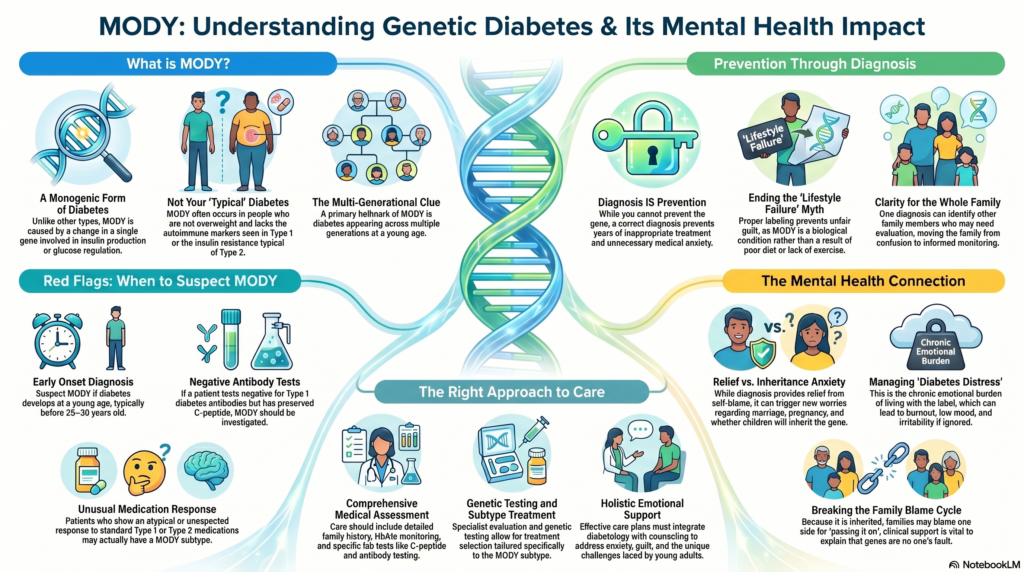
MODY is a form of monogenic diabetes, meaning it is usually caused by a change in a single gene involved in insulin production or glucose regulation.
Unlike Type 2 diabetes, MODY may occur even in people who are not overweight and do not have the typical features of insulin resistance. Unlike Type 1 diabetes, many people with MODY do not have autoimmune destruction of the pancreas.
A strong clue is this:
Diabetes in multiple generations of the same family, especially when it appears at a young age, should raise suspicion of MODY.
For example, if a grandparent, parent, and child all developed diabetes early in life, MODY should be considered.
Can MODY be prevented?
This is where we need to be careful.
Since MODY is genetic, we cannot “prevent” the genetic tendency in the usual sense. A person does not develop MODY because they ate too much sugar or failed to exercise. It is not a moral failure or a lifestyle failure.
But we can prevent many problems related to MODY.
1. We can prevent misdiagnosis
Many people with MODY are wrongly diagnosed as Type 1 or Type 2 diabetes. This can lead to years of inappropriate treatment.
Some MODY subtypes may not need insulin. Some may respond well to specific oral medicines. Some may need only monitoring in certain situations. So, correct diagnosis can completely change the treatment plan.
In MODY, diagnosis itself is prevention.
2. We can prevent unnecessary guilt
Young people with diabetes often hear statements like:
“You must have eaten too many sweets.”
“You did not exercise enough.”
“You caused this.”
In MODY, this can be deeply unfair. Since the condition is genetic, blaming the patient is not only wrong but psychologically damaging.
A proper diagnosis helps the person and family understand that this is a biological condition, not a character defect.
3. We can prevent family-level confusion
Because MODY runs in families, one diagnosis may help identify others. Parents, siblings, or children may also need evaluation.
This does not mean everyone should panic. It means the family can move from confusion to clarity. Genetic counselling, proper testing, and appropriate monitoring can help families make informed decisions.
4. We can prevent long-term complications
Some types of MODY can increase the risk of diabetes-related complications if sugar levels are not controlled properly. Regular follow-up, HbA1c monitoring, eye check-ups, kidney assessment, blood pressure control, and lipid management remain important.
Even in genetic diabetes, good medical care matters.
Mental health implications of MODY
MODY is not just a sugar problem. It affects identity, family relationships, future planning, and emotional wellbeing.
1. Relief after diagnosis
For some patients, getting a MODY diagnosis is a relief.
They finally understand why diabetes appeared despite being young, active, or not overweight. They may feel less guilty. They may also feel reassured that their condition has a clear explanation.
A correct diagnosis can reduce years of self-blame.
2. Anxiety about inheritance
At the same time, a genetic diagnosis can create new worries.
Patients may ask:
“Will my child get this?”
“Should my siblings be tested?”
“Did I inherit this from my parent?”
“Will this affect marriage or pregnancy planning?”
These questions are very real, especially in the Indian family context where health, marriage, fertility, and family reputation are often interconnected.
This is why MODY care should include not only diabetology but also counselling and emotional support.
3. Diabetes distress
Even when diabetes is mild, the label itself can be stressful. A young person may feel different from peers. They may worry about food, future health, relationships, career, pregnancy, or insurance.
This chronic emotional burden is called diabetes distress. It is not the same as depression, but if ignored, it can lead to anxiety, low mood, irritability, burnout, and poor self-care.
4. Family blame
Because MODY is inherited, some families may start blaming one side of the family.
“Your father’s side has diabetes.”
“Your mother’s family passed this on.”
“Why did no one tell us earlier?”
Such conversations can create guilt, resentment, and conflict. A good clinician should actively reduce blame and explain that genes are not anyone’s fault.
The goal is not to find someone to blame. The goal is to help the family understand, adapt, and act wisely.
5. Impact on young adults
Young adults with MODY may be starting college, careers, relationships, or marriage discussions. A diabetes diagnosis at this stage can affect confidence and self-image.
Some may become overly anxious. Some may deny the illness. Some may become careless because they feel “nothing is happening now.” Others may feel angry that they have to carry a lifelong label.
This is where psychological support becomes important. The person should not be reduced to a blood sugar number.
When should MODY be suspected?
MODY may be considered when:
A person develops diabetes at a young age, especially before 25–35 years.
There is diabetes in successive generations of the family.
The person is not obese or does not have typical insulin resistance.
Type 1 diabetes antibodies are negative.
C-peptide is preserved.
Blood sugars are mildly raised and stable over time.
There is an unusual response to usual diabetes medicines.
Final diagnosis usually requires specialist evaluation and, when appropriate, genetic testing.
The right approach to MODY
A good MODY care plan should include:
Medical assessment to understand the diabetes pattern.
Family history across generations.
Laboratory evaluation including HbA1c, C-peptide, and antibody testing where needed.
Genetic testing when clinically indicated.
Correct treatment selection based on MODY subtype.
Family counselling to reduce fear and blame.
Mental health support for anxiety, guilt, distress, and adjustment issues.
Long-term follow-up to prevent complications.
The main message
MODY cannot be prevented like ordinary lifestyle-related diabetes. But its consequences can be prevented.
We can prevent delayed diagnosis.
We can prevent wrong treatment.
We can prevent unnecessary guilt.
We can prevent family confusion.
We can prevent long-term complications.
We can prevent emotional suffering.
The future of diabetes care is not only about controlling sugar. It is about understanding the person, the family, the genes, the emotions, and the life context.
Need help with diabetes-related stress or emotional difficulties?
Living with diabetes — especially a genetic or early-onset form like MODY — can affect mood, anxiety, sleep, confidence, family relationships, and long-term motivation.
If you or a family member is struggling with diabetes-related stress, health anxiety, low mood, adjustment difficulties, or emotional burnout, professional support can help.
Dr. Srinivas Rajkumar T, MD (AIIMS, New Delhi), DNB, MBA (BITS Pilani)
Senior Consultant Psychiatrist
Mind & Memory Clinic, Apollo Clinic Velachery
Opp. Phoenix Mall, Chennai
✉ srinivasaiims@gmail.com
📞 +91-8595155808