How to Recognize Early Dementia: A Practical Guide to Memory, Language, Behavior, and Cognitive Changes
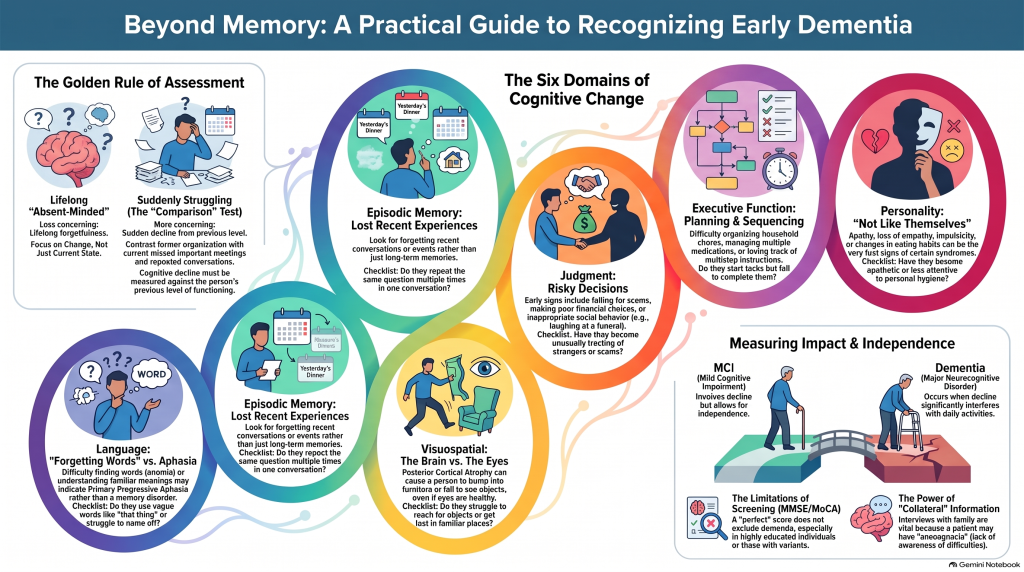 Dementia does not always begin with forgetting. Understanding changes in language, vision, judgment, and personality can help identify cognitive impairment earlier and guide a more accurate diagnosis.
When a person begins forgetting things, family members often wonder whether it is normal aging or the beginning of dementia.
However, not every memory complaint indicates dementia, and not every person with dementia initially experiences memory loss.
Some people develop difficulty finding words. Others struggle to locate objects despite having normal eyesight. A previously responsible individual may begin making poor financial decisions, while another person may gradually become withdrawn, impulsive, or socially inappropriate.
These changes can be confusing for patients and families. They may also be difficult to recognize during a routine medical consultation.
The key to understanding cognitive impairment is to identify which abilities have changed, how those changes have progressed, and whether they interfere with everyday life.
A detailed cognitive and behavioral history, supported by appropriate neuropsychological assessment, can help distinguish different clinical presentations and guide further investigations.
This article explains how patients, caregivers, and healthcare professionals can systematically recognize cognitive and behavioral changes.
1. The First Question: What Has Changed From the Person’s Previous Abilities?
The most important principle in dementia assessment is that cognitive decline must be understood in relation to a person’s previous level of functioning.
Consider two individuals.
One person has always been somewhat forgetful, frequently misplacing keys and occasionally missing appointments. These characteristics have remained relatively unchanged for many years.
Another person was previously exceptionally organized but has recently started missing important meetings, repeating conversations, and struggling to manage familiar responsibilities.
Although both may describe themselves as forgetful, the second person’s change from their previous abilities warrants closer evaluation.
The same principle applies to language, judgment, behavior, and personality.
A person who has always been quiet and socially reserved may simply have a longstanding personality characteristic.
However, someone who was previously outgoing and socially engaged but has gradually become apathetic, indifferent, or withdrawn may be experiencing a significant behavioral change.
Questions to ask
When was the person last functioning at their usual level?
What was the first noticeable change?
Did the symptoms develop suddenly or gradually?
Have the difficulties progressively worsened?
Do the symptoms fluctuate?
Which abilities remain relatively preserved?
Have the changes affected work, relationships, finances, or personal independence?
For clinicians, identifying the earliest symptom can provide important clues about the initially affected cognitive networks.
The first symptom may not reveal the exact underlying disease, but it can help characterize the clinical syndrome.
2. Language: When Forgetting Words Is Not Actually a Memory Problem
One of the most common complaints in a cognitive consultation is:
“I keep forgetting words.”
However, difficulty finding words does not necessarily indicate a problem with episodic memory.
Language depends on several interconnected cognitive processes, including word retrieval, speech production, grammar, comprehension, reading, and writing.
A person may know exactly what they want to communicate but struggle to retrieve the correct word.
Another individual may speak fluently but have difficulty understanding the meaning of familiar words.
These are different clinical problems.
Questions patients and families can consider
Does the person frequently pause during conversations because they cannot find the correct word?
Do they substitute incorrect words?
Do they pronounce familiar words incorrectly or replace sounds within words?
Do they struggle to name familiar objects?
Have they started using vague descriptions such as “that thing” instead of the correct word?
Do they have difficulty understanding conversations despite adequate hearing?
Can they follow instructions involving several steps?
Have they developed difficulty reading or writing?
What these symptoms mean clinically
Difficulty naming objects or retrieving words is called anomia.
Incorrect substitution of sounds or words may represent phonological or semantic errors.
Difficulty understanding the meaning of words may indicate impairment of semantic knowledge.
Progressive language impairment may raise the possibility of primary progressive aphasia (PPA).
PPA is a clinical syndrome characterized by progressive impairment of language. Its major variants include nonfluent/agrammatic, semantic, and logopenic presentations.
Importantly, PPA does not identify a single underlying disease. Different neuropathologies, including frontotemporal lobar degeneration and Alzheimer’s disease, can produce progressive aphasic syndromes.
A detailed language assessment can help distinguish these presentations and guide further evaluation.
The practical lesson: A person who says they are forgetting words may have a language disorder rather than a primary memory disorder.
3. Episodic Memory: Is the Person Forgetting Recent Experiences?
Episodic memory allows us to remember personally experienced events and recently learned information.
It enables us to remember a conversation from yesterday, an appointment scheduled for tomorrow, or what happened during a family gathering last week.
Episodic memory impairment is a common presentation of Alzheimer’s disease, but it is not exclusive to it.
Before concluding that someone has a memory disorder, we must establish whether they adequately understood and attended to the information in the first place.
For example, a person with language comprehension difficulties may appear to forget a conversation because they never fully understood it.
Similarly, someone with significant attentional difficulties may fail to register information adequately.
Questions to ask
Does the person forget important appointments or events?
Do they forget something they did the previous week?
Do they repeatedly ask the same question without remembering that it has already been answered?
Do they repeat stories or comments during the same conversation?
Do they forget recent conversations?
Do they struggle to remember whether they have taken their medication?
Does providing a reminder help them remember?
Can they recognize information when given choices?
Understanding different types of memory difficulty
Memory performance involves several processes.
Encoding refers to initially learning information.
Retention refers to maintaining information over time.
Retrieval refers to accessing information that has been learned.
These processes can be affected differently.
A person with attentional or executive dysfunction may have difficulty retrieving information independently but remember it when provided with appropriate cues.
Another individual may learn information initially but lose it rapidly and continue to struggle even when reminders are provided.
These patterns can provide clues about the nature of the cognitive impairment.
Formal neuropsychological assessment examines learning across repeated trials, delayed recall, recognition, and the benefit obtained from cues.
This is considerably more informative than relying exclusively on a brief three-word recall task.
4. Visuospatial Functions: When the Eyes Are Normal but the Brain Struggles to Interpret What Is Seen
Some individuals develop significant difficulties with visual perception despite having relatively normal eyesight.
They may complain that they cannot see objects properly, frequently bump into furniture, or struggle to locate items that are directly in front of them.
Repeated ophthalmological examinations may fail to explain these difficulties.
The underlying problem may involve how the brain processes visual information rather than the eyes themselves.
Questions to ask
Does the person fail to notice objects that are clearly visible?
Do they struggle to locate an object on a crowded table?
Do they reach inaccurately for objects?
Do they frequently bump into furniture or doorways?
Have they developed difficulty judging distances?
Do they struggle to locate clothes inside a cupboard?
Have they become disoriented in familiar surroundings?
Do they have difficulty navigating stairs or driving?
Do they struggle to identify several objects presented simultaneously?
A clinical example: A perfect MMSE score despite significant impairment
In a clinical case described by Sandra Weintraub, a 63-year-old man developed progressive visuospatial difficulties over four years.
He frequently bumped into objects, struggled to reach accurately for items, and could not easily locate clothing that was clearly visible inside his cupboard.
Ophthalmological evaluations did not adequately explain his symptoms.
Remarkably, he scored 30 out of 30 on the Mini-Mental State Examination (MMSE).
Despite this apparently normal cognitive screening result, his family reported substantial difficulties with everyday activities.
Detailed neuropsychological testing identified significant impairment in visual attention and visual search.
The clinical presentation was consistent with posterior cortical atrophy.
What is posterior cortical atrophy?
Posterior cortical atrophy (PCA) is a progressive clinical syndrome characterized predominantly by higher-order visual and visuospatial impairment.
It is associated with dysfunction of posterior cortical networks, particularly occipitoparietal and related regions.
Alzheimer’s disease is a common underlying pathology, although other neurodegenerative conditions can produce a similar syndrome.
Individuals with PCA may initially seek ophthalmological consultations because their symptoms appear to involve vision.
Recognizing that the difficulty may originate in cortical visual processing can help avoid diagnostic delays.
The practical lesson: A normal eye examination or a normal MMSE score does not necessarily exclude a significant cognitive disorder.
5. Reasoning and Judgment: When Decision-Making Begins to Change
Judgment allows us to evaluate situations, anticipate consequences, and make appropriate decisions.
It is essential for managing finances, responding to emergencies, maintaining personal safety, and navigating social interactions.
A decline in judgment may become apparent before significant memory impairment develops.
Questions to ask
Has the person started making unusually poor financial decisions?
Have they fallen victim to scams?
Have they become excessively trusting of strangers?
Do they struggle to solve problems they previously handled independently?
Can they respond appropriately during an emergency?
Do they understand the consequences of their actions?
Have they started making unsafe decisions while driving or cooking?
Do they behave inappropriately in social situations?
For example, a person may laugh during a funeral, make inappropriate comments to strangers, or behave in ways that are markedly different from their previous personality.
What these changes suggest
Reasoning, judgment, and social behavior depend on distributed brain networks, including frontal and associated cortical-subcortical systems.
Progressive impairment in judgment, inhibition, and socially appropriate behavior may raise concern for executive or social cognitive dysfunction.
Behavioral variant frontotemporal dementia is one important consideration when progressive personality and behavioral changes are prominent.
However, similar difficulties can occur in psychiatric disorders, medication-related conditions, and other neurological illnesses.
The distinction requires careful evaluation of the onset, progression, associated symptoms, and functional consequences.
6. Attention and Executive Functioning: When Familiar Activities Become Difficult
Not every cognitive problem involves forgetting information.
Some individuals remember what they need to do but struggle to organize, initiate, sequence, or complete activities.
These difficulties may reflect changes in attention or executive functioning.
Executive functions allow us to plan, organize, maintain goals, switch between tasks, inhibit inappropriate responses, and solve problems.
Questions to ask
Does the person lose track of conversations?
Do they struggle to follow multistep instructions?
Have they become slower at completing familiar activities?
Do they find it difficult to organize household responsibilities?
Can they independently manage medications and appointments?
Do they struggle to switch between tasks?
Have they become unusually distracted?
Do they begin activities but fail to complete them?
Why this distinction matters
Consider a person who repeatedly misses medication doses.
One possibility is that they forget the medication was prescribed.
Another possibility is that they remember the medication but struggle to organize the tablets, follow the dosing schedule, or initiate the required action.
The first presentation may predominantly reflect memory impairment.
The second may involve executive dysfunction.
These differences can influence both diagnostic assessment and the practical support required.
Executive impairment can occur in vascular cognitive impairment, frontotemporal dementia, and several other neurodegenerative conditions.
Depression, sleep disorders, medications, and systemic medical illnesses may also contribute to similar difficulties.
7. Personality and Behavioral Changes: When Someone Is No Longer Acting Like Themselves
Changes in personality and behavior can be among the earliest manifestations of certain neurodegenerative syndromes.
Families may describe the person as no longer behaving like the individual they have known for years.
A previously considerate person may become indifferent to others.
Someone who was consistently cautious may begin making impulsive decisions.
A previously active individual may lose interest in work, hobbies, or social interactions.
These changes may initially be attributed to depression, stress, relationship difficulties, or ordinary aging.
However, progressive behavioral changes deserve careful evaluation.
Questions to ask
Has the person become unusually apathetic?
Have they lost interest in previously enjoyable activities?
Have they become impulsive or socially disinhibited?
Do they show reduced empathy toward family members?
Have they developed repetitive behaviors or rigid routines?
Have their eating habits changed?
Have they developed unusual food preferences?
Have they become less attentive to personal hygiene?
Do they recognize that their behavior has changed?
Why caregiver observations are important
Some individuals with cognitive or behavioral impairment have reduced awareness of their difficulties.
This is known as anosognosia.
They may sincerely believe they are functioning normally even when family members describe substantial changes.
For this reason, dementia assessment should not rely exclusively on the patient’s account.
Information from a knowledgeable caregiver or family member can provide important evidence about changes in everyday functioning.
However, disagreement between the patient and family does not automatically establish anosognosia. The clinician must evaluate specific examples and the reliability of the information provided.
8. Functional Independence: When Does Cognitive Impairment Become Dementia?
Cognitive symptoms must always be interpreted in relation to everyday functioning.
An individual may demonstrate measurable cognitive impairment while continuing to live independently.
Another person may require increasing assistance with finances, medications, transportation, or household responsibilities.
The degree of functional impairment helps distinguish mild cognitive impairment from dementia.
Questions to ask
Can the person independently manage finances?
Can they remember and attend appointments?
Can they take medications correctly?
Can they shop and cook safely?
Can they use familiar household appliances?
Can they travel independently?
Do they require reminders or supervision?
Have they stopped performing activities they previously managed?
Have there been safety incidents involving driving, cooking, or financial transactions?
Mild cognitive impairment versus dementia
Mild cognitive impairment involves cognitive decline that does not substantially interfere with independent everyday functioning.
Individuals may require greater effort, reminders, or compensatory strategies, but they generally retain independence.
Dementia, also termed major neurocognitive disorder, involves cognitive decline that significantly interferes with independent daily activities.
This distinction cannot be established using an MMSE or MoCA score alone.
Clinical history, cognitive assessment, and evaluation of functional independence must be considered together.
9. Why Both the Patient and Family Should Be Interviewed
A comprehensive cognitive assessment should ideally include information from both the patient and someone who knows them well.
The patient may recognize subtle difficulties that others have not noticed.
Family members may identify changes in judgment, behavior, or daily functioning that the patient does not recognize.
Both perspectives are valuable.
It can be particularly useful to ask the patient and caregiver the same questions.
For example, a patient may report that they continue to manage finances independently.
However, a family member may explain that the patient has recently made unusual payments, forgotten transactions, or required increasing assistance with banking.
The purpose of obtaining collateral information is not to prove that the patient is wrong.
It is to develop a more complete picture of cognitive functioning and determine whether a meaningful change has occurred.
10. Why a Normal Cognitive Screening Score Does Not Always Exclude Dementia
The MMSE and Montreal Cognitive Assessment (MoCA) are widely used cognitive screening instruments.
They are valuable for identifying possible cognitive impairment and documenting changes over time.
However, brief screening instruments cannot comprehensively assess every cognitive domain.
Some individuals with early cognitive impairment may perform within the normal range, particularly when their previous cognitive abilities were high.
Others may have significant language, visuospatial, or behavioral difficulties that are inadequately captured by a global screening score.
The clinical example of posterior cortical atrophy discussed earlier illustrates this limitation.
A patient may achieve a perfect MMSE score while experiencing substantial functional impairment.
Similarly, a highly educated individual may demonstrate a meaningful decline from their previous cognitive abilities while still obtaining a score considered normal for the general population.
This is why cognitive test scores must always be interpreted in relation to the person’s previous abilities, educational background, clinical history, and functional status.
A normal screening score should not automatically dismiss persistent concerns about progressive cognitive or behavioral change.
11. When Is Detailed Neuropsychological Assessment Necessary?
Comprehensive neuropsychological assessment examines cognitive functioning across multiple domains using standardized instruments.
It is particularly useful when the diagnosis remains uncertain, when symptoms are unusual, or when brief cognitive screening does not adequately explain the patient’s difficulties.
Neuropsychological evaluation can help answer several important questions.
Which cognitive domains are impaired?
Which functions remain relatively preserved?
How significant is the decline compared with the person’s expected abilities?
Is the impairment predominantly related to memory, language, visuospatial functioning, attention, or executive abilities?
Does the pattern suggest involvement of particular brain networks?
How are these difficulties affecting everyday functioning?
What compensatory strategies and support may be helpful?
Neuropsychological testing can also establish a baseline against which future cognitive changes can be measured.
However, it is important to understand that neuropsychological assessment does not independently identify the underlying neuropathological cause of dementia.
The cognitive profile provides important clinical clues, but the final diagnostic formulation requires integration with medical history, neurological examination, laboratory investigations, neuroimaging, and appropriate biomarkers when indicated.
12. How Families Can Prepare for a Dementia Consultation
Patients and families can make a dementia consultation more informative by documenting specific examples of cognitive or behavioral changes.
Instead of simply reporting that memory is poor, describe what the person has forgotten and how frequently it occurs.
For example:
“He has missed three familiar appointments over the past two months.”
“She repeatedly asks the same question within a few minutes.”
“He has recently started making unusual financial transactions.”
“She struggles to find objects that are clearly visible.”
“He has become unusually indifferent toward family members.”
These descriptions are more clinically informative than general statements such as “memory is weak” or “behavior has changed.”
It is also helpful to document when the symptoms first appeared, whether they have progressed, and how they affect everyday independence.
Bring a complete medication list, relevant medical records, previous cognitive test results, and information about the person’s educational and occupational background.
Sudden cognitive changes, particularly when accompanied by confusion, altered consciousness, or new neurological symptoms, require prompt medical evaluation rather than assuming the person has a slowly progressive dementia.
Conclusion: Dementia Is More Than Memory Loss
Dementia is not a single symptom or a single disease.
It is a clinical syndrome that can affect different cognitive and behavioral functions depending on the underlying disorder and the brain networks involved.
Some individuals initially develop episodic memory impairment.
Others present with language difficulties, visuospatial dysfunction, changes in judgment, executive impairment, or alterations in personality and behavior.
Recognizing the earliest and most prominent symptoms helps clinicians characterize the cognitive syndrome, select appropriate investigations, and develop individualized management plans.
The most important question in dementia assessment is therefore not simply, “Is this person forgetting things?”
It is:
“What can this person no longer do as well as they used to?”
Understanding that change is often the first step toward a more accurate diagnosis and better care.
About the Author
Dr. Srinivas Rajkumar T is a Senior Consultant Psychiatrist with an MD in Psychiatry from AIIMS New Delhi.
His clinical interests include Depression, Treatment-Resistant Depression, Anxiety, OCD, ADHD, Cognitive Assessment, and Interventional Psychiatry.
He provides psychiatric evaluation and cognitive assessment for individuals experiencing memory difficulties, changes in behavior, and other symptoms suggestive of cognitive impairment.
His clinical approach emphasizes understanding the individual patient’s cognitive and behavioral profile, identifying potentially treatable contributors, and developing personalized management plans.
For patients and families concerned about changes in memory, language, attention, judgment, or behavior, a comprehensive evaluation can help clarify the nature of the difficulties and guide appropriate treatment and support.
Consultation Details
Dr. Srinivas Rajkumar T
Senior Consultant Psychiatrist
MD Psychiatry — AIIMS New Delhi
Apollo Clinic — Velachery, Chennai Opposite Phoenix Market City
Appointments: +91 85951 55808 Email: srinivasaiims@gmail.com
Reference
Weintraub S. Neuropsychological Assessment in Dementia Diagnosis. Continuum (Minneap Minn). 2022;28(3):781–799. DOI: 10.1212/CON.0000000000001135.