How Does JPMR Work? The Neurophysiology of Progressive Muscle Relaxation
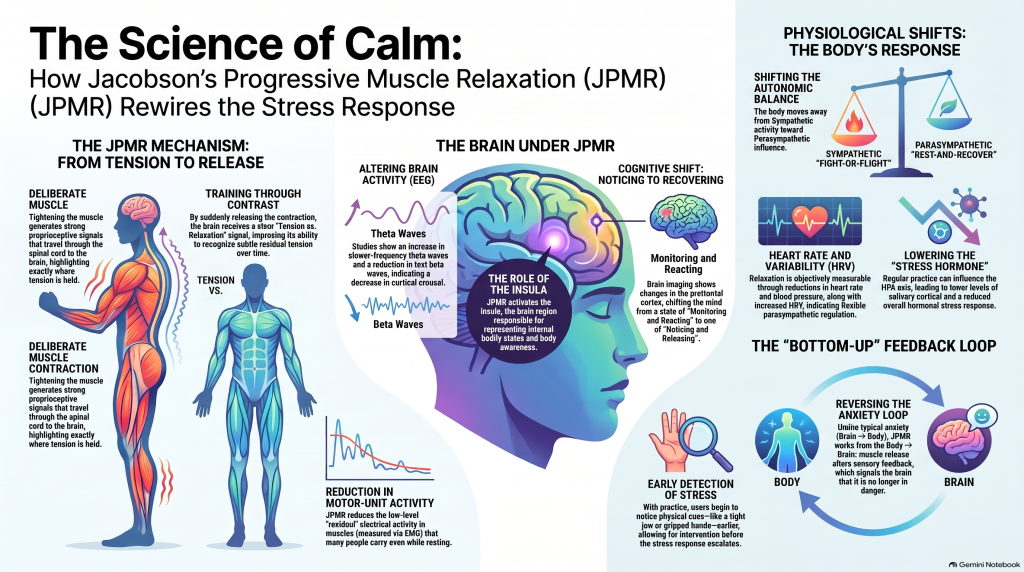 Jacobson’s Progressive Muscle Relaxation works through an important principle:
The brain influences the body—but the body can also influence the brain.
During stress, the brain prepares us for action. Muscles tighten, heart rate increases, breathing changes and the sympathetic nervous system becomes more active.
JPMR deliberately moves this system in the opposite direction.
The sequence can be understood as:
Muscle tension → awareness of tension → muscle release → reduced motor activity → altered sensory feedback to the brain → reduced autonomic arousal → quieter stress response
1. JPMR Reduces Actual Muscle Activity
Muscle contraction occurs when motor neurons activate muscle fibres, producing electrical activity that can be measured using electromyography (EMG).
Many people continue to carry low levels of muscular tension even when they believe they are resting.
Progressive relaxation training helps reduce this residual muscle activity.
The first physiological step is therefore:
↓ Motor-unit activity → ↓ Muscle tension
2. Why Do We Tense the Muscle Before Relaxing It?
Why not simply tell someone:
“Relax your muscles”?
Because many of us do not realise how much tension we are carrying.
When a muscle is deliberately tightened, receptors in muscles and tendons generate strong proprioceptive signals that travel through peripheral nerves and the spinal cord to the brain.
When the muscle is suddenly released, that sensory input changes.
The nervous system gets a clear contrast:
“This is tension.” → “This is relaxation.”
With repeated practice, the brain becomes better at recognising subtle tension much earlier.
The contraction is therefore not simply meant to tire the muscle.
It helps train the brain to recognise and release muscular tension.
3. The Autonomic Nervous System Begins to Shift
Stress is associated with activation of the sympathetic nervous system—the system that prepares the body for action.
Relaxation is associated with a relative increase in parasympathetic regulation.
During progressive muscle relaxation, studies have demonstrated changes in measures such as:
- heart rate
- blood pressure
- heart-rate variability
- electrodermal activity
- respiratory patterns
A simplified way to understand this is:
Sympathetic “fight-or-flight” activity ↓
Parasympathetic “rest-and-recover” influence ↑
It is more accurate to think of this as a shift in autonomic balance rather than the sympathetic nervous system simply being “switched off.”
4. The Heart Reflects This Change
Autonomic regulation of the heart provides one of the easiest ways to measure relaxation physiologically.
Studies of progressive muscle relaxation have demonstrated:
- reductions in heart rate
- reductions in blood pressure in some populations
- changes in heart-rate variability (HRV)
HRV reflects variation in the interval between consecutive heartbeats.
Changes in vagally mediated HRV can indicate greater flexibility of parasympathetic regulation.
This means that relaxation does not necessarily exist only as:
“I feel calmer.”
Part of the response can sometimes be measured objectively.
5. JPMR Can Influence the Stress-Hormone System
Another important biological stress system is the:
Hypothalamic–Pituitary–Adrenal, or HPA, axis
During stress:
Hypothalamus → Pituitary gland → Adrenal gland → Cortisol
Cortisol is an important adaptive hormone. It helps mobilise energy and prepares the body to respond to challenge.
But persistent stress can maintain repeated activation of this system.
Research on progressive muscle relaxation has demonstrated reductions in salivary cortisol and, in some studies, lower overall cortisol secretion following regular relaxation practice.
So JPMR can potentially influence both:
How stressed we feel
and
How strongly the body expresses the stress response.
6. What Happens Inside the Brain?
The effects of JPMR are not confined to muscles.
Brain-imaging studies have demonstrated changes in regions involved in:
- attention
- body awareness
- motor regulation
- emotional processing
- self-monitoring
Regions showing changes during progressive muscle relaxation have included areas of the:
- prefrontal cortex
- anterior and posterior cingulate cortex
- insula
- somatosensory cortex
- putamen
The insula is particularly interesting because it helps the brain represent internal bodily states.
The somatosensory cortex processes information coming from muscles and the body.
Frontal and cingulate regions participate in attention, monitoring and emotional regulation.
In simple terms, JPMR may help shift the brain away from:
Monitoring → Preparing → Reacting
towards:
Noticing → Releasing → Recovering
7. EEG Studies Also Suggest Changes in Cortical Arousal
Electroencephalography, or EEG, provides another way of studying relaxation.
Some studies of progressive muscle relaxation have demonstrated:
- increases in slower-frequency activity such as theta
- reductions in faster beta activity in certain regions
These findings are broadly compatible with a reduction in cortical arousal.
However, there is no single universal “JPMR EEG signature.”
Brain-wave patterns vary depending on:
- the individual
- the relaxation technique
- whether the person is resting or actively following instructions
- anxiety levels
- medications
- sleepiness
- recording conditions
Therefore EEG findings are better viewed as supporting evidence that relaxation can alter brain state rather than as a diagnostic test for whether somebody is “properly relaxed.”
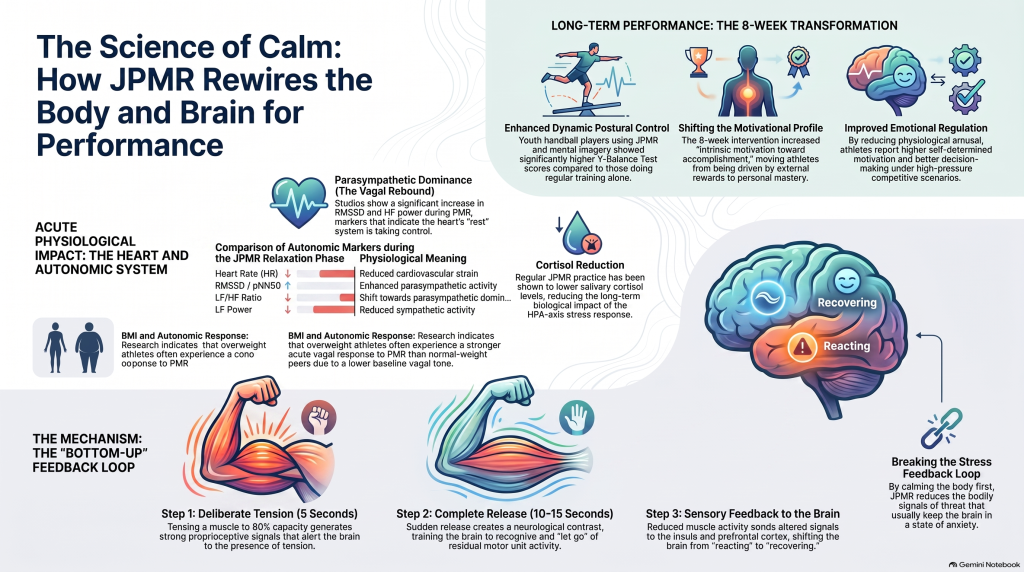
JPMR Is Essentially Bottom-Up Regulation
We usually imagine anxiety as:
Brain → Body
Threat or worry → autonomic activation → muscle tension
JPMR deliberately uses the opposite direction:
Body → Brain
Muscle release → altered sensory feedback → reduced physiological arousal → calmer brain state
This can produce a useful feedback loop:
Muscle relaxation
↓
Reduced somatic arousal
↓
Reduced autonomic activation
↓
Fewer bodily signals of threat
↓
The brain perceives less physiological danger
↓
Further relaxation becomes easier
JPMR Also Trains Body Awareness
One of the most valuable effects of regular practice may happen outside the formal relaxation session.
People gradually begin noticing:
“My jaw is tight.”
“My shoulders have gone up.”
“I am gripping my hands.”
“My abdomen is tense.”
Previously these physical signs may have gone unnoticed until anxiety became severe.
With practice, they are recognised earlier.
That creates an opportunity to regulate the stress response before it escalates.
So JPMR is not merely a way of relaxing for 15 minutes.
It is training in recognising and regulating physiological arousal.
The Neurophysiology in One Simple Sequence
STRESS
Threat perception
↓
Sympathetic activation
↓
Motor-neuron activation
↓
Muscular tension
↓
Increased bodily signals of stress
↓
Brain continues to perceive arousal
JPMR
Deliberate muscle contraction
↓
Strong awareness of tension
↓
Complete release
↓
Reduced muscle activity
↓
Changed proprioceptive and interoceptive feedback
↓
Reduced autonomic arousal
↓
Greater parasympathetic influence
↓
Changes in heart rate / HRV / cortisol
↓
Reduced cortical arousal
↓
Greater subjective calm
The Simplest Way to Understand JPMR
Relaxation is not purely psychological.
It is also a physiological state that can be trained.
By repeatedly moving muscles from contraction to release, JPMR teaches the nervous system to recognise the difference between tension and relaxation.
Over time, the goal is not simply to become good at performing a relaxation exercise.
The more useful skill is becoming able to recognise:
“My nervous system is becoming activated.”
and then knowing:
“I can do something about it.”
Guided JPMR Practice
Understanding the mechanism is useful—but JPMR works through practice rather than theory alone.
You can follow this guided JPMR session:
https://www.youtube.com/watch?v=ihO02wUzgkc
Regular practice is generally more useful than waiting until anxiety has already become overwhelming.
A Note From Dr. Srinivas Rajkumar T
In psychiatric practice, I find it useful to help patients understand that symptoms such as anxiety, restlessness, poor sleep and difficulty “switching off” are not simply matters of willpower.
They involve measurable interactions between the brain, autonomic nervous system, muscles, sleep, cognition and stress-response systems.
Techniques such as JPMR can therefore become useful components of a broader, evidence-based treatment plan.
My approach focuses on understanding the individual patient’s symptom pattern, cognitive profile, physiological arousal and underlying psychiatric condition, and then combining appropriate psychological strategies, medication and technology-assisted assessment or treatment where clinically useful.
For consultations and comprehensive assessment:
Dr. Srinivas Rajkumar T
Senior Consultant Psychiatrist, Apollo Hospitals
Assistant Professor of Psychiatry, SBMCH, Chennai
ATTN Clinic — Attention. Understood.
ATTN Clinic currently functions from Apollo Clinic, opposite Phoenix Market City, Velachery, Chennai.
Appointments: +91 85951 55808
Website: srinivasaiims.com
Medical disclaimer: This article and the accompanying JPMR exercise are intended for education and relaxation training. They are not a substitute for individual psychiatric or medical assessment and treatment.