Why Does Methylphenidate Wear Off So Quickly? Understanding Duration, Rebound and the Crash
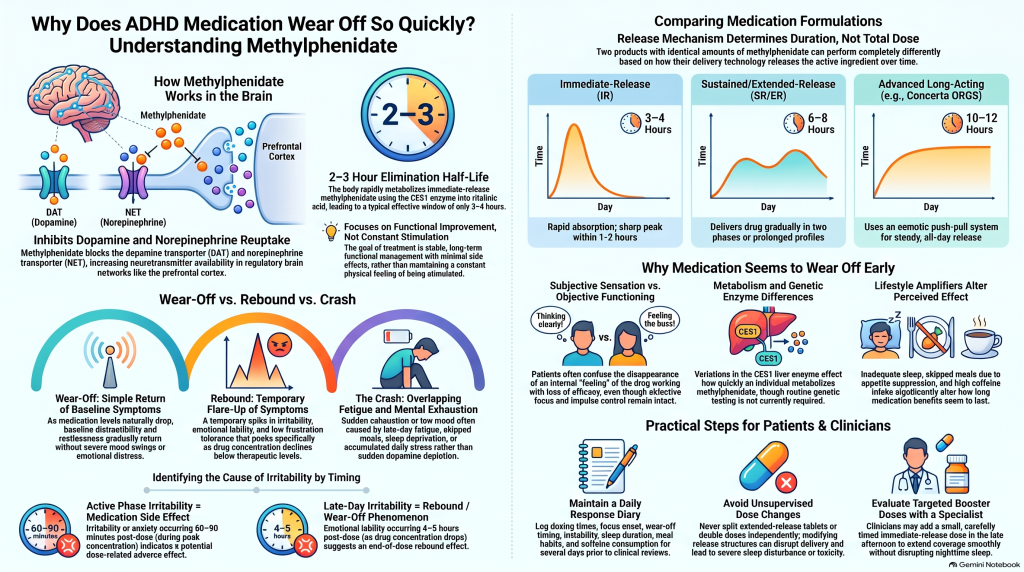 Why your ADHD medication may work beautifully for a few hours—and then seem to disappear.
By Dr. T. Srinivas Rajkumar, MD (Psychiatry), AIIMS New Delhi
Imagine taking your ADHD medication in the morning.
Within an hour, something changes. Your thoughts become quieter. You can concentrate, organise your activities, and finally begin tasks that previously seemed impossible.
For the next two or three hours, everything feels more manageable.
Then, quite unexpectedly, the effect seems to disappear.
Your mind becomes noisy again. You feel restless, distracted, irritable, or unusually tired. Sometimes, you feel worse than you did before taking the medication.
Naturally, several questions arise:
Why did my medication stop working so quickly? Is the dose too low? Is my body metabolising it unusually fast? Am I developing tolerance?
These are common concerns among people taking methylphenidate for Attention-Deficit/Hyperactivity Disorder (ADHD).
The explanation lies in understanding how methylphenidate enters the bloodstream, how it acts on the brain, how different formulations release the drug, and what happens as its effects decline.
Importantly, wearing off, rebound, and medication-related adverse effects are not the same phenomenon.
1. How Does Methylphenidate Work in the Brain?
Methylphenidate is a central nervous system stimulant commonly prescribed for ADHD.
It primarily acts by blocking two neurotransmitter transporters:
- Dopamine transporter (DAT): Reduces the reuptake of dopamine into nerve terminals.
- Norepinephrine transporter (NET): Reduces the reuptake of norepinephrine (noradrenaline).
By inhibiting these transporters, methylphenidate increases the availability of these neurotransmitters in relevant brain circuits.
Dopamine and norepinephrine are involved in attention regulation, working memory, behavioural inhibition, motivation, and other executive functions.
The prefrontal cortex and its connections with deeper brain structures play important roles in these processes.
In individuals with ADHD, appropriately prescribed methylphenidate can improve the efficiency of these regulatory networks.
This may translate into improved task initiation, reduced impulsivity, better sustained attention, and greater emotional self-regulation.
However, methylphenidate does not permanently increase dopamine or norepinephrine levels.
Its effects depend on how much active medication is available over time, how it reaches the brain, and how the individual responds to it.
This is where pharmacokinetics becomes important.
2. Why Does Immediate-Release Methylphenidate Last Only 3–4 Hours?
Methylphenidate is a relatively short-acting molecule.
After taking an immediate-release (IR) tablet, the drug is absorbed through the gastrointestinal tract and enters the bloodstream.
Clinical effects commonly begin within approximately 30–60 minutes, although onset varies.
Blood concentrations usually peak around 1–2 hours after administration.
The medication is then progressively metabolised, predominantly through an enzyme called carboxylesterase 1 (CES1), which converts methylphenidate into the largely inactive metabolite ritalinic acid.
The elimination half-life of immediate-release methylphenidate is approximately 2–3 hours.
A half-life describes the time required for the concentration of a drug in the body to fall by half. It does not mean the entire drug has disappeared.
As concentrations decline, they may eventually fall below the level needed to produce a clinically meaningful benefit.
For many people, this means the useful effect of an immediate-release tablet lasts around 3–4 hours.
Therefore, experiencing a clear therapeutic effect for approximately three hours after taking immediate-release methylphenidate is not necessarily abnormal.
It may simply reflect the expected pharmacological profile of the formulation.
3. Why Doesn’t Sustained-Release Methylphenidate Always Last All Day?
This is where misunderstandings frequently occur.
A sustained-release tablet contains methylphenidate, but it is designed to release the medication gradually rather than delivering the entire dose immediately.
Different formulations achieve this through different technologies.
Some preparations release medication in two phases. Others use specialised delivery systems to provide a more prolonged release profile.
Consequently, two tablets containing the same total quantity of methylphenidate can produce substantially different patterns of blood concentration and symptom control.
Understanding the different formulations
| Formulation | Approximate clinical duration |
|---|---|
| Immediate-release methylphenidate (IR) | 3–4 hours |
| Some sustained/extended-release formulations | 6–8 hours |
| Certain longer-acting formulations, including Concerta’s OROS system | Around 10–12 hours |
These are approximate durations reported for particular formulation types, not guarantees. Individual response and the exact product matter. Products labelled SR or ER are not necessarily equivalent.
For example, Concerta uses an osmotic-controlled release oral delivery system (OROS).
A proportion of the medication is released initially, followed by controlled delivery from the tablet core over several hours.
This creates a different concentration-time profile from immediate-release methylphenidate.
Other sustained-release preparations use different release mechanisms and may provide shorter coverage.
The important clinical principle is that the name or total dose of a medication cannot, by itself, predict how long it will work for an individual.
This is particularly relevant in India, where patients may encounter different methylphenidate products, including Inspiral, Addwize and Concerta, subject to local availability.
Formulations should not be substituted or treated as dose-equivalent without professional review.
4. The Difference Between Wearing Off, Rebound and the Crash
Patients often use the word crash to describe any unpleasant experience after ADHD medication begins to fade.
Clinically, however, distinguishing three different patterns is useful.
A. Wearing Off: The Return of Baseline ADHD Symptoms
Imagine your concentration improves significantly after taking medication.
Four hours later, your distractibility gradually returns. Tasks become harder, your thoughts become more scattered, and you start procrastinating again.
However, you are not significantly more irritable, distressed, or emotionally unstable than usual.
This may represent ordinary wearing off.
The therapeutic effect has declined, and the underlying ADHD symptoms have returned.
Wearing off is not automatically a side effect. It often reflects the end of the medication’s effective period.
B. Rebound: A Temporary Intensification of Symptoms
Rebound is different.
Some individuals experience a noticeable deterioration in behaviour or emotional regulation as stimulant effects decline.
For example, an individual who was calm and focused during the morning may become disproportionately irritable, restless, impatient, or emotionally reactive later in the day.
Symptoms may temporarily appear more intense than their usual unmedicated baseline.
This is commonly called stimulant rebound.
Reported manifestations include irritability, emotional lability, agitation, restlessness, distractibility and low frustration tolerance.
Rebound has been documented in clinical studies, particularly among children receiving short-acting stimulants. However, its frequency and severity should not be automatically generalised to all adults taking methylphenidate.
The timing of symptoms offers an important clinical clue.
Rebound typically occurs as medication effects are declining—not when blood concentrations are at their highest.
C. The Crash: Fatigue, Low Mood and Mental Exhaustion
The term methylphenidate crash is less precisely defined medically.
Patients may use it to describe sudden fatigue, sleepiness, mental fog, low motivation, headaches, irritability, or a feeling of emotional emptiness.
These experiences may overlap with rebound, but they may also reflect other factors.
For example, somebody who has spent several intensely productive hours without eating adequately may experience exhaustion when the medication wears off.
Similarly, sleep deprivation, anxiety, excessive caffeine intake, and prolonged mental demands can contribute to feeling unwell later in the day.
A crash should therefore not automatically be interpreted as evidence of a sudden dopamine deficiency.
There is insufficient evidence to conclude that an ordinary end-of-dose crash is caused by the brain becoming depleted of dopamine.
That popular explanation oversimplifies a complex pharmacological and behavioural phenomenon.
5. Why Does Methylphenidate Wear Off Earlier in Some People?
Several factors can influence the duration of perceived benefit.
1. Individual Differences in Drug Metabolism
Methylphenidate is predominantly metabolised by CES1.
Differences in enzyme activity, including genetic variation, can affect methylphenidate exposure.
However, these variations do not explain every case of apparently short medication duration.
Routine genetic testing is not currently a standard requirement for adjusting methylphenidate treatment.
2. The Release Profile of the Medication
The formulation itself may be more important than the total dose.
Some preparations provide a relatively pronounced early effect, followed by a decline.
Others distribute medication release more gradually across the day.
An individual may therefore respond differently to two products containing the same active ingredient.
3. Dose May Be Inadequate for Sustained Symptom Control
A dose may initially improve attention but fail to maintain adequate symptom control across the intended period.
However, a short duration of benefit does not automatically mean the dose should be increased.
A higher dose may improve symptoms in some individuals while increasing anxiety, irritability, palpitations, appetite suppression, or sleep problems in others.
The goal is not to achieve the strongest possible stimulant effect.
The goal is the lowest appropriate dose and formulation that provides meaningful functional benefit with tolerable adverse effects.
4. The Difference Between Feeling the Medication and Benefiting From It
This is an important but frequently overlooked distinction.
Some individuals experience an obvious subjective change when methylphenidate begins acting.
They describe feeling unusually calm, mentally clear, energised, or motivated.
After several hours, that striking sensation becomes less noticeable.
They may conclude that the medication has stopped working.
However, objective functioning may still be improved.
The person may continue completing tasks, listening more effectively, or controlling impulsive behaviour even when the initial feeling has faded.
The disappearance of a noticeable internal sensation does not necessarily mean the therapeutic effect has ended.
For this reason, medication response should be assessed through real-world functioning, not merely how strongly the medication is felt.
5. Sleep, Nutrition, Caffeine and Other Factors
Sleep deprivation can produce substantial difficulties with attention, working memory, emotional regulation and reaction time.
Poor sleep may therefore make methylphenidate appear less effective.
Appetite suppression can also contribute indirectly to late-day discomfort if patients routinely skip meals.
Excessive caffeine may increase jitteriness, anxiety, palpitations or sleep disturbance.
Coexisting anxiety, depression, substance use, chronic stress and other conditions can further complicate assessment.
Importantly, these factors do not necessarily make methylphenidate leave the bloodstream more quickly.
They may instead alter how the patient experiences the medication or how effectively they can function despite treatment.
6. Rebound or Medication-Induced Irritability? Timing Makes the Difference
Not every episode of irritability during methylphenidate treatment is rebound.
Consider two different situations.
Situation A:
A patient takes methylphenidate at 9 AM.
By 10:30 AM, they experience increased anxiety, restlessness and irritability.
These symptoms occur while the medication is becoming more active.
This pattern may suggest stimulant-related adverse effects during the active phase, rather than rebound.
Situation B:
Another patient takes methylphenidate at 9 AM.
They remain calm and productive during the morning.
At around 1 PM, as their medication effect declines, they experience sudden irritability, emotional sensitivity and poor frustration tolerance.
This timing is more consistent with a possible wear-off or rebound phenomenon.
The distinction matters because the treatment approach may be different.
Increasing medication exposure in someone experiencing dose-related irritability could potentially worsen the problem.
A careful clinical assessment should identify when symptoms begin, when they peak, and how they relate to each dose.
7. Does Wearing Off Mean You Are Developing Tolerance?
Not necessarily.
Pharmacological tolerance refers to a reduction in drug response following repeated exposure.
Some patients report that methylphenidate becomes less effective over time, but establishing true tolerance requires careful assessment.
Several alternative explanations should be considered.
The person may have become accustomed to the initial subjective sensation. Their work or academic demands may have increased. Sleep quality may have deteriorated. Their medication formulation may have changed, or previously unrecognised symptoms of depression or anxiety may have emerged.
A predictable decline in benefit three or four hours after every immediate-release dose is more likely to reflect the medication’s expected duration than newly developed tolerance.
Similarly, rebound symptoms are not, by themselves, evidence of addiction or dependence.
Dependence, problematic use, misuse and addiction are distinct clinical concepts requiring separate assessment.
8. What Can Be Done When Methylphenidate Wears Off Too Early?
The first step is not necessarily increasing the dose.
A specialist should review the pattern of symptoms, the formulation used, timing of administration, functional demands and adverse effects.
Possible approaches include adjusting the medication schedule, selecting a preparation with a different release profile, or evaluating whether the existing dose is appropriate.
In selected patients, a clinician may prescribe a carefully timed immediate-release dose to extend coverage after a longer-acting formulation.
This is sometimes called a booster dose.
It is not appropriate for every patient and may increase the risk of insomnia, appetite suppression or other adverse effects.
In other cases, reducing a dose, changing the formulation, or reconsidering the treatment plan may be more suitable.
Patients should not add doses, split sustained-release tablets, or modify their medication schedule independently.
Some specialised extended-release tablets must be swallowed whole because altering their structure can disrupt the release mechanism.
Treatment should also address sleep, nutrition, physical activity, coexisting mental health conditions and the patient’s daily schedule.
Medication optimisation is fundamentally an individualised process.
9. A Practical Way to Understand Your Medication Response
One of the simplest ways to improve a medication review is to maintain a brief response diary for several days.
Record the time medication was taken, when the first meaningful benefit appeared, when concentration was best, when difficulties returned, and whether any unpleasant symptoms occurred.
Also note sleep duration, meals, caffeine consumption and daily activities.
For example:
| Time | Observation |
|---|---|
| 9:00 AM | Medication taken |
| 9:45 AM | Easier to begin work |
| 10:30 AM | Better focus, reduced distractibility |
| 12:00 PM | Still productive |
| 1:00 PM | Concentration declining |
| 1:30 PM | Restlessness and irritability |
| 3:00 PM | Returning to usual baseline |
This is an illustrative example, not a standard response curve.
Such a diary can reveal whether symptoms occur during the initial medication peak, during the expected wearing-off period, or independently of medication timing.
The distinction helps guide a more precise clinical discussion.
It is also useful to document actual outcomes: whether tasks were completed, appointments remembered, interruptions reduced, or emotional responses managed more effectively.
These observations are often more informative than repeatedly asking whether a person can still feel the medication.
10. When Should You Seek Medical Review?
A routine review is appropriate when the medication repeatedly wears off earlier than expected, symptoms interfere with work or relationships, or significant rebound affects daily functioning.
Persistent insomnia, marked appetite suppression, anxiety, low mood, or troublesome cardiovascular symptoms also require assessment.
Chest pain, fainting, severe palpitations accompanied by dizziness or breathlessness, or new severe psychiatric symptoms warrant urgent medical attention.
Severe depression, suicidal thoughts, mania, or psychotic symptoms require prompt professional assessment rather than being dismissed as a medication crash.
Methylphenidate treatment should include appropriate monitoring of blood pressure, pulse, weight, sleep, adverse effects and clinical response.
Frequently Asked Questions
Is it normal for methylphenidate to last only three hours?
For immediate-release methylphenidate, approximately three to four hours of benefit can fall within the expected range.
If a sustained-release product consistently provides only three hours of useful benefit, the formulation and response should be reviewed.
Can ADHD medication work for only two hours?
Some patients report a short period of noticeable benefit. This may reflect individual response, inadequate symptom coverage, an early medication peak, or confusion between subjective sensations and actual functional benefit.
The pattern deserves assessment rather than an automatic increase in dose.
Why do I feel sleepy when methylphenidate wears off?
Fatigue may become noticeable when stimulant effects decline. Sleep deprivation, inadequate food intake, accumulated mental demands and other medical or psychological factors may contribute.
Persistent or severe sleepiness warrants evaluation.
Does rebound mean methylphenidate is unsuitable for me?
Not necessarily. Some patients experience rebound despite obtaining significant benefit during the active period.
Adjustments to the formulation or treatment schedule may help, but other causes of irritability and fatigue must first be considered.
Should I take another tablet when the first one wears off?
Only according to an agreed prescription.
Additional doses can increase adverse effects and interfere with sleep. Decisions about supplementary doses should be made with the treating clinician.
Can exercise help with an ADHD medication crash?
Regular exercise can support sleep, mood and overall health, and may help with some ADHD symptoms. A walk or light physical activity may also be a useful transition after mentally demanding work.
However, exercise does not replace appropriate medication assessment, and evidence that it specifically prevents methylphenidate rebound is limited.
The Bigger Picture: ADHD Treatment Is About Functional Improvement, Not Constant Stimulation
One of the most important goals of ADHD treatment is helping individuals achieve sustained improvements in everyday functioning.
Being able to study, work, organise responsibilities, regulate emotions, maintain relationships and complete meaningful activities matters more than experiencing a continuous feeling of heightened concentration.
A medication that produces a dramatic initial effect but leaves someone struggling later in the day may require adjustment.
Equally, a medication that feels subtle but consistently improves functioning may be providing substantial therapeutic benefit.
Successful ADHD treatment is not about making the brain feel stimulated throughout the day. It is about helping the individual function better, more consistently, and with fewer adverse effects.
Understanding the relationship between medication pharmacokinetics, subjective experience and real-world outcomes is central to achieving this balance.
About the Author
Dr. T. Srinivas Rajkumar, MBBS, MD (Psychiatry), DNB (Psychiatry)
Dr. Srinivas Rajkumar completed his MBBS at Madurai Medical College and MD in Psychiatry at AIIMS, New Delhi.
He is a Consultant Psychiatrist practising in Chennai, with a special interest in Adult ADHD, neuropsychiatry, psychopharmacology, and technology-assisted psychiatric assessment.
His approach emphasises comprehensive clinical evaluation, individualised treatment, and measurement-based follow-up.
At Attention Clinic – 360° ADHD Care in Chennai, the focus is on understanding attention difficulties in their broader clinical context, integrating specialist psychiatric assessment, validated rating scales, appropriate cognitive and performance-based assessments, and personalised treatment planning. Technologies such as CPT and qEEG may be considered as adjuncts when clinically relevant, rather than as standalone diagnostic tests.
Patients experiencing inconsistent ADHD medication response, troublesome adverse effects, or difficulties with sustained attention can benefit from a structured specialist review.
Medical disclaimer: This article is intended for educational purposes and does not replace individual medical advice. Methylphenidate is a prescription medicine requiring appropriate assessment, monitoring and supervision. Do not change your medication dose or schedule without consulting your prescribing clinician.