What qEEG and EEG Tell Us About the OCD Brain
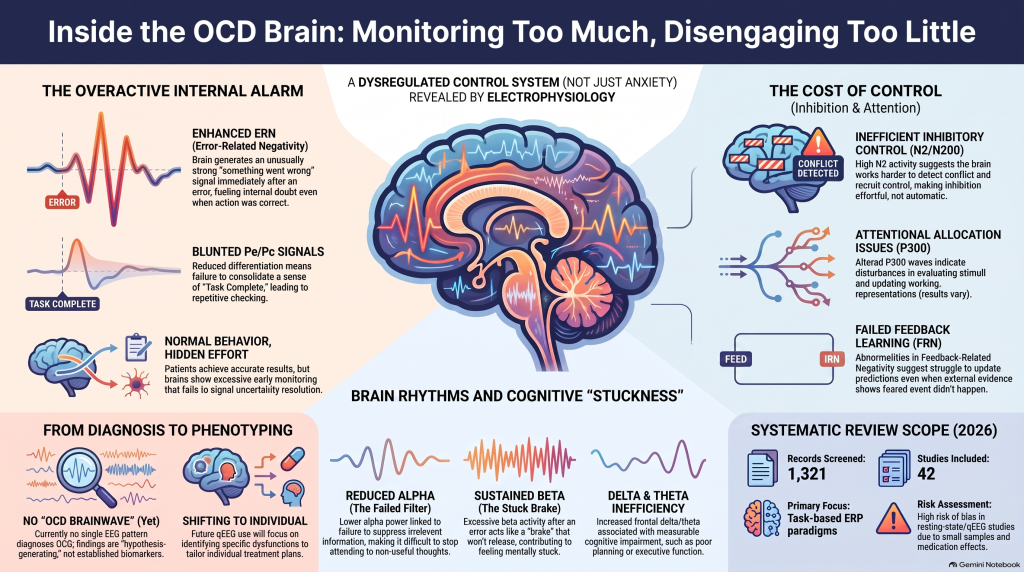 Obsessive–compulsive disorder (OCD) is commonly understood through its characteristic symptoms: intrusive thoughts, persistent doubt, repetitive checking, washing, reassurance seeking and mental rituals.
But why does the brain continue to signal that something is wrong even after a person knows that an action has been completed?
A major 2026 systematic review of EEG, event-related potentials (ERP) and quantitative EEG (qEEG) research offers an interesting perspective. Rather than suggesting that people with OCD simply have “poor cognition,” the evidence points toward a more specific problem:
the brain systems responsible for monitoring, inhibition, attention and cognitive flexibility may be working in an unusually intense or inefficient way.
The review screened 1,321 records and included 42 studies examining electrophysiological measures in OCD. Most investigated task-related ERPs, while a smaller number examined resting-state EEG and qEEG.
OCD may be a disorder of excessive monitoring
One of the most consistent EEG findings in OCD involves error-related negativity, or ERN.
ERN is a rapid electrical response generated shortly after the brain detects that a person has made an error.
In many studies, people with OCD show an increased ERN response.
In simple terms, their brain may produce a stronger-than-usual:
“Something went wrong.”
signal.
Interestingly, this increased error-monitoring response may occur even when the person performs the task correctly overall. The 2026 review found that enhanced early error detection is one of the more consistent electrophysiological findings in OCD, although it does not necessarily correspond to worse behavioural performance.
This fits remarkably well with the clinical experience of OCD.
A person may check whether a door is locked.
They see that it is locked.
They remember locking it.
Yet the internal feeling of certainty does not arrive.
The problem may therefore not simply be remembering whether the door was locked.
It may partly involve an excessively sensitive internal monitoring system that continues asking:
“But are you completely sure?”
Why doesn’t the brain say, “Done”?
Another group of EEG signals may be even more interesting clinically.
Components called Pe and Pc occur later in the processing of errors and correct responses. They appear to contribute to how the brain evaluates whether an action was right or wrong.
The review suggests that some patients with OCD may show abnormalities in this later stage of response evaluation.
This raises an intriguing possibility.
A person may actually perform an action correctly but may not generate a sufficiently clear internal signal saying:
“Yes. That was correct. The task is complete.”
The authors note that abnormalities in later error evaluation could potentially contribute to persistent doubt and difficulty experiencing a sense of completion.
This provides a useful neurobiological way of thinking about repetitive checking.
The person may not be checking because they completely forgot what happened.
They may be checking because the brain does not generate enough internal certainty to terminate the behaviour.
Inhibition in OCD may be inefficient rather than simply weak
OCD is frequently described as a disorder involving poor inhibition.
But EEG studies suggest that the situation is more complicated.
One important EEG component is N2 or N200, which appears approximately 200–350 milliseconds after a stimulus and is associated with processes such as conflict detection and the recruitment of cognitive control.
Different experiments have produced apparently different N2 findings.
During some Go/NoGo tasks, OCD patients show reduced N2 activity.
During stop-signal tasks, however, they may show an increased Stop-N2.
This does not necessarily mean that one study is wrong.
The tasks measure different forms of inhibition.
A Go/NoGo task requires someone to prevent a response from starting.
A stop-signal task requires someone to cancel a response that has already begun.
The review suggests that increased N2 activity during stopping may represent greater conflict or compensatory effort rather than better inhibition.
In other words, the OCD brain may sometimes generate more control activity to achieve the same behavioural result.
That could help explain why people with OCD often describe even apparently simple decisions as mentally exhausting.
P300: attention and updating information
Another frequently studied EEG signal is the P300.
P300 is involved in several cognitive functions, including:
- attention allocation,
- identifying relevant information,
- stimulus evaluation,
- working-memory updating,
- and aspects of executive control.
Several studies have reported P300 abnormalities in OCD.
Some have found reduced P300 responses associated with poorer executive performance, while others have found electrophysiological differences even when behavioural performance was relatively preserved.
The overall evidence therefore suggests abnormalities in attention, inhibitory control and information updating, but there is no single P300 pattern that appears in every patient with OCD.
This is an important point.
OCD is unlikely to have one universal electrical signature.
Different patients may have different cognitive and electrophysiological profiles.
What does qEEG show in OCD?
ERP studies examine the brain’s response to specific events occurring during a task.
Quantitative EEG (qEEG) instead analyses broader patterns of electrical activity, including the relative amount and distribution of frequencies such as:
- delta,
- theta,
- alpha,
- and beta.
These frequency bands cannot simply be labelled “good” or “bad.” Their significance depends on where they occur, when they occur and what the brain is doing at that moment.
Nevertheless, several interesting patterns have emerged.
Delta and theta: possible inefficient frontal regulation
One resting EEG study found increased delta and theta activity, particularly involving frontal and frontolimbic regions.
The most interesting observation was that these abnormalities were not present equally across all patients with OCD.
Patients with relatively preserved cognitive performance were similar to healthy controls.
However, OCD patients with poorer performance on executive tests showed significantly increased delta and theta source activity.
This suggests that the EEG abnormality may have been associated more closely with cognitive dysfunction within OCD than with OCD diagnosis itself.
This may represent an important future direction for qEEG.
Instead of asking:
“Does this EEG prove that someone has OCD?”
a more useful question may eventually become:
“What type of cognitive dysfunction does this particular patient with OCD have?”
Alpha: filtering irrelevant information
Alpha activity is often misunderstood as simply representing an inactive brain.
In reality, alpha oscillations play an important role in controlling attention and suppressing information that is irrelevant to the current task.
One qEEG study found reduced alpha activity in OCD, particularly within slower alpha frequencies.
Importantly, reduced alpha activity was associated with slower performance on an executive task requiring self-organisation, monitoring and response selection.
Higher beta activity was also associated with slower executive performance.
Another study found markedly reduced prestimulus alpha and theta activity when patients with OCD performed a selective-attention task.
The researchers interpreted reduced prestimulus alpha as potentially representing poorer top-down suppression of irrelevant information.
EEG abnormalities were also related to perseverative responses on the Wisconsin Card Sorting Test, a classic test of cognitive flexibility.
This gives us another way to conceptualise OCD.
The difficulty may not always be:
“I cannot pay attention.”
It may sometimes be:
“My brain cannot efficiently stop processing information that is no longer relevant.”
Beta: applying the brake and failing to release it
Beta activity is involved in motor control, maintaining cognitive states and aspects of behavioural inhibition.
One study found that greater error-related beta activity was associated with slower responses after mistakes.
A useful analogy is a car brake.
The OCD brain may apply the brake strongly after detecting something potentially wrong.
The difficulty may be releasing the brake and moving on.
That could contribute to:
- prolonged hesitation,
- excessive checking,
- repeated mental review,
- and difficulty disengaging after perceived mistakes.
Feedback learning may also be altered
Another electrophysiological component called feedback-related negativity (FRN) helps researchers study how the brain responds to external feedback.
Some studies suggest that feedback learning may be abnormal in OCD.
Patients may have difficulty adapting efficiently after receiving positive or negative feedback, particularly during reversal-learning tasks where previously correct information suddenly becomes incorrect.
This has an interesting connection with clinical OCD.
A patient may repeatedly receive evidence that:
“Nothing bad happened.”
The door remained locked.
The feared contamination did not cause catastrophe.
The intrusive thought did not translate into action.
Yet the brain may continue demanding additional checking or reassurance.
The EEG evidence does not prove that abnormal feedback processing directly causes compulsions, but it suggests that learning from corrective information may form part of the broader cognitive-control disturbance in OCD.
A brain that monitors too much and disengages too little
When these findings are combined, an interesting model emerges.
OCD may involve an imbalance between three processes.
Excessive monitoring
Errors, uncertainty, conflict and potential threat may generate disproportionately strong internal signals.
Inefficient inhibition
Considerable neural effort may be required to suppress thoughts or stop behaviour.
Reduced cognitive flexibility
Once a thought, rule or response becomes activated, the brain may have difficulty disengaging from it and switching to something else.
The review concludes that this combination may allow patients to perform normally on simple tasks while relying on increased effort and over-monitoring.
When cognitive demands increase, the system becomes less efficient, potentially contributing to slower executive processing, perseveration and persistent doubt.
This may help explain one of the most important features of OCD:
The person often knows that the fear is excessive — but knowing is not enough to switch the internal alarm off.
Can qEEG diagnose OCD?
At present, no.
There is no established qEEG pattern that can independently diagnose obsessive–compulsive disorder.
In fact, the systematic review is appropriately cautious about the available evidence.
Only a relatively small number of resting-state and qEEG studies were available, and all five were judged to have serious overall risk of bias.
Problems included:
- small samples,
- medication effects,
- psychiatric comorbidities,
- participant-selection issues,
- multiple EEG comparisons,
- and substantial differences in EEG methodology.
The authors therefore emphasise that current qEEG findings should be considered hypothesis-generating rather than validated reproducible biomarkers.
This distinction is critical.
qEEG should not currently be used to tell someone:
“Your brain scan proves that you have OCD.”
OCD remains a clinical diagnosis.
Where EEG and qEEG may eventually become useful
The more exciting possibility is not simply diagnosing OCD from a brainwave pattern.
The future may lie in electrophysiological phenotyping.
Two people can satisfy the diagnostic criteria for OCD while having very different underlying cognitive difficulties.
One patient may have severe error hypermonitoring.
Another may have prominent attentional inflexibility.
Another may have problems with inhibitory control or feedback learning.
Future EEG research may therefore help answer more personalised questions:
Which cognitive-control mechanism is most abnormal in this individual?
And eventually:
Does that pattern change following treatment?
This could become relevant to medication, exposure and response prevention, cognitive interventions and neuromodulation research.
But that clinical translation still requires considerably better evidence.
The bigger picture
The 2026 systematic review does not identify a single electrical signature for OCD.
Instead, abnormalities occur across multiple stages of information processing — including sensory gating, attention, inhibition, conflict monitoring, error processing, feedback learning and cognitive flexibility.
The strongest overall interpretation is therefore that OCD may represent, at least partly, a dysregulated cognitive-control system.
The brain may:
detect errors too strongly,
filter irrelevant information inefficiently,
require excessive effort to inhibit responses,
learn from feedback differently,
and struggle to generate the internal sense that a task is finally complete.
That gives us a far more nuanced understanding of OCD than simply describing it as “repetitive thoughts and behaviours.”
For now, EEG and qEEG are best viewed as complementary tools for understanding brain function and investigating mechanisms — not standalone diagnostic tests for OCD. The review itself calls for larger samples, standardised EEG methods and longitudinal brain–behaviour studies before these findings can be reliably translated into individual clinical decisions.
Reference
Chmiel J, Kładna A. Electrophysiological Correlates of Cognitive Dysfunction in Obsessive–Compulsive Disorder (OCD): A Systematic and Mechanistic Review of EEG, ERP, and QEEG Evidence. Journal of Clinical Medicine. 2026;15:5994.