Gottman vs Esther Perel: Two Powerful Ways to Understand Modern Relationships
 Why do some marriages remain stable for decades while others slowly lose intimacy or collapse entirely? Modern relationship psychology has produced many theories, but two thinkers stand out for their profound influence on how we understand love, marriage, and desire.
One approaches relationships like a scientist studying behavioral patterns. The other explores the deeper emotional and cultural dynamics of intimacy.
These two thinkers are John Gottman and Esther Perel.
Although both study romantic relationships, they focus on different but complementary aspects of long-term partnerships.
Understanding their ideas together offers powerful insights into how relationships succeed—and why they sometimes struggle.
Two Different Questions About Love
At first glance, Gottman and Perel appear to study the same subject. In reality, they are trying to answer different questions.
Gottman asks:
Why do marriages survive or fail?
Perel asks:
Why does passion disappear in long-term relationships, and how can it be revived?
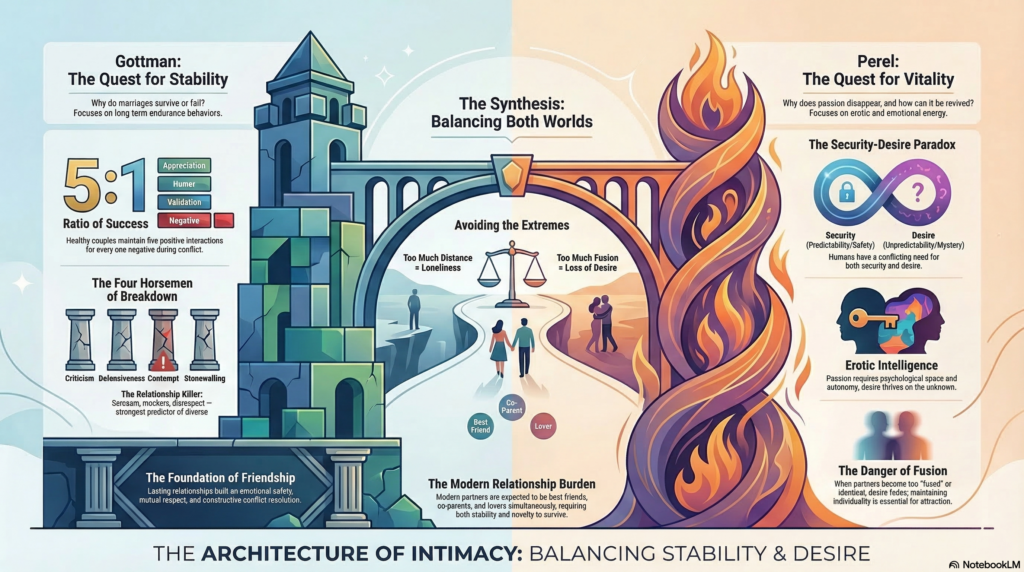
Gottman focuses on relationship stability.
Perel focuses on desire and vitality within relationships.
Both perspectives are essential because a relationship can be stable yet emotionally dull, or passionate yet unstable.
John Gottman: The Scientist of Marital Stability
Gottman’s work is grounded in decades of empirical research. At the University of Washington, he created the famous “Love Lab,” where couples were observed discussing real-life conflicts while researchers monitored their interactions.
Through careful observation of thousands of couples, Gottman discovered that certain communication patterns strongly predict relationship outcomes.
One of his most influential discoveries is the concept of the Four Horsemen of relationship breakdown.
These include:
Criticism – attacking a partner’s character rather than addressing a specific issue.
Defensiveness – responding to criticism by denying responsibility or shifting blame.
Contempt – sarcasm, mockery, or disrespect toward the partner.
Stonewalling – emotional withdrawal from conflict.
Among these behaviors, contempt is the strongest predictor of divorce.
Gottman also discovered the importance of the 5:1 ratio. Healthy couples maintain roughly five positive interactions for every negative interaction during conflict discussions. These positive interactions include appreciation, affection, humor, and emotional validation.
For Gottman, the foundation of lasting relationships is friendship, emotional safety, and respectful communication.
Esther Perel: The Psychology of Desire
Esther Perel approaches relationships from a different angle. Her work explores the tension between security and desire in long-term partnerships.
Many couples who are emotionally stable still report losing passion over time. Perel argues that this happens because long-term relationships must satisfy two psychological needs that often conflict.
Humans desire security, familiarity, and stability. These qualities create emotional safety and attachment.
But humans also crave novelty, mystery, and excitement, which fuel romantic and erotic desire.
Security thrives on predictability. Desire thrives on unpredictability.
This tension explains why passion often fades when relationships become overly familiar.
Perel suggests that maintaining individuality, curiosity, and psychological space within relationships helps sustain attraction.
Stability vs Desire
The contrast between Gottman and Perel can be summarized simply.
Gottman teaches couples how to protect emotional connection.
Perel teaches couples how to preserve erotic energy and individuality.
Gottman emphasizes:
-
emotional responsiveness
-
respect and kindness
-
constructive conflict resolution
-
friendship within marriage
Perel emphasizes:
-
autonomy within relationships
-
maintaining mystery and curiosity
-
preserving individuality
-
creating space for novelty and excitement
In many ways, Gottman focuses on the emotional architecture of relationships, while Perel explores the psychology of attraction and desire.
Why Modern Relationships Need Both Perspectives
Modern marriages often carry enormous expectations. One partner is expected to be a romantic companion, best friend, emotional support system, co-parent, and lifelong lover.
This concentration of roles places significant pressure on relationships.
Gottman’s research helps couples build stable emotional foundations through communication, respect, and emotional responsiveness.
Perel’s insights help couples maintain aliveness and curiosity, preventing relationships from becoming stagnant.
Together, these perspectives reveal that successful relationships balance two essential forces:
closeness and individuality
Too much emotional distance leads to loneliness.
Too much emotional fusion can lead to loss of desire.
Healthy relationships allow partners to remain deeply connected while still maintaining their own identities.
A Practical Takeaway for Couples
If we combine the insights of Gottman and Perel, a clear picture of healthy relationships emerges.
Strong marriages tend to include:
-
mutual respect and appreciation
-
emotional responsiveness
-
constructive conflict resolution
-
curiosity about each other’s inner world
-
space for individuality and personal growth
Long-term love requires both emotional safety and psychological freedom.
Couples who manage this balance often find that their relationships evolve into something deeper than initial romance—a partnership built on trust, admiration, and shared life experiences.
Final Thoughts
There is no single formula for a perfect relationship. But decades of psychological research suggest that lasting relationships require more than love alone.
They require attention, respect, curiosity, and emotional intelligence.
The work of John Gottman shows us how to protect the stability of relationships. The work of Esther Perel reminds us how to preserve vitality and desire within them.
Together, they reveal an important truth: successful relationships are not static—they are living systems that grow, adapt, and evolve over time.
Dr. Srinivas Rajkumar T, MD (AIIMS,New Delhi), DNB, MBA (BITS Pilani)
Consultant Psychiatrist & Neurofeedback Specialist
Mind & Memory Clinic, Apollo Clinic Velachery (Opp. Phoenix Mall)
✉ srinivasaiims@gmail.com 📞 +91-8595155808