Train the Mind, Question the Thought – Dhammapada
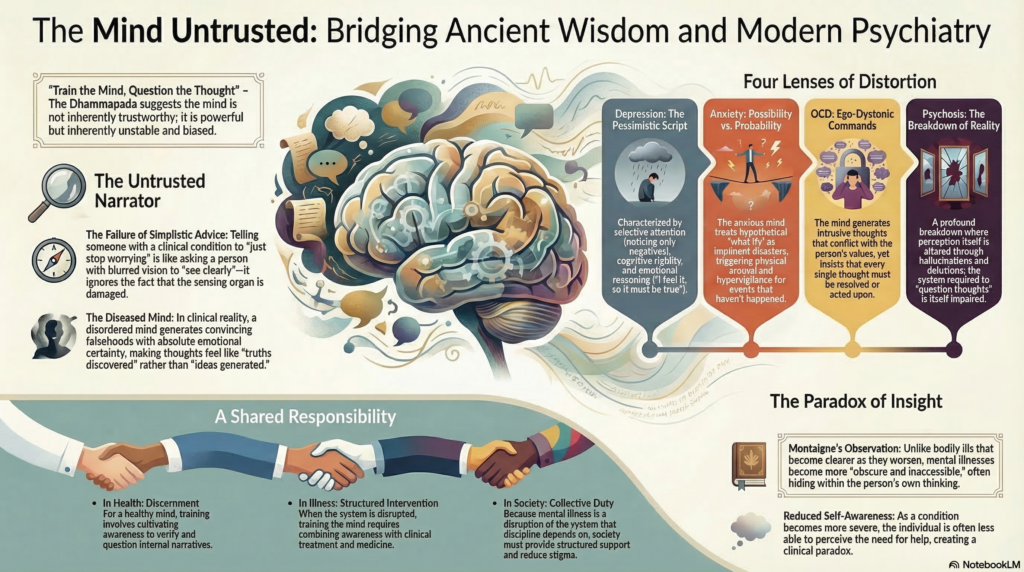 Modern self-help often carries a quiet but dangerous assumption:
your mind is your guide—listen to it, trust it, follow it.
That works… until it doesn’t.
The Dhammapada takes a far more sober stance. It suggests that the mind is not inherently trustworthy. It is powerful, yes—but also unstable, biased, and at times, deeply misleading.
In everyday life, this insight offers clarity.
In mental illness, it becomes critical.
When the Mind Itself Becomes Unreliable
In conditions like depression, anxiety, OCD, and psychosis, the problem is not just “what a person thinks.”
It is that the thinking apparatus itself is altered.
This is where simplistic advice collapses.
Telling someone:
-
“Think positive” in depression
-
“Don’t worry” in anxiety
-
“Ignore it” in OCD
-
“That’s not real” in psychosis
…is like telling a person with blurred vision to just see clearly.
The Dhammapada anticipated this in principle:
An untrained mind leads to suffering.
But in clinical reality, we refine this further:
A diseased mind can generate convincing falsehoods with emotional certainty.
Depression: When the Mind Turns Against the Self
In depression, thoughts acquire a specific tone:
-
self-critical
-
hopeless
-
absolute
“I am not good enough”
“This will never improve”
“I have failed”
These are not casual thoughts. They feel like truths discovered, not ideas generated.
The distortion lies in:
-
selective attention (only negatives are noticed)
-
cognitive rigidity (no alternative interpretations)
-
emotional reasoning (“I feel it, so it must be true”)
Here, the mind is not a neutral observer.
It is a biased narrator with a pessimistic script.
Trusting such a mind without examination deepens the illness.
Anxiety: When the Mind Overestimates Threat
Anxiety disorders are driven by a different distortion:
The mind treats possibility as probability.
“What if something goes wrong?”
“What if I lose control?”
“What if this leads to disaster?”
These are hypothetical constructs—but the body reacts as if danger is imminent.
The result:
-
physiological arousal
-
hypervigilance
-
avoidance
The Dhammapada’s insight applies sharply here:
The restless, untrained mind creates suffering not by events—but by anticipation of events.
OCD: When Thoughts Become Commands
Obsessive-compulsive disorder reveals something even more unsettling:
The mind generates thoughts that feel intrusive, alien, yet compelling.
-
“What if I contaminated someone?”
-
“What if I harmed someone unintentionally?”
These thoughts are:
-
ego-dystonic (not aligned with the person’s values)
-
repetitive
-
resistant to logic
Yet they carry moral weight and urgency.
The individual knows the thought is irrational…
but cannot feel it as irrational.
Here, the failure is not intelligence.
It is control over the significance assigned to thoughts.
The Dhammapada’s warning becomes precise:
Not every thought deserves belief.
But in OCD, the mind insists that every thought must be resolved.
Psychosis: When Reality Itself Becomes Distorted
In psychosis, the breakdown is more profound.
The mind does not merely distort interpretation—it alters perception and belief formation.
-
Delusions: fixed, false beliefs
-
Hallucinations: perception without external stimulus
At this point, asking someone to “question their thoughts” is insufficient.
Because:
The system that performs questioning is itself impaired.
This is where philosophy meets its limits—and medicine must intervene.
Yet even here, the Dhammapada offers a distant but important truth:
The mind, when unregulated, can construct entire realities.
Montaigne’s Observation: The Hidden Nature of Mental Illness
Michel de Montaigne made a striking observation:
“Bodily ills become clearer as they worsen, but diseases of the mind become more obscure and inaccessible.”
This is not just poetic—it is clinically accurate.
-
A fracture becomes visible on X-ray
-
A tumor grows detectable
But mental illness often:
-
reduces insight
-
distorts self-awareness
-
hides itself within the person’s own thinking
The more severe it becomes, the less the individual may recognize it.
This creates a paradox:
The person most in need of help may be least able to perceive the need.
The Ethical Shift: From Individual Responsibility to Collective Duty
Ancient wisdom emphasizes self-mastery.
Modern psychiatry adds an essential correction:
Not all minds are equally capable of self-regulation at all times.
Which leads to an ethical conclusion:
It is the responsibility of society to care for those whose minds cannot reliably guide them.
This includes:
-
access to treatment
-
reduction of stigma
-
structured support systems
-
compassionate clinical care
Mental illness is not a failure of discipline.
It is a disruption of the very system that discipline depends on.
A More Mature Interpretation of “Train the Mind”
The phrase “train the mind” must be understood with nuance.
It does not mean:
-
forcing control
-
suppressing thoughts
-
relying solely on willpower
It means:
-
In health → cultivating awareness and discernment
-
In illness → combining awareness with structured intervention
-
In society → supporting those who cannot do this alone
Training the mind is not always an individual project.
Sometimes, it is a shared responsibility.
Final Reflection
The mind can illuminate reality.
The mind can distort it.
Sometimes, it cannot be trusted at all.
Ancient wisdom teaches us to question thoughts.
Modern medicine teaches us when questioning is not enough.
The real synthesis lies here:
Respect the mind—but verify it.
Train it—but treat it when it falters.
And support others when theirs cannot guide them.
About the Author
Dr. Srinivas Rajkumar T, MD (AIIMS), DNB, MBA (BITS Pilani)
Consultant Psychiatrist & Neurofeedback Specialist
Mind & Memory Clinic, Apollo Clinic Velachery (Opp. Phoenix Mall)
✉ srinivasaiims@gmail.com 📞 +91-8595155808