Tracking Tau Pathology : Network Progression and Cognitive Decline Across the Alzheimer’s Disease Continuum
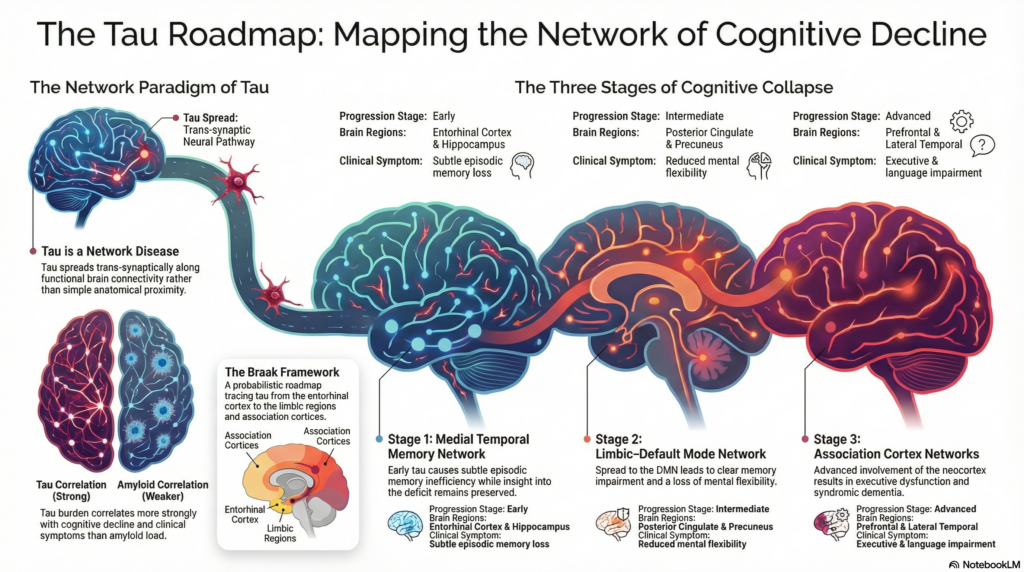 If amyloid marks the presence of Alzheimer’s disease, tau pathology determines its clinical fate. This distinction has become one of the most important insights in modern dementia research. Patients can live for years with amyloid deposition and remain cognitively intact—but once tau begins to spread across brain networks, cognition follows biology with unsettling precision.
Understanding how tau progresses through brain networks and how this progression maps onto cognitive decline is now central to diagnosis, prognosis, and treatment planning.
Tau is not just a protein—it is a network disease
Early models treated tau as a regional pathology. We now know this is incomplete. Tau spreads in a network-based, trans-synaptic manner, following functional and structural brain connectivity rather than simple anatomical proximity.
Tau behaves less like rust on metal and more like a misfolded signal hijacking neural communication pathways.
This network perspective explains why:
-
Cognitive decline follows predictable patterns
-
Symptoms cluster into syndromes (amnestic, dysexecutive, visuospatial)
-
Tau burden correlates more strongly with cognition than amyloid load
The Braak framework: a scaffold, not a prison
Classically, tau progression is described using Braak staging:
-
Stages I–II: Transentorhinal and entorhinal cortex
-
Stages III–IV: Limbic regions (hippocampus, amygdala)
-
Stages V–VI: Neocortex (association cortices)
While still useful, Braak staging is now understood as a probabilistic roadmap, not a rigid sequence. Tau spreads preferentially along functionally connected networks, which explains clinical heterogeneity.
Network-based tau progression: from memory to meaning
1. Medial temporal memory network (early tau)
Initial tau accumulation occurs in:
-
Entorhinal cortex
-
Hippocampus
Cognitive correlate:
-
Subtle episodic memory inefficiency
-
“I remember, but it doesn’t feel solid”
-
Preserved insight
This stage often corresponds to subjective cognitive decline or very mild MCI.
2. Limbic–default mode network (intermediate tau)
Tau spreads into:
-
Posterior cingulate cortex
-
Precuneus
-
Inferior parietal lobule
These regions form the default mode network (DMN)—the brain’s hub for autobiographical memory, internal narrative, and self-referential thinking.
Cognitive correlate:
-
Clear episodic memory impairment
-
Reduced mental flexibility
-
Early executive dysfunction
This stage marks the transition from compensation to clinical detectability.
3. Association cortex networks (advanced tau)
Later tau involvement includes:
-
Dorsolateral prefrontal cortex
-
Lateral temporal cortex
-
Parietal association areas
Cognitive correlate:
-
Executive dysfunction
-
Language impairment
-
Visuospatial deficits
-
Loss of abstraction and judgment
At this point, dementia is no longer subtle—it is syndromic.
Tau PET: watching the disease move
Tau PET imaging has allowed us, for the first time, to visualize disease progression in vivo.
Key observations:
-
Tau PET burden correlates tightly with cognitive decline
-
Regional tau predicts domain-specific impairment
-
Longitudinal tau accumulation predicts future decline better than amyloid
In practical terms, tau PET answers a crucial clinical question:
“Where is the disease now—and where is it going next?”
Blood tau biomarkers: dynamic tracking without scanners
Recent advances in plasma biomarkers—especially p-tau217 and p-tau181—have made longitudinal tracking feasible beyond research settings.
What makes blood tau remarkable:
-
Levels rise with tau PET positivity
-
Increases parallel network spread
-
Predict conversion from MCI to dementia
Blood tau is not just diagnostic—it is trajectory-sensitive.
This opens the door to:
-
Monitoring disease progression over time
-
Assessing treatment response
-
Identifying rapid vs slow progressors
Cognitive decline mirrors network disruption
Cognition does not fail randomly. It collapses along network lines.
-
Memory fails when medial temporal–DMN connectivity breaks
-
Executive function declines when frontal control networks are invaded
-
Language deteriorates when lateral temporal networks are involved
This explains why:
-
Two patients with similar MMSE scores can have very different impairments
-
A single “global” cognitive score often misses early disease
-
Network-aware cognitive testing is essential
Tau teaches us that what fails depends on where tau goes.
Clinical implications: from staging to forecasting
Tracking tau pathology allows clinicians to move beyond static diagnosis toward dynamic forecasting.
-
Early tau → focus on memory strategies and risk modification
-
Limbic tau → anticipate executive decline, plan supports
-
Neocortical tau → prepare for functional dependence
This shifts dementia care from reaction to anticipation.
Therapeutic implications
Modern disease-modifying strategies increasingly target:
-
Tau aggregation
-
Tau spread
-
Network vulnerability
Amyloid removal may slow disease initiation—but tau suppression is likely necessary to preserve cognition.
Future trials are already stratifying patients by:
-
Tau burden
-
Tau network involvement
-
Rate of tau accumulation
A deeper lesson from tau
Tau pathology humbles us with a simple truth:
The brain fails as a network, not as isolated parts.
Memory loss is not a symptom—it is the echo of a collapsing system. By tracking tau progression, we are finally learning to listen to that echo early enough to matter.
Closing thoughts
The future of Alzheimer’s care will not be defined by a single test or drug. It will be defined by longitudinal understanding—watching biology unfold, networks reorganize, and cognition adapt or fail.
Tau pathology gives us the clearest map yet of this journey.
Not just where the disease is—but where it is going.
Dr. Srinivas Rajkumar T, MD (AIIMS, New Delhi), DNB, MBA (BITS Pilani)
Consultant Psychiatrist & Neurofeedback Specialist
Mind & Memory Clinic, Apollo Clinic Velachery (Opp. Phoenix Mall)
✉ srinivasaiims@gmail.com 📞 +91-8595155808