Reels Addiction: How Simple Scrolling leads to Behavioural Addiction – Instagram / Youtube
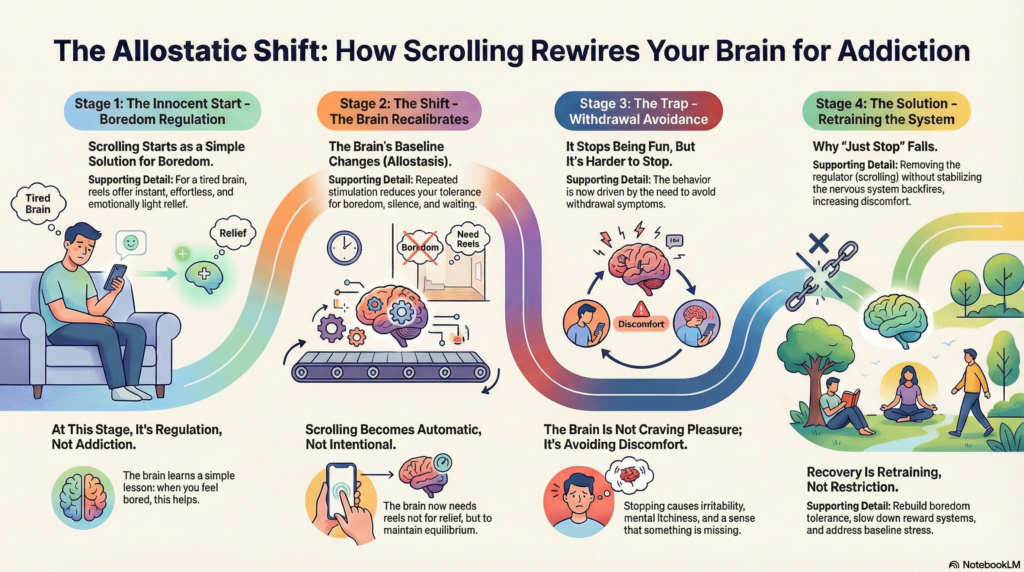 It almost always starts innocently.
A few reels while waiting.
A quick scroll to kill time.
Something to ease boredom after a long day.
No distress. No guilt. No diagnosis.
Just scrolling.
And for a while, it works.
Boredom Is the Beginning, Not the Problem
Boredom is not a disease.
It is a signal—of unused attention, unmet stimulation, or emotional underload.
In modern life, reels are a near-perfect response:
-
instant,
-
effortless,
-
endlessly novel,
-
emotionally lightweight.
For a tired brain, this feels like relief.
At this stage, scrolling is not addiction.
It is regulation.
The brain learns a simple lesson:
When there is boredom, this helps.
Repetition Changes the Nervous System, Not the Intention
The intention remains the same: “just to pass time.”
What changes is the brain.
With repeated scrolling:
-
boredom tolerance reduces,
-
silence becomes uncomfortable,
-
waiting feels irritating,
-
stillness starts to feel like restlessness.
This is not lack of discipline.
This is allostasis—the brain recalibrating its baseline in response to repeated stimulation.
What once relieved boredom now becomes necessary to avoid discomfort.
The Quiet Allostatic Shift
At some point, people notice a subtle change:
“I open reels without even thinking.”
“I don’t know what I watched, but I can’t stop.”
“I feel uneasy when my phone isn’t nearby.”
This is the allostatic shift.
The brain is no longer using reels to relieve boredom.
It is using reels to maintain emotional equilibrium.
Scrolling stops being optional.
It becomes automatic.
Why Reels Stop Being Enjoyable—but Harder to Stop
Many people are confused by this phase.
“I’m not even enjoying it anymore.”
“Everything feels repetitive.”
“I feel drained, not relaxed.”
This paradox makes sense once allostasis is understood.
The behaviour is no longer reward-driven.
It is withdrawal-avoidance driven.
Without reels, the person experiences:
-
irritability,
-
mental itchiness,
-
vague anxiety,
-
a sense that “something is missing.”
The brain is not craving pleasure.
It is avoiding dysregulation.
From Boredom Relief to Behavioural Addiction
This is where behavioural addiction quietly takes shape—not through excess, but through dependence.
Reel-watching becomes problematic when:
-
it is the default response to any idle moment,
-
boredom feels intolerable without stimulation,
-
attention outside reels deteriorates,
-
stopping creates disproportionate discomfort.
Importantly, this has little to do with hours spent.
It has everything to do with loss of psychological flexibility.
Why “Just Reduce Screen Time” Rarely Works
When scrolling has become an allostatic regulator, advice like:
-
“Use willpower”
-
“Just stop”
-
“Delete the app”
often backfires.
People report:
-
increased restlessness,
-
rebound scrolling,
-
irritability,
-
anxiety.
That’s because boredom was never the real issue.
The nervous system was.
Remove the regulator without stabilising the system, and discomfort spikes.
What Actually Helps
Recovery does not begin with restriction.
It begins with retraining regulation.
Clinically, what helps is:
-
rebuilding tolerance for boredom and silence,
-
slowing down reward systems,
-
addressing baseline stress and fatigue,
-
restoring attention depth,
-
expanding life beyond passive consumption.
When the nervous system feels safer, scrolling naturally loses its grip.
A Reframe Worth Sitting With
Most people did not set out to develop a behavioural addiction.
They were simply bored.
Then tired.
Then stressed.
Then overstimulated.
Allostasis reminds us of something important:
People don’t lose control suddenly.
They adapt gradually—until adaptation becomes costly.
Understanding this replaces shame with insight.
And insight is where meaningful change begins.
About the Author
Dr. Srinivas Rajkumar T, MD (AIIMS), DNB, MBA (BITS Pilani), is a Consultant Psychiatrist and Neurofeedback Specialist at Mind & Memory Clinic, Apollo Clinic Velachery, Chennai. His clinical work focuses on behavioural addictions, attention regulation, ADHD, and stress-related disorders, with a strong emphasis on neuroscience-informed care and avoiding unnecessary pathologisation of everyday behaviours.
📍 Apollo Clinic Velachery (Opp. Phoenix Mall)
✉️ srinivasaiims@gmail.com
📞 +91-8595155808