Chemical Hypnosis in Psychiatry: From Narcoanalysis to Modern Pharmacological Interviews
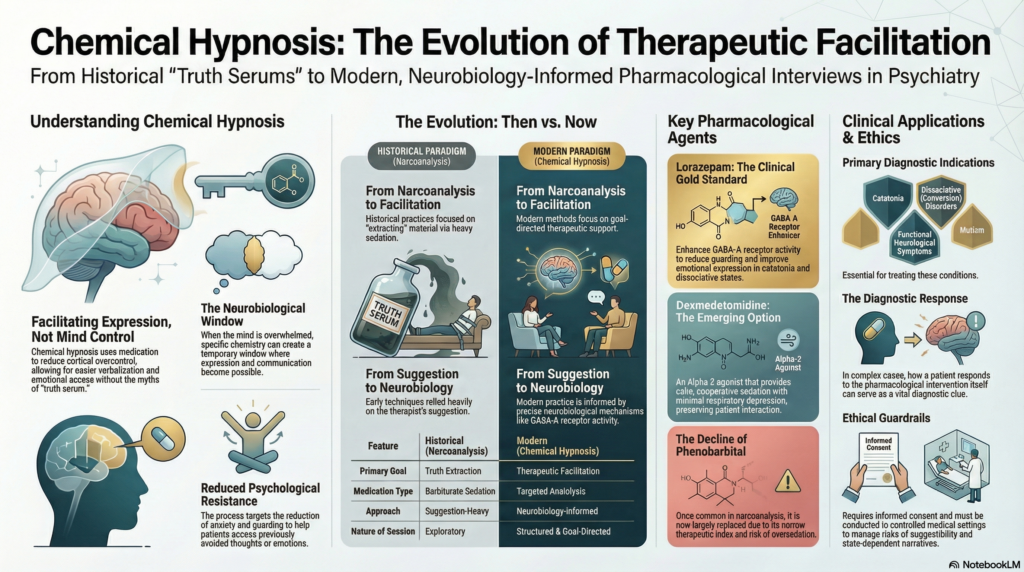 Psychiatry has always sought ways to help patients access experiences that feel blocked, defended, or overwhelming. Historically, this led to the use of hypnosis. Over time, another pathway emerged—one that works not through suggestion, but through neurobiology:
👉 Chemical hypnosis
This umbrella term includes techniques such as narcoanalysis and benzodiazepine-assisted interviews, where medications are used in controlled settings to reduce inhibition and facilitate expression.
🧠 What is Chemical Hypnosis?
Chemical hypnosis refers to the therapeutic use of medications to create a state of reduced psychological resistance, allowing:
- Easier verbalisation
- Emotional access
- Reduced anxiety
- Improved diagnostic clarity
Importantly:
This is not about “truth serums” or mind control—it is about creating conditions where communication becomes easier.
🛋️ A Brief History: Narcoanalysis
Narcoanalysis was one of the earliest forms of chemical facilitation.
- Widely used in the mid-20th century
- Often associated with barbiturates
- Popularly (and inaccurately) called “truth serum”
🔹 Phenobarbital and related agents
- Produced sedation with reduced inhibition
- Allowed patients to speak more freely
- Used in war psychiatry and early psychodynamic work
However, narcoanalysis fell out of favour due to:
- Ethical concerns
- Risk of suggestibility
- Questionable reliability of retrieved material
👉 Modern psychiatry has moved away from “truth extraction” toward therapeutic facilitation.
💊 Modern Chemical Hypnosis: Key Agents
🔹 Lorazepam
The most clinically relevant agent today.
Mechanism:
- Enhances GABA-A receptor activity
- Reduces anxiety and cortical overcontrol
Clinical effects:
- Patients become less guarded
- Emotional expression improves
- Useful in dissociative states, catatonia, and severe anxiety
👉 Forms the basis of lorazepam-assisted interviews
🔹 Dexmedetomidine
An emerging option in controlled settings.
Mechanism:
- Alpha-2 agonism → reduced sympathetic activity
Clinical profile:
- Calm, cooperative sedation
- Minimal respiratory depression
- Preserves interaction
👉 Particularly useful where calm engagement is needed without deep sedation
🔹 Phenobarbital
- Previously used in narcoanalysis
- Strong sedative properties
Limitations:
- Narrow therapeutic index
- Higher risk of oversedation
- Less predictable clinical control
👉 Largely replaced by safer agents like benzodiazepines
🔹 Other Agents
While less commonly used for interview facilitation, some agents have conceptual overlap:
- Midazolam → short-acting benzodiazepine (procedural settings)
- Propofol → sedation, but too deep for meaningful interaction
- Ketamine → dissociative properties (used therapeutically, but different mechanism and purpose)
👉 These are not routine for psychiatric interviews, but reflect the evolving interface between anesthesia and psychiatry
⚡ What Happens During Chemical Hypnosis?
When used appropriately, patients may:
- Experience reduced anxiety
- Become less inhibited
- Speak more openly
- Access previously avoided thoughts
This may lead to emotional release, sometimes described as abreaction, a concept associated with Sigmund Freud.
However, modern understanding emphasises:
This is not uncovering hidden truths—it is facilitating expression in a less defended state
🔍 Clinical Applications
Chemical hypnosis can be useful in:
- Dissociative (conversion) disorders
- Functional neurological symptoms
- Catatonia (diagnostic + therapeutic)
- Severe anxiety with mutism
- Complex diagnostic dilemmas
👉 In some cases, the response itself becomes diagnostic
⚠️ Ethical and Clinical Considerations
Given its history and potential risks:
- Must be used judiciously and ethically
- Requires informed consent
- Conducted in controlled medical settings
Key limitations:
- Increased suggestibility
- Risk of state-dependent narratives
- Not suitable for routine or indiscriminate use
👉 Interpretation should always remain clinically grounded and cautious
🧠 From Narcoanalysis to Precision Psychiatry
The evolution is clear:
| Then | Now |
|---|---|
| Narcoanalysis (“truth serum”) | Therapeutic facilitation |
| Barbiturate sedation | Targeted anxiolysis |
| Suggestion-heavy | Neurobiology-informed |
| Exploratory | Structured, goal-directed |
🧠 The Bigger Shift
Modern psychiatry is no longer divided into:
- Biological vs Psychological
Instead, we are moving toward:
Integrated psychiatry—where brain-based interventions support psychological healing
Chemical hypnosis represents this integration.
🧠 One-Line Takeaway
When the mind is overwhelmed, chemistry can create a window where expression becomes possible.
📍 Availability in Chennai
Advanced psychiatric techniques, including lorazepam-assisted interviews and chemical hypnosis approaches, are now available in Chennai for selected clinical indications.
📣 About the Author
Dr. Srinivas Rajkumar T, MD (AIIMS, New Delhi), DNB, MBA (BITS Pilani)
Senior Consultant Psychiatrist
Mind & Memory Clinic, Apollo Clinic Velachery (Opp. Phoenix Mall)
Dr. Srinivas specialises in:
- Dissociative and functional neurological disorders
- Complex psychiatric diagnostics
- Neurotechnology-based assessments (QEEG, CPT)
- Advanced integrative approaches in psychiatry
📍 Apollo Clinic Velachery, Chennai
✉ srinivasaiims@gmail.com 📞 +91-8595155808