ADHD Testing in Chennai – A Review of Current Practices and Emerging Objective Models
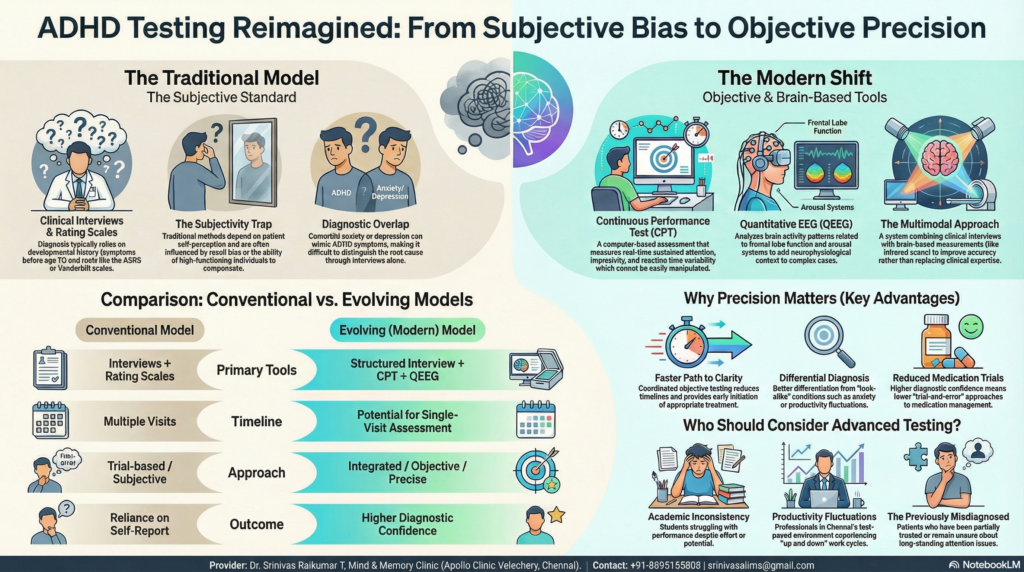 ADHD testing has evolved significantly over the years — but in many clinical settings, it still remains largely dependent on subjective reporting.
In a city like Chennai, where awareness about adult ADHD is rapidly increasing, the demand for accurate, timely, and evidence-based diagnosis has never been higher.
This article reviews:
- How ADHD is traditionally diagnosed
- Limitations of current models
- And how newer, objective approaches are reshaping ADHD testing
Traditional ADHD Testing: The Clinical Gold Standard
Across most centres in Chennai, ADHD diagnosis is based on:
1. Clinical Interview
A detailed psychiatric evaluation remains the cornerstone:
- Developmental history (symptoms before age 12)
- Functional impairment (academic, occupational, social)
- Symptom persistence across settings
These are aligned with frameworks like DSM-5 and ICD-11, which require:
- Multiple symptoms
- Early onset
- Significant functional impairment
2. Rating Scales and Questionnaires
Common tools include:
- ASRS (Adult ADHD Self-Report Scale)
- Vanderbilt scales (in children)
These help structure symptom assessment — but are still:
- Dependent on self-perception
- Influenced by recall bias
3. Psychological Testing
Some centres incorporate:
- Executive function tests
- Attention assessments
These attempt to measure:
- Working memory
- Processing speed
- Sustained attention
The Core Problem: Over-Reliance on Self-Report
While clinical interviews are essential, modern psychiatry recognises a critical limitation:
👉 ADHD diagnosis can be distorted by subjective bias
- Patients may under-report or over-report symptoms
- Comorbid anxiety/depression can mimic ADHD
- High-functioning individuals may compensate well
As a result:
- Underdiagnosis and overdiagnosis can both occur
The Emerging Shift: Objective ADHD Testing
Globally, there is a move toward multimodal diagnostic models.
A notable example comes from the National University of Singapore, where researchers developed a system combining:
- Clinical interviews
- Continuous Performance Tests
- Brain-based measurements (infrared scans)
This approach is designed to be used alongside traditional evaluation, not replace it
The rationale is simple:
👉 No single method is sufficient — integration improves accuracy
Objective Tools Now Used in Advanced ADHD Testing
1. Continuous Performance Test (CPT)
A computer-based test that measures:
- Sustained attention
- Impulsivity
- Reaction time variability
Unlike questionnaires:
- It captures real-time performance
- It is difficult to consciously manipulate
2. Quantitative EEG (QEEG)
QEEG analyses brain activity patterns related to:
- Attention regulation
- Arousal systems
- Frontal lobe function
While not diagnostic alone, it:
- Adds neurophysiological context
- Helps in borderline or complex cases
ADHD Testing in Chennai: Where We Stand
In Chennai today, ADHD testing exists across a spectrum:
Conventional Model
- Clinical interview + rating scales
- Multiple visits
- Trial-based approach
Evolving Model
- Structured interview
- Objective testing (CPT, QEEG)
- Faster and more integrated diagnosis
This reflects a broader shift toward:
👉 Precision psychiatry
Single-Visit ADHD Assessment: Is It Possible?
With proper structuring, yes.
Research-backed models show that when:
- Clinical interview
- Objective cognitive testing
- Brain-based assessment
…are conducted in a coordinated manner, diagnostic confidence improves and timelines reduce.
This allows:
- Faster clarity for patients
- Reduced unnecessary medication trials
- Better differentiation from look-alike conditions
Key Advantages of Modern ADHD Testing Models
- Reduced reliance on self-report alone
- Better differentiation from anxiety/depression
- Objective measurement of attention and impulsivity
- Higher diagnostic confidence
- Early initiation of appropriate treatment
Who Should Consider Advanced ADHD Testing?
- Adults unsure about long-standing attention issues
- Students with academic inconsistency
- Professionals with productivity fluctuations
- Patients previously misdiagnosed or partially treated
The Future of ADHD Diagnosis
The future lies in integration, not replacement.
- Clinical expertise remains central
- Technology enhances precision
- Objective data supports decision-making
The goal is not faster diagnosis alone —
but more accurate, reproducible, and patient-centred diagnosis
Conclusion
ADHD testing in Chennai is at a transition point.
From:
- Subjective, multi-visit assessments
To:
- Structured, objective, and integrated models
As awareness increases, the focus must shift from simply diagnosing ADHD to diagnosing it correctly.
About the Author
Dr. Srinivas Rajkumar T, MD (AIIMS,New Delhi), DNB, MBA (BITS Pilani)
Consultant Psychiatrist & Neurofeedback Specialist
Mind & Memory Clinic, Apollo Clinic Velachery (Opp. Phoenix Mall)
✉ srinivasaiims@gmail.com 📞 +91-8595155808
With a clinical approach that integrates structured interviews, QEEG, and cognitive testing, Dr. Srinivas focuses on objective, accurate, and efficient ADHD diagnosis tailored to real-world practice in Chennai.