ADHD, Autism and Obesity: The Overlooked Neurodevelopmental Link in Weight Management
 Obesity is usually discussed through the familiar language of calories, diet, exercise, metabolism, hormones and increasingly, medications. Yet for some people, repeated difficulty with weight may also involve something less obvious: the way the brain regulates attention, impulses, emotions, routines and reward.
This is particularly relevant to attention-deficit/hyperactivity disorder (ADHD) and potentially autism.
A 2025 scoping review published in Nutrients, titled Autism, ADHD, and Their Traits in Adults with Obesity, examined this intersection. The researchers reviewed 31 studies involving more than one million adults. What emerged was an important clinical message: ADHD appears disproportionately common among adults with obesity, and the presence of ADHD may influence eating behaviour, persistence with lifestyle interventions and response to obesity treatment. At the same time, the evidence surrounding autism and obesity remains surprisingly sparse.
The implication is not that obesity is simply caused by ADHD or autism. It is that, in some patients, treating weight without understanding the underlying neurodevelopmental profile may mean treating only one part of the problem.
Weight Management Is Also an Executive-Function Task
Consider what conventional weight-loss advice actually asks a person to do.
They must plan meals in advance, buy appropriate food, resist immediate rewards, maintain routines, monitor quantities, remember exercise schedules, tolerate slow results, recover after lapses and continue the plan for months or years.
In other words, successful weight management requires sustained executive functioning.
These are precisely some of the domains that may be challenging in ADHD.
ADHD is characterised not only by distractibility or hyperactivity but also by difficulties involving inhibition, planning, organisation, time management, reward processing and emotional regulation. The review highlights plausible pathways by which these difficulties can affect eating: impulsivity may facilitate binge-type eating, inattention may interfere with awareness of hunger and satiety, emotional dysregulation can contribute to emotional eating, and executive-function difficulties can produce irregular eating patterns.
This changes the clinical question.
Instead of asking only:
“Why is this patient unable to follow the diet?”
we may sometimes need to ask:
“What cognitive or behavioural process is repeatedly preventing this patient from following the diet?”
That distinction matters.
ADHD Appears to Be Overrepresented in Adults With Obesity
Across the studies included in the review, ADHD appeared more frequently among people presenting with obesity than might otherwise be expected.
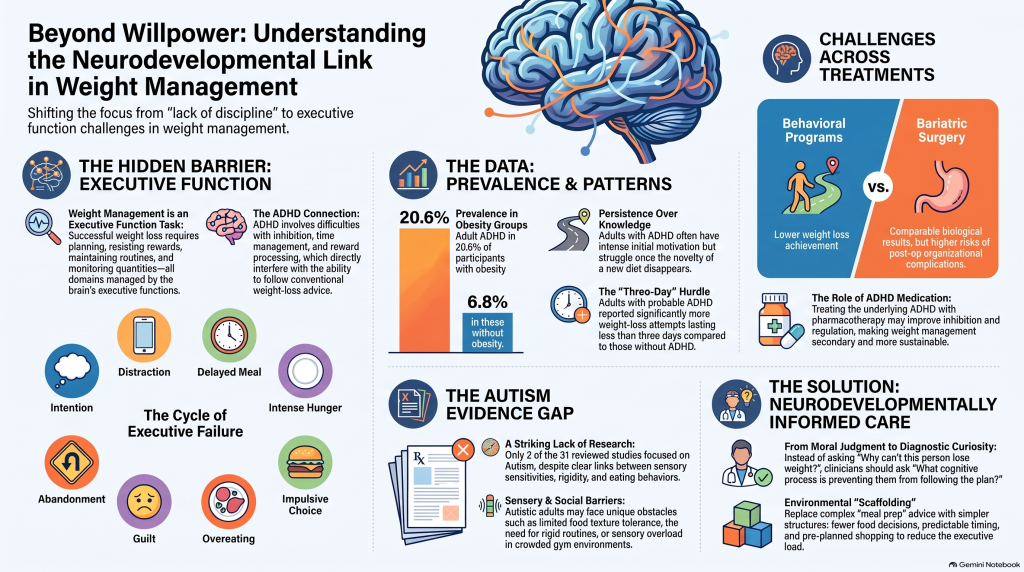
One case-control study reported adult ADHD in 20.6% of participants with obesity compared with 6.8% of participants without obesity. The authors appropriately caution that this estimate is considerably higher than other published estimates; a meta-analysis cited within the review found adult ADHD in approximately 9.9% of metabolic and bariatric surgery candidates and persistent ADHD in 8.9%.
The exact percentage therefore should not be treated as settled.
What appears more convincing is the broader signal: a clinically meaningful subgroup of adults seeking obesity treatment may also have ADHD.
The association did not seem to be explained entirely by binge-eating disorder. The review concluded that ADHD appears to be overrepresented in obesity irrespective of binge-eating status.
Evidence linking ADHD prevalence with the severity of obesity was less consistent. Some studies suggested greater ADHD prevalence in severe obesity, whereas others did not reproduce this relationship. This is an important reminder that ADHD should not be inferred from a person’s BMI.
Diagnosis still requires a proper developmental and clinical assessment.
The ADHD–Obesity Connection May Be Visible at the Dining Table
Perhaps some of the most clinically useful findings concern eating behaviour.
Adults with obesity and ADHD symptoms showed greater levels of several problematic eating patterns, including binge eating, bulimic symptoms, secret eating, snacking, hunger, food craving and measures of food addiction. Emotional eating and nighttime eating were also elevated in some studies, while cognitive restraint appeared lower.
Formal measures reflected the same pattern. ADHD groups scored higher on measures of binge eating, loss of control over eating and emotional cravings in several studies.
This does not mean that every individual with ADHD overeats.
Nor does it mean that someone who binge eats necessarily has ADHD.
The significance lies in recognising a potential behavioural phenotype.
A person may understand nutrition perfectly well but still repeatedly experience a sequence such as:
intention → distraction → delayed meal → intense hunger → impulsive food choice → overeating → guilt → ambitious new diet → difficulty maintaining it → abandonment.
From the outside this can look like poor motivation.
From a neurodevelopmental perspective, it may partly represent difficulty translating intention into sustained behaviour.
The Problem May Be Persistence Rather Than Knowledge
One particularly interesting finding involved weight-loss attempts.
Adults with probable ADHD reported more weight-loss attempts lasting less than three days than those without ADHD.
That observation captures an important aspect of ADHD remarkably well.
Many adults with ADHD are capable of intense initial motivation. They may research a new diet extensively, purchase exercise equipment, download tracking applications and begin a highly structured programme.
The difficulty may emerge several days or weeks later when novelty disappears and the behaviour must be sustained through routine.
The problem is therefore not always failure to start.
It may be failure to maintain behaviour once immediate reward, urgency or novelty diminishes.
This is why repeatedly providing more nutritional information may achieve relatively little in an individual whose actual difficulty lies in planning, inhibition, emotional regulation or sustained execution.
Mental Health Adds Another Layer
The review also identified important psychological differences.
Among adults with obesity, ADHD groups tended to show higher impulsivity and reduced cognitive flexibility. Several studies also identified more depressive and anxiety symptoms, emotional dysregulation and alexithymia. Problematic alcohol use was higher in one study.
At the same time, these findings require nuance.
When researchers examined categorical psychiatric diagnoses rather than symptom scores, differences were not always present. For example, some studies found no significant difference in formal rates of depressive disorders, anxiety or mood disorders, panic disorder or binge-eating disorder.
The message therefore is not simply that “ADHD patients have more psychiatric disorders.”
Rather, some adults carrying the combined burden of ADHD and obesity may experience greater dimensional psychological difficulties—impulsivity, emotional dysregulation, depressive symptoms and problematic eating—even when they do not meet criteria for another categorical psychiatric disorder.
Why Standard Behavioural Weight-Loss Programmes May Be Harder
One study examining a behavioural weight-loss programme found that participants with ADHD experienced the programme as more difficult.
They reported lower self-efficacy in resisting eating, greater emotional eating and greater fast-food consumption. Most importantly, they achieved lower percentage weight loss and were less likely to reach the programme’s 5% weight-loss target.
This finding deserves attention because many obesity programmes implicitly assume that all patients have roughly equivalent capacity to follow the behavioural structure being prescribed.
They do not.
A person struggling with prospective memory, organisation, delayed gratification and emotional regulation may need a different intervention architecture.
For example, a conventional recommendation such as “prepare healthy meals throughout the week” contains several executive tasks. It may work better when converted into environmental and behavioural scaffolding: fewer food decisions, predictable meal timing, reminders, pre-planned shopping, readily available appropriate food and simpler exercise routines.
The goal is not to lower expectations.
It is to design the treatment around how the patient’s brain actually functions.
What About Weight-Loss Medication?
The review found that people with ADHD had poorer BMI reduction following obesity pharmacotherapy in one large retrospective study.
This should not be interpreted as evidence that obesity medications do not work in ADHD. The literature remains limited, and the review itself is a scoping rather than definitive effectiveness review.
More interestingly, treatment of ADHD itself may sometimes affect weight-related behaviour.
One longitudinal intervention included 78 adults with severe obesity and persistent ADHD. Most of those receiving ADHD pharmacotherapy were treated with psychostimulants. Over approximately 466 days, the treated group showed a substantial reduction in weight while the untreated comparison group gained weight.
This is intriguing but requires considerable caution.
ADHD medication should not be prescribed simply as a weight-loss treatment. ADHD pharmacotherapy is indicated when an appropriate clinical assessment establishes ADHD and treatment is warranted. Appetite and weight changes may occur as consequences of treatment, but they are not a substitute for appropriate obesity management.
The more important possibility is behavioural: if treating ADHD improves inhibition, planning and regulation of eating, weight management may become easier because the underlying executive dysfunction has improved.
That hypothesis needs better prospective research.
Bariatric Surgery Presents a Different Picture
Interestingly, bariatric surgery did not show the same pattern of poorer weight outcomes.
Across most studies, postoperative weight or BMI outcomes were broadly similar between people with and without ADHD.
However, ADHD was associated with other challenges.
Some studies reported more postoperative complications, longer hospital stays and poorer adherence to scheduled follow-up appointments, although serious operative complications and short-term reoperation rates were not consistently different.
This distinction is important.
The surgical procedure may produce comparable biological weight loss, while ADHD-related organisational difficulties continue to influence follow-up, adherence and long-term care.
The review even describes a case in which oral methylphenidate apparently lost therapeutic effectiveness following Roux-en-Y gastric bypass, with benefit returning after switching to transdermal methylphenidate.
For clinicians managing patients after bariatric surgery, medication absorption therefore deserves consideration when a previously effective psychiatric medication unexpectedly appears to stop working.
Autism and Obesity: A Huge Evidence Gap
The difference between the ADHD and autism literature was striking.
Of the 31 studies in the review, only two were specifically about autism and obesity, both case reports involving a total of three autistic individuals. There were no studies examining autism prevalence within obesity services, no studies of patients’ lived experiences and essentially no evidence evaluating autism-adapted obesity interventions.
That does not mean autism is unimportant.
In fact, existing research outside the obesity literature suggests that sensory sensitivities, rigidity, executive-function differences and restrictive or repetitive behaviours can strongly influence eating. Standard eating-disorder treatments have also sometimes failed to adequately address autism-related needs.
It is easy to imagine how these factors could matter in obesity treatment.
An autistic adult might tolerate only a limited range of food textures. Another might depend strongly on a predictable eating routine. Exercise environments such as crowded gyms may be sensory-overloading. Social aspects of group-based weight management may themselves become barriers.
But these remain clinically plausible considerations rather than conclusions established by the obesity literature.
That distinction is important.
The review essentially exposes how little research has been done.
Obesity Treatment May Need to Become Neurodevelopmentally Informed
One of the most important ideas emerging from this literature is that obesity care may eventually need to move away from uniform behavioural programmes toward neurodevelopmentally informed weight management.
The authors propose exploring interventions addressing executive function, emotional regulation and motivation. They discuss potential adjuncts such as dialectical behaviour therapy, motivational interviewing and mindfulness, while emphasizing that ADHD-specific psychotherapy protocols for obesity have not yet been properly studied.
Clinically, this suggests a broader assessment model. In selected patients with persistent difficulty managing weight, particularly when there is also chronic disorganisation, impulsivity, procrastination, emotional dysregulation, binge-type eating or a lifelong history of attention problems, it may be worthwhile to assess whether an underlying neurodevelopmental disorder is contributing.
This does not mean screening everybody with obesity and labelling them with ADHD.
It means recognising that repeated treatment failure sometimes deserves diagnostic curiosity rather than moral judgement.
The Evidence Still Has Important Limitations
This field remains early.
The review included adults only and defined obesity predominantly using BMI ≥30 kg/m². Much of the literature came from Western Europe, many samples were predominantly female and ethnicity was poorly reported. Medication status was inconsistently controlled, particularly important because ADHD and psychiatric medications can themselves affect appetite and weight.
The autism evidence is particularly insufficient.
There were also no studies investigating the lived experiences and perspectives of adults with ADHD and obesity within the studies included in this review.
So the current evidence supports awareness and better assessment far more strongly than it supports rigid new treatment algorithms.
A Different Way to Think About Repeated Weight-Loss Failure
For decades obesity has frequently been framed as a struggle between knowledge and willpower.
Modern medicine increasingly recognises that this is inadequate.
Metabolism matters. Genetics matter. Sleep matters. Medication matters. Psychological health matters. Food environments matter.
And for some individuals, neurodevelopment matters as well.
An adult who repeatedly abandons diets may not necessarily lack motivation. An individual who eats impulsively may not simply lack discipline. Someone who cannot maintain a complicated exercise and meal-planning programme may actually be struggling with executive functioning.
Recognising ADHD or autism will not magically solve obesity.
But recognising them may allow treatment to become more realistic, individualised and sustainable.
Perhaps the most useful clinical question is therefore not:
“Why can’t this person lose weight?”
but:
“What is making weight regulation unusually difficult for this particular person?”
That is the point at which personalised medicine begins.
Adult ADHD Assessment in Chennai – ATTN Clinic
Adults with ADHD are frequently identified only after years of difficulties involving attention, procrastination, impulsivity, emotional regulation, inconsistent productivity, relationships or repeated attempts to establish routines. Problems with eating and weight regulation can sometimes form part of this wider clinical picture.
Dr. Srinivas Rajkumar T is a Senior Consultant Psychiatrist with Apollo Hospitals, Chennai, with MD Psychiatry from AIIMS New Delhi, and a clinical and research interest in adult ADHD, cognitive assessment and technology-assisted psychiatry.
At ATTN Clinic – Attention. Understood., the emphasis is on a comprehensive assessment rather than making a diagnosis from a questionnaire alone. Clinical evaluation remains central, with validated ADHD measures and, where clinically appropriate, additional objective assessments of attention and cognitive functioning.
ATTN Clinic currently functions from:
Apollo Clinic, opposite Phoenix Market City, Velachery, Chennai.
Appointments: +91 85951 55808
Email: srinivasaiims@gmail.com
Website: srinivasaiims.com
For adults who have spent years being told simply to “be more disciplined,” understanding whether attention, executive functioning or another psychiatric condition is contributing can sometimes be the first step toward a more appropriate treatment plan.
Source article: Makin L, Meyer A, Zesch E, Mondelli V, Tchanturia K. “Autism, ADHD, and Their Traits in Adults with Obesity: A Scoping Review.” Nutrients. 2025;17:787