Autism and the Immune System: What Neuroimmunology Is Teaching Us About the Brain–Body Connection
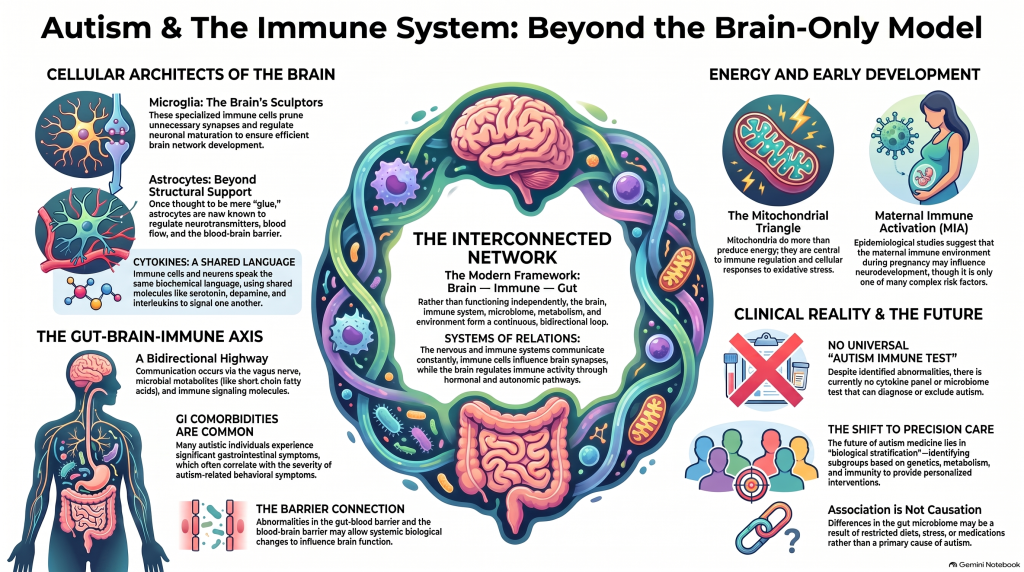 Autism spectrum disorder (ASD) is usually described as a neurodevelopmental condition affecting social communication, behaviour, sensory processing and patterns of interest. But increasingly, autism research is looking beyond neurons alone.
A major 2026 review in Molecular Neurobiology, titled “The Neuroimmunology of Autism,” examines a much broader question: could the immune system, brain, gut and metabolism interact in ways that influence at least some forms or features of autism?
The answer emerging from neuroimmunology is increasingly nuanced.
Autism should not simply be reclassified as an “immune disorder.” Rather, the evidence suggests that immune dysregulation may be one component of a much larger biological network in a subset of autistic individuals.
That distinction is important.
Autism May Be More Than a “Brain-Only” Condition
For decades, the brain was often regarded as relatively isolated from the immune system. We now know that this is not the case.
The nervous system and immune system constantly communicate with each other. Immune cells influence brain development and synaptic function, while the brain regulates immune activity through hormonal, autonomic and behavioural pathways.
The review describes the nervous and immune systems as interconnected “systems of relations.” The microbiome adds another layer to this network.
This creates a useful modern framework:
Brain ↔ Immune system ↔ Gut microbiome ↔ Metabolism ↔ Environment
Rather than functioning independently, these systems continuously influence one another.
For autism research, this matters because ASD itself is extremely heterogeneous. Two people can meet criteria for autism while having very different cognitive profiles, medical comorbidities, developmental trajectories and underlying biology.
1. Neuroinflammation: When the Brain’s Immune System Becomes Relevant
Inflammation is not inherently harmful.
It is one of the body’s essential defence and repair mechanisms. Problems arise when inflammatory responses become excessive, persistent or poorly regulated.
Research reviewed in the paper has identified abnormalities involving both innate and adaptive immune systems in some autistic individuals. These include changes involving:
- microglia
- astrocytes
- T lymphocytes
- B lymphocytes
- natural killer cells
- mast cells
- monocytes
- inflammatory cytokines and chemokines
The literature reviewed spans several decades and links ASD in some individuals with inflammatory processes, oxidative stress, mitochondrial dysfunction and systemic immune dysregulation.
But there is an essential caveat:
These abnormalities are not found in every autistic person.
The review itself acknowledges that there is currently no single reproducible biological or immune signature that defines autism. This strongly argues against simplistic ideas such as “autism is caused by one inflammatory molecule” or “one immune imbalance explains autism.”
Autism remains biologically heterogeneous.
2. Microglia: The Immune Cells That Help Build the Brain
One particularly interesting area of autism research involves microglia.
Microglia are specialised immune cells residing inside the central nervous system.
They do far more than fight infection.
During normal brain development, microglia help regulate:
- synaptic formation
- removal or “pruning” of unnecessary synapses
- neuronal network maturation
- excitation–inhibition balance
- responses to injury
- maintenance of the brain environment
The review discusses evidence of differences in microglial density, morphology and activity in ASD, as well as the possibility that abnormal microglial function could affect synaptic pruning and the balance between excitatory and inhibitory signalling.
This is potentially significant.
The developing brain initially creates an enormous number of neural connections. Some are strengthened while others are removed. This process helps create efficient neural networks.
If immune mechanisms participate in this developmental sculpting process, neuroimmunity becomes directly relevant to neurodevelopment.
This does not mean that inflammation alone causes autism.
It means that the traditional distinction between “neural development” and “immune biology” is becoming increasingly artificial.
3. Astrocytes: More Than Support Cells
Astrocytes were once regarded primarily as structural support for neurons.
We now know that they participate in:
- synapse formation
- neurotransmitter regulation
- metabolic support
- neuroinflammation
- cerebral blood-flow regulation
- maintenance of the blood–brain barrier
- sleep and wakefulness
- neuroplasticity
The review describes alterations in astrocyte number and function as another possible contributor to ASD pathophysiology.
Together, neurons, microglia and astrocytes should increasingly be viewed as interacting components of the same functional system.
4. Cytokines: How the Immune System Talks to the Brain
Immune cells communicate through molecules called cytokines.
Examples include:
- interleukins
- interferons
- tumour necrosis factor
- chemokines
These molecules can modify inflammatory responses, neural signalling and cellular behaviour.
The review also highlights interactions between immune signalling and familiar neurological molecules such as:
- serotonin
- dopamine
- noradrenaline
- glutamate
- GABA
- oxytocin
- cortisol
- histamine
- BDNF
Importantly, many substances traditionally labelled “neurotransmitters” or “hormones” also influence immune cells.
The brain and immune system therefore do not speak completely different biochemical languages.
They share many of the same signalling molecules.
5. The Gut–Brain–Immune Axis
Another major focus of modern autism research is the gut–brain axis.
The gut contains its own extensive nervous system—the enteric nervous system—along with enormous populations of bacteria, viruses and fungi collectively forming the microbiome.
Communication between the gut and brain occurs through several routes, including:
Vagus nerve → immune signalling → hormones → microbial metabolites → neurotransmitter systems
Gut microorganisms can produce or modify substances such as:
- short-chain fatty acids
- bile acids
- tryptophan metabolites
- neurotransmitter-related molecules
- immune signalling molecules
Meanwhile, the brain influences the gut through autonomic activity, stress responses and endocrine signalling.
This is therefore a bidirectional system, not simply “the gut controlling the brain.”
Gastrointestinal Problems Are Common in Autism
Many autistic children and adults experience gastrointestinal symptoms including:
- constipation
- diarrhoea
- abdominal bloating
- reflux
- feeding difficulties
The review notes studies reporting associations between the severity of gastrointestinal symptoms and autism-related symptoms.
Gut microbiome differences have also repeatedly been reported in ASD.
However, this is where scientific caution becomes particularly important.
The authors themselves emphasise:
Association does not prove causation.
Microbiome differences could potentially contribute to symptoms, but they could also arise secondarily because autistic individuals may have different diets, medications, stress levels, gastrointestinal disorders and feeding patterns.
Study location alone can substantially influence the microbiome, making apparently impressive differences difficult to interpret.
So the science is intriguing—but the idea that autism can simply be “treated through the microbiome” remains premature.
6. The Gut Barrier and Blood–Brain Barrier
Two important biological barriers feature prominently in neuroimmunology:
Gut–blood barrier
The intestinal lining separates the body’s internal circulation from the enormous microbial ecosystem inside the gut.
Blood–brain barrier
The blood–brain barrier tightly regulates which substances circulating in the bloodstream can enter brain tissue.
The review discusses evidence suggesting abnormalities of both barriers in some autistic individuals.
If intestinal barrier function, immune activation and blood–brain barrier permeability interact, theoretically they could provide another route through which systemic biological changes influence brain function.
But once again, major mechanistic gaps remain.
Many proposed gut-derived signalling molecules still have incompletely understood effects on the human brain.
7. Oxidative Stress, Mitochondria and Immunity
Another fascinating connection involves mitochondria.
Mitochondria are commonly described as the energy-producing structures of cells. But they are also intimately involved in immune regulation.
Mitochondrial metabolism influences:
- macrophage activity
- T-cell differentiation
- inflammatory signalling
- production of reactive oxygen species
- cellular responses to stress
Studies reviewed in the paper have reported abnormalities in mitochondrial energy metabolism and oxidative stress markers in subsets of autistic individuals.
This creates another biological triangle:
Energy metabolism ↔ oxidative stress ↔ immune regulation
Rather than being isolated abnormalities, these systems may interact.
8. Maternal Immune Activation
One of the most intensively studied areas of developmental neuroimmunology is maternal immune activation.
During pregnancy, the developing fetal brain exists within a complex maternal immune environment.
Epidemiological and experimental studies have investigated whether maternal:
- infections
- autoimmune disorders
- severe inflammation
- allergic disease
- environmental exposures
may influence subsequent neurodevelopment.
The review describes epidemiological associations between maternal immune activation and later autism or schizophrenia in offspring.
But risk is not destiny.
These associations do not mean that maternal infection automatically causes autism, nor that mothers should be blamed for a child’s neurodevelopmental condition.
Autism develops through complex interactions involving genetic susceptibility, neurodevelopment and environmental influences.
9. Is Autism an Autoimmune Disease?
No.
That would be an oversimplification.
However, autoimmune disorders and abnormal immune signalling appear to occur more frequently in some autistic populations, and autoimmune mechanisms may be clinically relevant in particular subgroups.
This is especially important because certain neurological illnesses—such as autoimmune encephalitis—can occasionally present with major psychiatric, behavioural or cognitive changes.
These are separate medical disorders requiring specific diagnosis and treatment.
The existence of these conditions should not be extrapolated into treating ordinary autism with aggressive immunotherapy.
10. There Is Currently No “Autism Immune Test”
This may be the most clinically important message.
Despite abnormalities being reported involving cytokines, microglia, oxidative stress, mitochondrial function and microbiome composition, the review acknowledges that no universal robust biomarker for ASD has been identified.
Therefore, at present:
A cytokine panel cannot diagnose autism.
A microbiome test cannot diagnose autism.
An inflammation marker cannot confirm or exclude autism.
An immune profile cannot replace a proper developmental and clinical assessment.
Autism continues to be diagnosed clinically.
Biological measures may eventually help us identify meaningful subtypes, but we are not there yet.
11. Should We Treat Autism With Anti-Inflammatory or Immune Drugs?
This is where enthusiasm must be separated from evidence.
Numerous immune-modulating and anti-inflammatory treatments have been explored experimentally, including agents with antioxidant, anti-inflammatory or immunomodulatory properties.
But the review notes a major problem: rigorous clinical trials and successful replication are limited.
For many proposed immune treatments, evidence remains insufficient and adverse effects can be substantial.
Aggressive treatments such as:
- corticosteroids
- intravenous immunoglobulin
- plasma exchange
- immunosuppressants
have legitimate roles in specific immune-mediated neurological diseases.
They should not become routine autism treatments simply because neuroinflammation is scientifically interesting.
12. What About Microbiome Transplants?
Microbial transplantation is another experimental area.
Early studies have reported changes in gastrointestinal symptoms, microbiome diversity and some behavioural measures following microbiota-based interventions.
But the review also highlights significant limitations involving:
- donor variability
- safety
- adverse effects
- microbiological standardisation
- long-term immune consequences
This remains an area for controlled research rather than routine autism treatment.
13. Nutrition and the Microbiome: Interesting, but No Universal Autism Diet Exists
Diet clearly influences metabolism, intestinal function and the microbiome.
But autism is far too heterogeneous for a single nutritional prescription.
The review notes that despite considerable research interest, there is still no consensus regarding an optimal nutritional treatment for ASD.
Nutritional care may nevertheless be extremely important when an autistic individual has:
- restrictive eating
- nutritional deficiency
- obesity
- constipation
- gastrointestinal disease
- metabolic problems
- medication-related appetite or weight changes
The key is treating the individual’s actual medical problem, rather than assuming that every autistic person requires the same supplements or elimination diet.
14. The Future May Be Autism Subtyping, Not One Autism Treatment
Perhaps the most valuable idea arising from neuroimmunology is not a new drug.
It is better biological stratification.
The review proposes a systems-biology approach combining information across:
- genetics
- epigenetics
- metabolomics
- proteomics
- immune function
- microbiome
- environmental exposures
- neurological function
- clinical phenotype
The eventual goal would be to identify biological subgroups and develop more personalised interventions.
This makes far more biological sense than searching indefinitely for a single “autism molecule.”
Autism Is Probably Many Biological Pathways Converging on Similar Behavioural Phenotypes
This is perhaps the broader lesson.
Two autistic individuals may share difficulties with social communication or sensory processing but arrive at those difficulties through very different combinations of:
genetics + development + neural connectivity + immune regulation + metabolism + environment + microbiome
That helps explain why autism varies so enormously between individuals.
It also explains why treatments that appear remarkably helpful for one person may do little for another.
What Neuroimmunology Changes—and What It Does Not
Neuroimmunology changes how we think about autism.
It tells us that the brain cannot be completely separated from the rest of the body.
It encourages clinicians to pay attention to genuine medical comorbidities rather than assuming that every behavioural change is “just autism.”
But it does not currently justify abandoning established developmental assessment or replacing evidence-based interventions with unproven immune treatments.
The strongest clinical position is therefore somewhere between two extremes:
Autism is not simply a static disorder confined to neurons.
But neither is autism a single inflammatory, autoimmune or microbiome disease waiting for one biological cure.
The Emerging Model: Neurodevelopment Meets Systems Medicine
The review ultimately argues for a more personalised, multi-system approach rather than a single “magic-bullet” treatment.
That direction is compelling.
The future of autism medicine may involve combining careful clinical phenotyping with increasingly sophisticated biological measurements to answer a much better question than simply:
“Does this person have autism?”
We may increasingly ask:
What type of neurodevelopmental profile does this person have?
Which brain systems are affected?
What are their cognitive strengths and vulnerabilities?
Are there important sleep, gastrointestinal, metabolic, neurological or immune comorbidities?
Which problems are actually treatable today?
That is the transition from a diagnostic label to precision neurodevelopmental care.
About the Author
Dr. Srinivas Rajkumar T is a Senior Consultant Psychiatrist with Apollo Hospitals and an Assistant Professor of Psychiatry. He trained in psychiatry at AIIMS New Delhi and has a particular interest in biological psychiatry, neurodevelopmental disorders, ADHD, autism, cognitive assessment and objective approaches to understanding brain function.
His clinical approach emphasises that technologies and biological measures should complement—not replace—a careful clinical assessment. The aim is not merely to apply diagnostic labels, but to understand an individual’s cognitive, behavioural and functional profile and identify problems for which meaningful interventions are available.
This article is for educational purposes and is based primarily on the 2026 narrative review “The Neuroimmunology of Autism” in Molecular Neurobiology. Several hypotheses discussed in that review—including specific environmental, immune and microbiome mechanisms—remain scientifically debated and should not be interpreted as established causes of autism or as justification for unproven treatments.