Aging vs Dementia: Understanding Neurocognitive Dysfunction
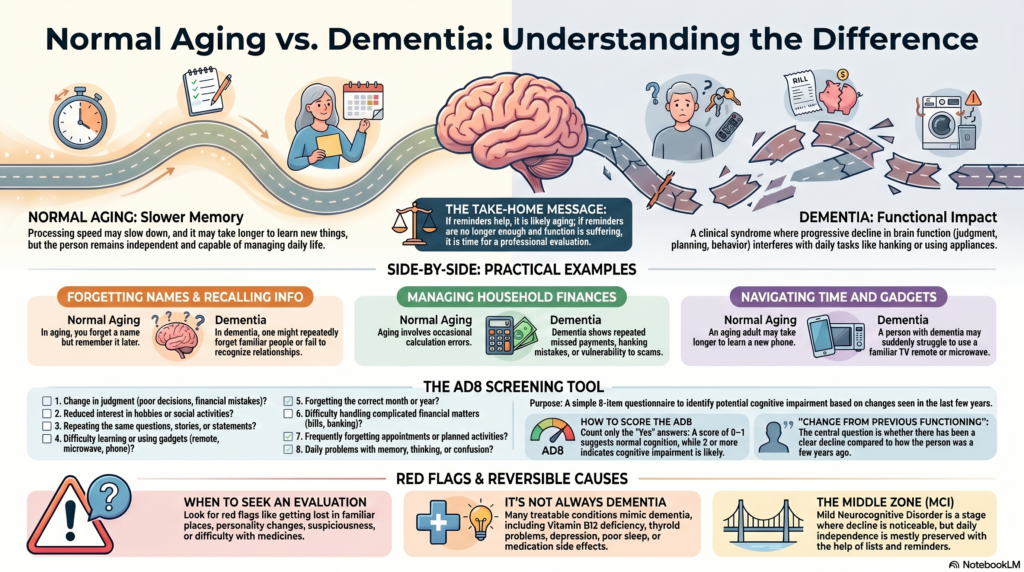 Forgetfulness is one of the most common concerns among older adults and their families. A person may forget names, misplace objects, repeat a story, or take longer to recall information. Naturally, families begin to worry: “Is this normal aging, or is this dementia?”
The answer is not always straightforward. Normal aging can cause mild slowing of memory and thinking. Dementia, however, involves a clear decline from the person’s previous level of functioning, especially when memory, judgement, behaviour, or daily independence begins to suffer.
A useful way to understand the difference is:
Normal aging makes memory slower. Dementia causes neurocognitive dysfunction that makes daily life harder.
What Is Neurocognitive Dysfunction?
Neurocognitive dysfunction means difficulty in brain-based functions such as memory, attention, orientation, language, judgement, planning, decision-making, social behaviour, or problem-solving.
It is a broader clinical term than “memory loss.” Many people assume dementia means only forgetting names or events. In reality, dementia may first appear as:
Difficulty managing finances
Poor judgement
Repeated questioning
Loss of interest in activities
Difficulty using gadgets
Confusion about month or year
Behaviour or personality change
Trouble planning, organising, or making decisions
So, when we assess an older adult, we are not only asking, “Is memory affected?” We are asking, “Is there neurocognitive dysfunction affecting day-to-day life?”
What Happens in Normal Aging?
Aging affects the brain, but not all age-related changes are disease. Processing speed may slow. A person may need more time to remember names, learn a new phone, or recall where something was kept.
In normal aging, the person usually remains independent.
| Normal Aging | Example |
|---|---|
| Occasional forgetfulness | Forgetting a name but remembering it later |
| Slower recall | Taking longer to answer |
| Misplacing objects | Finding them after searching |
| Difficulty with new technology | Learning slowly with repetition |
| Occasional missed appointment | Remembering after a reminder |
| Preserved independence | Managing money, medicines, travel, and decisions |
In normal aging, reminders usually help. The person may feel frustrated, but their core ability to manage daily life remains intact.
What Is Dementia?
Dementia is a clinical syndrome where there is progressive neurocognitive dysfunction affecting one or more areas of brain function, such as:
Memory
Attention
Language
Orientation
Judgement
Planning
Behaviour
Social functioning
Daily decision-making
The most important point is this:
Dementia affects function.
A person with dementia may struggle with tasks they previously handled well. For example, someone who confidently managed household finances may begin making repeated payment mistakes. Someone who used a phone or remote comfortably may suddenly struggle with familiar devices. A person may ask the same question repeatedly, forget the month or year, or show poor judgement in everyday situations.
The Key Difference: Change from Previous Functioning
Families should not simply ask, “Is the person forgetful?”
A better question is:
“Has there been a clear change compared to how this person was a few years ago?”
This idea is central to the AD8 Dementia Screening Interview. The AD8 asks whether there has been a change in the last several years due to cognitive, thinking, or memory problems. It screens areas such as judgement, interest in activities, repetition, use of gadgets, orientation to month/year, financial handling, remembering appointments, and daily thinking or memory problems.
A Simple 8-Item Questionnaire for Neurocognitive Dysfunction
This questionnaire is best answered by a close family member, caregiver, or someone who knows the person well.
Ask:
“In the last few years, has there been a clear change due to memory or thinking problems?”
Mark Yes, No, or Don’t know.
| No. | Question | Yes | No | Don’t know |
|---|---|---|---|---|
| 1 | Has there been a change in judgement, such as poor decisions, financial mistakes, or difficulty thinking clearly? | |||
| 2 | Has interest in hobbies, social activities, or usual activities reduced? | |||
| 3 | Does the person repeat the same questions, stories, or statements again and again? | |||
| 4 | Has the person developed difficulty learning or using gadgets/appliances such as phone, remote, microwave, computer, or TV controls? | |||
| 5 | Does the person forget the correct month or year? | |||
| 6 | Is there difficulty handling complicated financial matters such as bills, banking, accounts, or payments? | |||
| 7 | Does the person frequently forget appointments, important dates, or planned activities? | |||
| 8 | Are there daily problems with memory, thinking, or confusion? |
How to Score
Count only the “Yes” answers.
| Score | Meaning |
|---|---|
| 0–1 | More likely normal cognition |
| 2 or more | Cognitive impairment or neurocognitive dysfunction is likely; further evaluation is advised |
The AD8 scoring guidance states that a score of 0–1 suggests normal cognition, while 2 or more suggests that cognitive impairment is likely to be present. However, it also clearly notes that a screening test alone is not sufficient to diagnose dementia.
Why Family Input Matters
Many people with early dementia may not fully notice their own decline. This is not always denial. Sometimes the illness itself affects insight.
A patient may say, “I am fine,” while the family observes repeated mistakes, missed bills, unsafe cooking, forgotten appointments, or personality changes.
That is why informant-based screening is valuable. The AD8 guidelines mention that it is preferable to administer the questionnaire to an informant if available. If an informant is not available, it may be administered to the patient, but family input often gives a more accurate picture of real-world functioning.
Aging vs Dementia: Practical Examples
1. Forgetting Names
Normal aging:
The person forgets a name temporarily but remembers it later.
Possible dementia:
The person repeatedly forgets familiar people, struggles to recognise relationships, or makes socially inappropriate mistakes due to memory decline.
2. Repeating Questions
Normal aging:
The person may repeat something occasionally, especially when distracted or stressed.
Possible dementia:
The person asks the same question again and again within minutes, even after receiving the answer.
3. Managing Finances
Normal aging:
Occasional calculation mistakes may occur, but the person corrects them.
Possible dementia:
There are repeated missed payments, wrong transfers, vulnerability to scams, difficulty understanding banking work, or inability to manage bills that were previously handled well.
4. Using Gadgets
Normal aging:
The person may take longer to learn a new smartphone or app.
Possible dementia:
The person forgets how to use familiar devices such as a TV remote, microwave, phone, or household appliance.
5. Orientation to Time
Normal aging:
The person may momentarily forget the date.
Possible dementia:
The person repeatedly forgets the month or year, gets confused about time, or mixes up past and present events.
6. Judgement and Safety
Normal aging:
Occasional minor errors in judgement may happen.
Possible dementia:
There may be unsafe decisions, unusual financial choices, inappropriate trust in strangers, unsafe driving, leaving the stove on, or poor awareness of risk.
Mild Neurocognitive Disorder: The Middle Zone
Between normal aging and dementia, there is a middle zone often described clinically as mild cognitive impairment or mild neurocognitive disorder.
In this stage, the person has noticeable cognitive problems, but daily independence is mostly preserved. They may need lists, reminders, supervision for complex tasks, or extra time, but they can still manage many essential activities.
This stage is important because some people remain stable, some improve if reversible causes are treated, and some may progress to dementia. Early identification gives families time to intervene, plan, and monitor.
Not All Neurocognitive Dysfunction Is Dementia
Not every memory or thinking problem is dementia. Several treatable conditions can cause neurocognitive dysfunction, including:
Depression
Anxiety
Poor sleep
Sleep apnea
Vitamin B12 deficiency
Thyroid problems
Medication side effects
Alcohol use
Delirium or infections
Hearing impairment
Vision impairment
Uncontrolled diabetes or hypertension
Stroke or small vessel disease
This is why dementia should not be diagnosed casually. A structured evaluation helps differentiate normal aging, mild neurocognitive disorder, depression-related cognitive symptoms, medication effects, and dementia.
When Should You Seek a Memory Evaluation?
A professional evaluation is advisable when there is:
Repeated questioning
Forgetting recent conversations
Getting lost in familiar places
Decline in judgement
Difficulty managing money
Mistakes with medicines
Personality or behaviour change
Reduced interest in usual activities
Suspiciousness or hallucinations
Difficulty using familiar appliances
Falls, urinary symptoms, or gait change
Rapid worsening of memory
Family concern despite patient reassurance
The most important red flag is:
Change plus functional impact.
What Does a Dementia Evaluation Usually Include?
A proper assessment is not just one memory test. It usually includes:
Detailed history from the patient and family
Assessment of daily functioning
Screening for depression, anxiety, sleep, and medication effects
Cognitive testing such as MoCA, MMSE, Mini-Cog, ACE-III, or AD8
Blood tests for reversible causes
Review of vascular risk factors such as diabetes, BP, and cholesterol
MRI brain or other imaging when clinically indicated
Further neuropsychological testing in selected cases
The aim is not merely to give a label. The aim is to understand the cause, stage, risks, strengths, family needs, and treatment options.
Why Early Detection Matters
Early detection of neurocognitive dysfunction helps families plan better. It allows treatment of reversible causes, optimisation of medicines, control of vascular risk factors, cognitive stimulation, safety planning, caregiver education, and future care planning.
Even when a condition is progressive, timely care can improve quality of life and reduce caregiver burden.
A Simple Take-Home Message
Normal aging: slower memory, but independence remains.
Mild neurocognitive disorder: noticeable decline, but daily life mostly preserved.
Dementia: progressive neurocognitive dysfunction affecting daily functioning, judgement, independence, or behaviour.
Or simply:
If reminders help, it may be aging. If reminders are no longer enough, evaluate for neurocognitive dysfunction.
Memory and Dementia Screening in Chennai
If you or your family member has noticed increasing forgetfulness, repeated questioning, confusion, behaviour change, poor judgement, or difficulty managing daily activities, a structured memory assessment can help clarify whether it is normal aging, mild neurocognitive disorder, depression-related cognitive difficulty, or dementia.
Dr. Srinivas Rajkumar T, MD (AIIMS), DNB, MBA (BITS Pilani)
Consultant Psychiatrist & Neurofeedback Specialist
Mind & Memory Clinic, Apollo Clinic Velachery (Opp. Phoenix Mall)
✉ srinivasaiims@gmail.com 📞 +91-8595155808