Lorazepam-Assisted Interview in Psychiatry: A Modern Alternative to Hypnosis
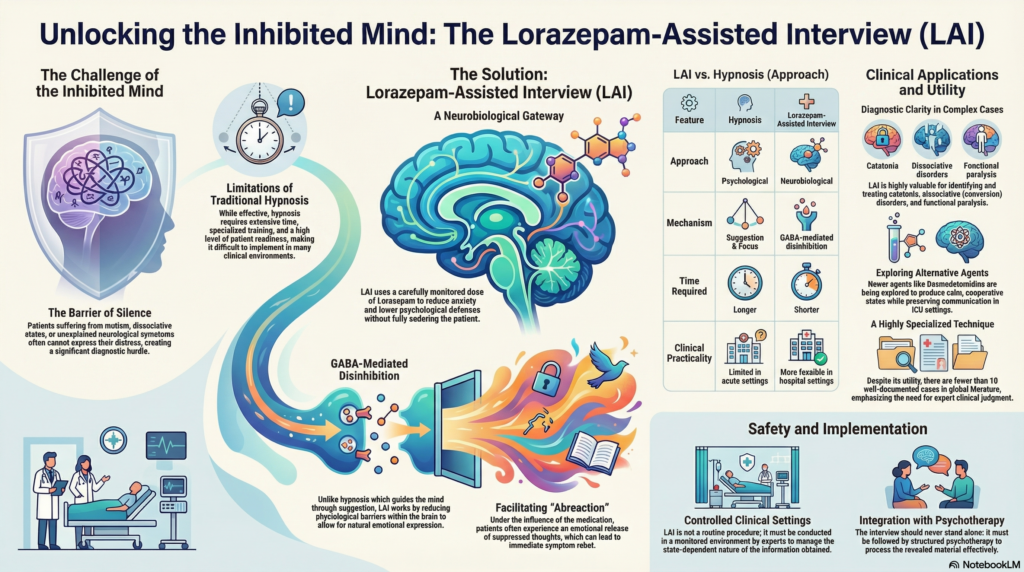 In psychiatry, one of the most challenging clinical situations is this:
A patient is suffering—but cannot express what is wrong.
They may be:
- Unable to speak (mutism)
- Overwhelmed by anxiety
- Stuck in dissociative states
- Presenting with unexplained neurological symptoms
Traditionally, clinicians turned to hypnosis to access such hidden or avoided material. But hypnosis requires time, specialised training, and patient readiness.
Today, modern psychiatry offers a neurobiological alternative:
👉 Lorazepam-assisted interview (LAI)
🧠 What is a Lorazepam-Assisted Interview?
A lorazepam-assisted interview uses a carefully monitored dose of Lorazepam to:
- Reduce anxiety
- Lower psychological defenses
- Facilitate emotional expression
Unlike sedation, the goal is not to “knock out” the patient—but to create a state where they can speak more freely and access difficult emotions.
🛋️ How is this different from Hypnosis?
| Feature | Hypnosis | Lorazepam-Assisted Interview |
|---|---|---|
| Approach | Psychological | Neurobiological |
| Mechanism | Suggestion & focus | GABA-mediated disinhibition |
| Time required | Longer | Shorter |
| Clinical practicality | Limited | More feasible in hospital settings |
👉 In simple terms:
Hypnosis guides the mind
Lorazepam reduces the barriers within the brain
⚡ What Happens During the Interview?
Under the effect of lorazepam, patients often:
- Feel calmer and less guarded
- Speak more openly
- Express previously avoided thoughts
- Experience emotional release
This phenomenon resembles abreaction, a concept linked to Sigmund Freud—where suppressed emotions are released, leading to symptom relief.
But today, we understand it differently:
This is not “digging out the unconscious”—it is reducing inhibition and allowing natural expression.
🔍 When is Lorazepam-Assisted Interview Useful?
This approach can be valuable in:
- Dissociative (conversion) disorders
- Functional neurological symptoms (e.g., unexplained paralysis, mutism)
- Catatonia (diagnostic and therapeutic)
- Severe anxiety with inability to communicate
- Complex diagnostic dilemmas
👉 In some cases, the response itself becomes diagnostic.
💡 What About Other Agents?
While lorazepam is the most commonly used, other agents are being explored:
🔹 Dexmedetomidine
- Produces calm, cooperative sedation
- Preserves communication
- Useful in ICU and procedural psychiatry
These advances reflect a broader shift:
Psychiatry is increasingly integrating brain-based tools to enhance psychological care
⚠️ Important Considerations
Lorazepam-assisted interviews are:
- Not routine
- Not suitable for all patients
- Conducted in controlled clinical settings
Key points:
- The information obtained can be state-dependent
- Interpretation requires clinical expertise
- It should always be followed by structured psychotherapy
📊 How Common is This Approach?
Despite its clinical utility:
👉 Less than 10 well-documented cases are available in published literature globally
This highlights two things:
- It is a highly specialised technique
- It requires clinical judgment and experience
🧠 The Bigger Picture
We are moving beyond the old divide:
- ❌ “Psychological vs Biological”
- ✅ Toward integrated psychiatry
Lorazepam-assisted interviews represent this evolution:
Using neurobiology to unlock psychological processes
📍 Availability in Chennai
This specialised approach is now available in Chennai as part of advanced psychiatric evaluation and treatment.
It is particularly useful for:
- Patients with unexplained neurological symptoms
- Severe emotional inhibition
- Difficult-to-diagnose psychiatric conditions
🧠 One-Line Takeaway
When words are blocked, reducing the brain’s inhibition can help the mind find its voice.
📣 About the Author
Dr. Srinivas Rajkumar T, MD (AIIMS, New Delhi), DNB, MBA (BITS Pilani)
Senior Consultant Psychiatrist
Mind & Memory Clinic, Apollo Clinic Velachery (Opp. Phoenix Mall)
With a clinical approach integrating:
- Structured diagnostic frameworks
- QEEG-based brain mapping
- AI-assisted psychiatric evaluation
- Advanced techniques like lorazepam-assisted interviews
Dr. Srinivas focuses on objective, precise, and personalised psychiatric care.
✉ srinivasaiims@gmail.com 📞 +91-8595155808