OCD Isn’t “Overthinking” — It’s a Brain Trap: 25 Hidden Patterns That Keep It Going
People often describe OCD as “overthinking” or “being too particular.” But OCD is more specific (and sneakier): it’s when the mind treats thoughts, doubt, and discomfort as emergencies—then learns to use rituals to feel better, even though those rituals quietly strengthen the problem.
Here’s a patient-friendly map of the common “concept traps” in OCD, grouped in a way that makes sense in real life.
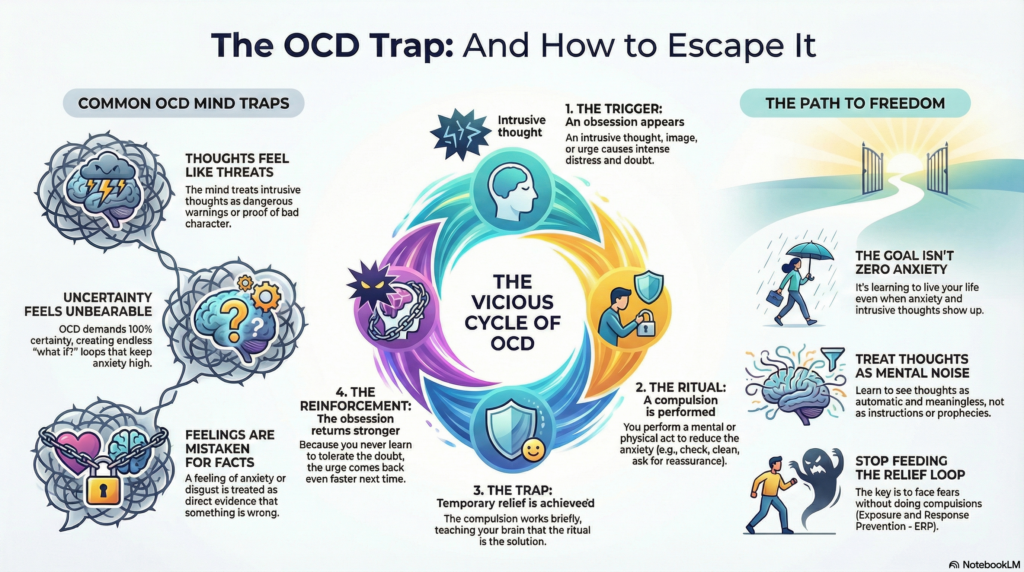
1) When thoughts feel dangerous
OCD doesn’t just produce unwanted thoughts. It convinces you that those thoughts mean something.
Thought–Action Fusion (TAF)
“Thinking it is almost like doing it” or “thinking it makes it happen.”
Example: “If I imagine harm, I might cause harm.”
Importance of Thoughts
The mind treats intrusive thoughts like warnings, not mental noise.
Example: “If this thought came, it must be important.”
Need to Control Thoughts
Belief that you must control thoughts to be safe or good.
Reality: thoughts are automatic; controlling them often makes them louder.
Cognitive Fusion (ACT idea)
Thoughts feel like facts.
Instead of “I’m having a thought…,” it becomes “This is true.”
Fear of Self
“Only a bad person would think this.”
OCD hijacks identity—making a thought feel like proof of character.
2) When responsibility becomes too heavy
OCD can turn normal care into an exhausting moral burden.
Inflated Responsibility
“I must prevent harm perfectly, or it’s my fault.”
Moral Rigidity
Being “good” becomes defined by mental purity rather than real behavior.
Scrupulosity
OCD focused on religion/morality—sin, blasphemy, “doing the right thing.”
Rituals may look like repeated prayers, confession, or reassurance seeking.
Guilt/Shame Amplification
A small doubt becomes massive guilt—then rituals are used as “self-cleansing.”
3) When uncertainty feels intolerable
This is one of OCD’s biggest engines: not fear of the event, but fear of not knowing for sure.
Intolerance of Uncertainty (IU)
“If I can’t be 100% sure, I can’t stop.”
Need for Closure
The mind demands a final answer or “complete relief.” OCD rarely gives it.
“What if?” Looping
Endless hypothetical questions that keep the alarm system switched on.
All-or-None Thinking
“Either perfectly safe or totally unsafe.”
Catastrophizing
A tiny possibility becomes “disaster is coming.”
4) When feelings are misread as facts
In OCD, your internal sensations can start behaving like “evidence.”
Emotional Reasoning
“I feel anxious/disgusted, so something must be wrong.”
Overestimation of Threat
Threat feels bigger, closer, more urgent than it truly is.
Disgust Sensitivity
Disgust can drive contamination OCD even more than fear.
Mental Contamination
Feeling dirty/tainted from thoughts, memories, people, or places—even without physical dirt.
Distress Intolerance
“I can’t handle this feeling.”
But feelings rise and fall naturally—if we stop feeding them.
5) The “not-right” experiences (not always about fear)
Some OCD is driven by a powerful internal sensation of wrongness.
“Just Right” Phenomenon
You repeat until it feels right—not until it’s logically correct.
Incompleteness
A persistent “unfinished” feeling that pushes repetition.
Urge-to-Act
Compulsions can feel like an itch—performed to relieve the urge, not because you truly believe the obsession.
6) The learning loop that keeps OCD strong
This is the heart of why OCD persists: rituals create short relief, and the brain learns “ritual = safety.”
Safety Behaviors
Small “just in case” acts (extra wiping, carrying sanitizer, checking backup locks). They prevent the brain from learning you’re okay without them.
Reassurance Seeking
Asking others, Googling, re-reading messages, checking symptoms. Relief is quick—but OCD grows stronger.
Negative Reinforcement Loop
Ritual → anxiety drops → brain learns ritual works → urge returns faster next time.
Avoidance
Not touching, not going out, not using knives, not reading certain words. Avoidance shrinks life and expands fear.
Mental Rituals (often missed!)
Counting, praying “until it feels okay,” repeating phrases, reviewing memories, canceling a thought with another thought.
Checking Paradox + Memory Distrust
More checking reduces trust in memory—so doubt increases.
So… what actually helps?
OCD improves when you learn a new skill set:
-
Treat thoughts as thoughts (not instructions, not prophecies, not identity)
-
Build tolerance for uncertainty
-
Stop feeding the relief loop
-
Practice exposure + response prevention (ERP) (with good guidance)
-
Learn to ride anxiety like a wave—unpleasant, but temporary
The aim isn’t “never feel anxious.”
The aim is: “I can live my life even when anxiety shows up.”
A simple self-check
If your “solution” gives quick relief but makes the doubt come back stronger later, it’s probably a compulsion or safety behavior.
That’s not your fault.
That’s how OCD trains the brain.
The good news: the brain can be trained the other way too.
Need help with OCD treatment in Chennai?
If you or your family member is struggling with OCD (checking, contamination, intrusive thoughts, “just-right” rituals, reassurance loops), you don’t have to fight it alone.
Dr. Srinivas Rajkumar T, MD (AIIMS, New Delhi)
Consultant Psychiatrist & Neurofeedback Specialist
Mind & Memory Clinic, Apollo Clinic Velachery (Opp. Phoenix Mall)
✉ srinivasaiims@gmail.com 📞 +91-8595155808
Related posts:
- The Hidden Drivers of OCD: Understanding Sensory Phenomena
- Communication Patterns in Personality Disorders: Understanding the Impact on Relationships
- Schema Therapy: A Comprehensive Approach to Healing Deep Emotional Patterns
- The New Motherhoods: Patterns of Early Child Care in Contemporary Culture (2022) by Salman Akhtar