ADHD and the Brain – What QEEG, fNIRS, and fMRI Actually Show
Attention-Deficit/Hyperactivity Disorder (ADHD) is often discussed as if it were either “purely behavioral” or “fully biological.” Both positions oversimplify a far more interesting reality.
ADHD is best understood as a disorder of brain network regulation, not a focal lesion or a single abnormality. Over the last two decades, three neuroimaging and neurophysiological approaches—QEEG, fNIRS, and fMRI—have helped clarify how attentional control breaks down, even if they do not offer a standalone diagnostic test.
What follows is a clinician-friendly synthesis of what each modality reliably shows, where it helps, and where caution is needed.
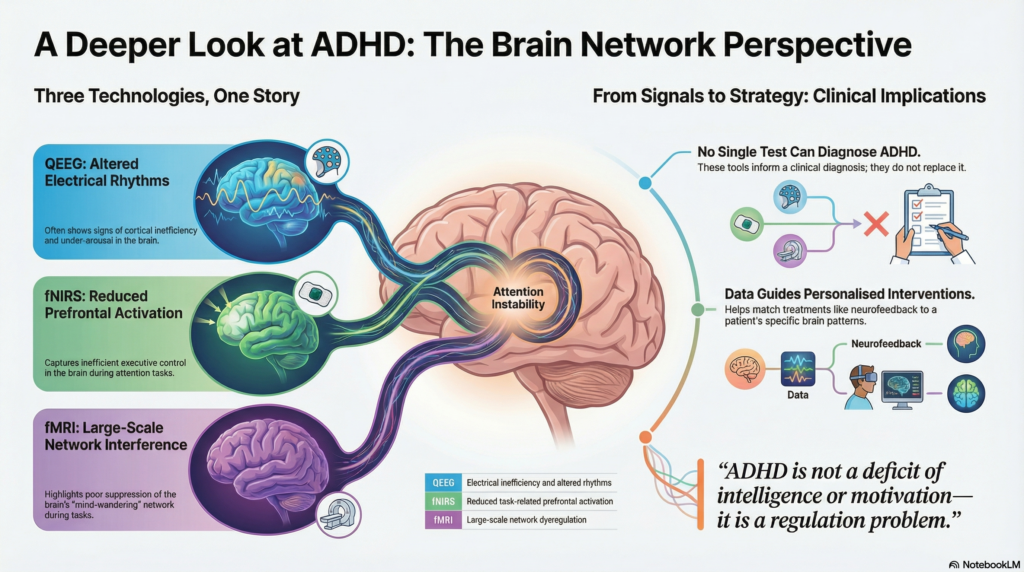
A Unifying Concept: ADHD as Network Dysregulation
Across modalities, a consistent theme emerges:
ADHD is associated with inefficient coordination between frontal executive networks and subcortical or posterior systems involved in arousal, salience, and default activity.
The problem is not absence of attention—but unstable allocation of attention.
Each tool captures a different slice of this dysfunction.
QEEG Findings in ADHD: Patterns, Not Proof
Quantitative EEG measures cortical electrical activity with high temporal resolution. In ADHD, QEEG has been studied longer than most other modalities.
Commonly Reported QEEG Patterns
-
Elevated theta power (4–8 Hz), especially fronto-central
-
Reduced beta activity (13–20 Hz) in attentional networks
-
Increased theta/beta ratio (TBR) in subsets of patients
-
Altered coherence suggesting inefficient network communication
These findings are most consistently observed in children, less uniformly in adults.
What QEEG Tells Us Clinically
QEEG does not diagnose ADHD. But it helps answer practical questions:
-
Is attentional inefficiency neurophysiological or affective?
-
Is there under-arousal versus hyper-arousal?
-
Which training or neuromodulation targets are plausible?
From a decision-making perspective, QEEG narrows uncertainty and informs individualized intervention (e.g., neurofeedback protocol selection).
fNIRS Findings in ADHD: Prefrontal Under-Recruitment
Functional near-infrared spectroscopy (fNIRS) measures task-related changes in cortical oxygenation, most reliably in the prefrontal cortex.
Consistent fNIRS Observations
-
Reduced activation of dorsolateral prefrontal cortex (DLPFC) during attention and executive tasks
-
Blunted hemodynamic response during sustained attention
-
Delayed or inefficient prefrontal engagement, especially under cognitive load
These findings align closely with clinical experience: patients can start tasks but struggle to sustain goal-directed control.
Why fNIRS Is Clinically Attractive
-
Task-based (mirrors real-world attentional demands)
-
Child- and adult-friendly
-
Portable and repeatable
-
Useful for longitudinal monitoring
fNIRS bridges the gap between symptom description and functional brain performance.
fMRI Findings in ADHD: Network-Level Insights
Functional MRI has provided the most detailed map of ADHD-related brain networks, though its use is primarily research-based.
Key fMRI Findings
-
Default Mode Network (DMN) Interference
-
Excessive DMN activity during tasks
-
Poor suppression of mind-wandering networks
-
-
Fronto-Striatal Circuit Dysfunction
-
Reduced connectivity between prefrontal cortex and basal ganglia
-
Impaired reward anticipation and response inhibition
-
-
Salience Network Dysregulation
-
Difficulty switching between internal and external focus
-
Poor prioritization of task-relevant stimuli
-
Together, these explain why ADHD patients often describe:
“I know what to do—but my brain doesn’t stay with it.”
Convergence Across Modalities
What makes these findings compelling is their convergence:
| Modality | What It Shows |
|---|---|
| QEEG | Electrical inefficiency and altered rhythms |
| fNIRS | Reduced task-related prefrontal activation |
| fMRI | Large-scale network dysregulation |
Different tools. Same story.
ADHD is not a deficit of intelligence or motivation—it is a regulation problem.
What This Means for Clinical Practice
1. Why No Single Test Diagnoses ADHD
All three modalities show overlapping but non-specific patterns. There is no ADHD “signature” brain scan.
This reinforces a crucial principle:
ADHD remains a clinical diagnosis, informed—not replaced—by objective tools.
2. Why Objectivity Still Matters
Even without diagnostic certainty, these tools:
-
Improve formulation clarity
-
Reduce clinician bias
-
Help explain symptoms to patients
-
Guide personalized interventions
-
Provide baselines for monitoring
They improve decision quality, not certainty.
3. Implications for Treatment Planning
-
Medication modulates network efficiency
-
Neurofeedback trains self-regulation of identified patterns
-
Cognitive training strengthens executive engagement
-
Behavioral strategies reduce environmental noise
Brain findings help match the right tool to the right problem.
A Cautionary Note
Neuroimaging findings in ADHD:
-
are probabilistic, not deterministic
-
show overlap with anxiety, sleep deprivation, mood disorders
-
must be interpreted in clinical context
The danger is not using these tools.
The danger is using them without judgment.
Conclusion: From Subjective Symptoms to Objective Signals
QEEG, fNIRS, and fMRI do not redefine ADHD.
They deepen our understanding of it.
They show that ADHD is neither a moral failing nor a vague label—but a measurable difficulty in coordinating brain networks responsible for attention, inhibition, and goal maintenance.
Used wisely, these tools help psychiatry do what it does best:
make careful decisions under uncertainty, with humility and responsibility.
About the Author
Dr. Srinivas Rajkumar T, MD (AIIMS), DNB, MBA (BITS Pilani)
Consultant Psychiatrist & Neurofeedback Specialist
Dr. Srinivas practices at Mind & Memory Clinic, Apollo Clinic Velachery (Opp. Phoenix Mall), Chennai, with a special interest in adult ADHD, objective neuropsychiatric assessment (QEEG, CPT, fNIRS), neurofeedback, and neuroscience-informed clinical decision-making.
📍 Apollo Clinic Velachery, Chennai
📞 +91-8595155808
✉️ srinivasaiims@gmail.com
🌐 https://srinivasaiims.com